

Summary
Two houses with the same price, on the same Tallahassee street, can get very different quotes for homeowners insurance (hazard insurance). Tallahassee homeowners insurance is priced from the house itself: the roof, the pipes, the wiring, the claims on its record, the way it is built to handle wind, and where it sits on the flood map. That makes hazard insurance part of your inspection, not a line on your closing statement.
Throughout this post, each requirement is marked as Florida law or a carrier rule.
What the evidence shows:
- Florida’s average homeowners premium nearly doubled from 2008 to 2022, and if that pace resumed from today’s level, it would reach $5,716 by 2040.
- A hurricane deductible is a percentage of your dwelling coverage, so a 5% deductible on $600,000 of coverage is $30,000, taken off your claim.
- About three of every four Leon County houses, townhouses and condominiums were built before Florida’s statewide building code took effect in 2002.
- About 36 of every 100 were built from 1978 through 1995, the years polybutylene pipe was made.
- About 4 of every 100 homes countywide sit in a FEMA flood zone. A standard homeowners policy does not cover flooding, so protecting the house takes separate flood coverage at added cost.
None of this means an older Tallahassee home is a bad buy. It means the questions that decide your insurance belong in the first week under contract, while you still have room to walk away.
Tallahassee Homeowners Insurance: Florida Law or Carrier Rule?
Buyers hear two kinds of insurance rules, often from the same person. Knowing which one you are hearing tells you whether you can argue with it.
Florida law applies to every insurer writing homeowners policies in the state. It sets the deductible choices insurers must offer, protects younger roofs, and defines what hurricane coverage means. You can point to the statute.
Carrier rule means one company’s own rule for which houses it will insure and on what terms. It covers what age of water heater a company accepts, whether it writes a house with a certain electrical panel, and when it asks for a four-point inspection. Another company may answer the same question differently, and the same company may change its answer next year.
When someone tells you a house “can’t be insured,” ask which company said so and why. A carrier rule closes one door. It rarely closes all of them.
How Much Has Florida Homeowners Insurance Grown?
Hazard insurance grows over the life of a loan, so budget for where it is heading as well as the first quote. The statewide record shows how much it has moved.
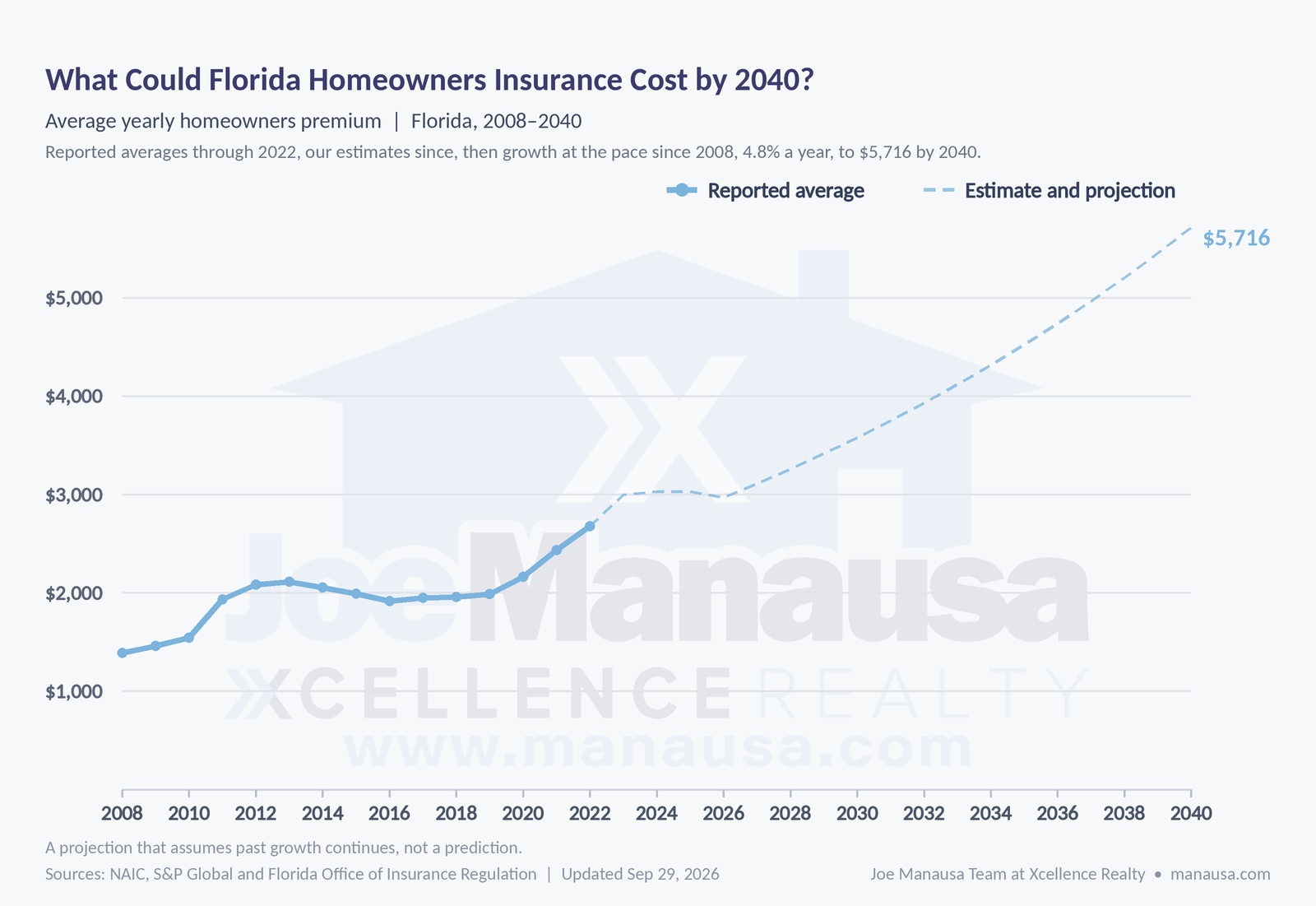
In 2008 the average Florida homeowners premium was $1,390. By 2022 it was $2,677, according to the national insurance regulators’ figures. That is close to a doubling in fourteen years, and the steepest part came at the end, from 2020 through 2022.
Premiums have not moved in a straight line. They held nearly flat from 2012 through 2019, and rate changes after the state’s 2022 and 2023 reforms were close to flat again. Each earlier plateau ended with another climb.
The dashed line starts from our 2026 estimate of about $2,968 and asks what happens if premiums climb at the pace they set from 2008 to 2022. At that pace, the average would reach $5,716 by 2040. That assumes the past repeats. It is not a forecast.
The figure is also a statewide average that coastal South Florida pulls upward. For a Tallahassee buyer, the takeaway is direction rather than a dollar figure. The house you choose sets your own premium.
What Hurricane Coverage Means in a Florida Policy
In Leon County, a standard homeowners policy normally includes wind coverage, so most buyers never see a separate wind policy. What they do see is a separate hurricane deductible, and it only applies during a defined window.
Florida law: the hurricane period begins when the National Hurricane Center issues a hurricane watch or warning for any part of Florida, continues while hurricane conditions exist anywhere in the state, and ends 72 hours after the last watch or warning ends. A severe thunderstorm or tornado outside that window falls under the policy’s other deductible instead, usually called the all other perils deductible.
Florida law: a homeowners policy that does not include flood must say so plainly. Water that rises from the ground is not covered, even when a hurricane pushed it there. Flood protection takes a separate flood policy or, from some insurers, a flood endorsement, covered below.
What Would a Hurricane Deductible Cost You?
The hurricane deductible is the number most first-time Florida buyers underestimate. It is a percentage of your dwelling coverage, known as Coverage A, not a percentage of the claim and not a percentage of your purchase price.
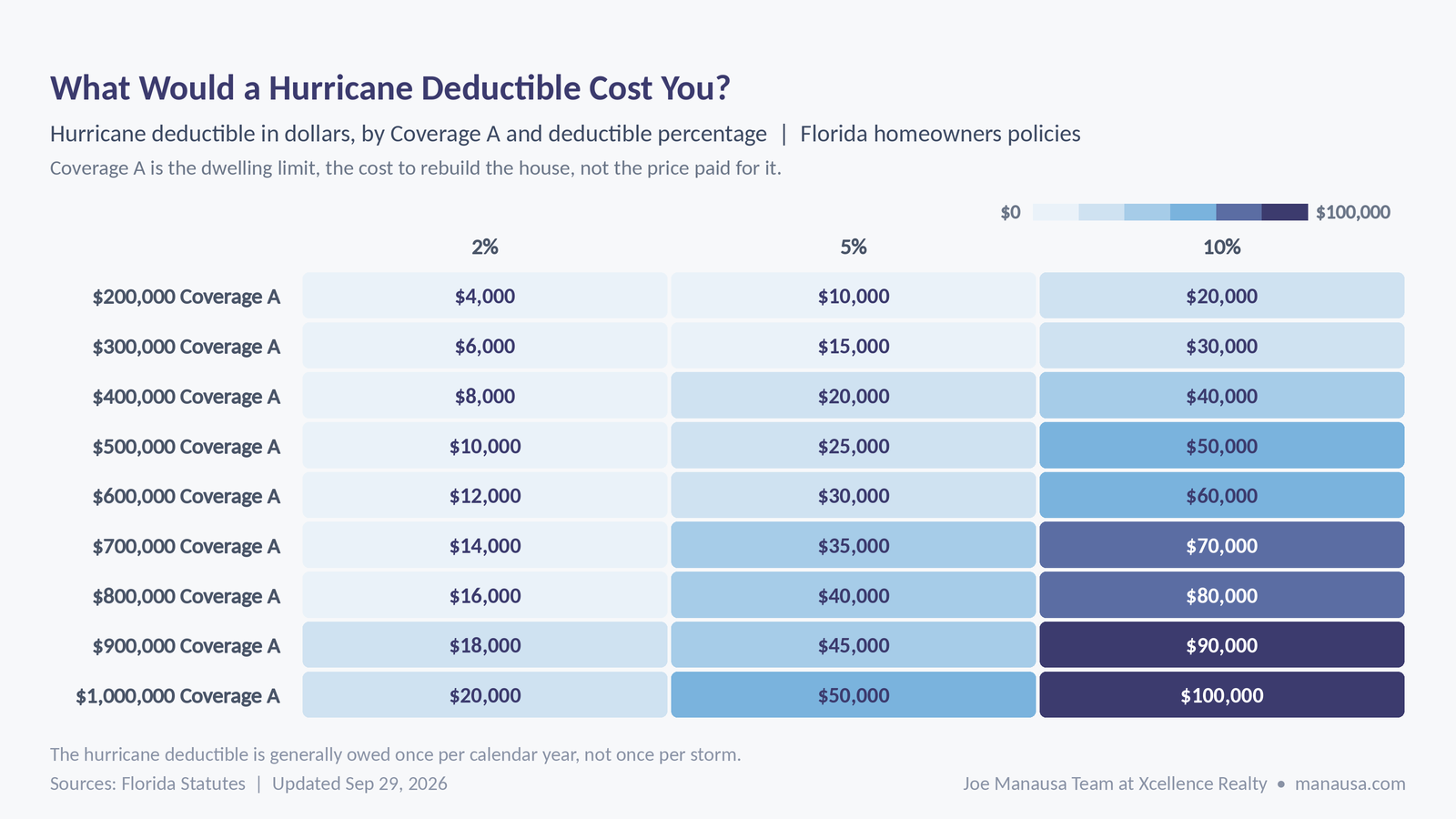
Florida law: section 627.701 requires insurers to offer hurricane deductibles of $500, 2%, 5% and 10% of the dwelling limit, with some exceptions tied to the size of the limit. The dollar amount must be printed on your policy.
Coverage A is based on the estimated cost to rebuild the house, so it rarely matches the price you paid or the value of your home. A home that sells for less than its rebuild cost can carry a larger deductible than its price suggests. At the upper end of the luxury price tiers, Coverage A can pass $1,000,000. On $600,000 of Coverage A, a 5% deductible is $30,000, and the insurance company takes it off your claim.
If a storm does $600,000 of damage, your check is $570,000. If it does $50,000 of damage, your check is $20,000.
The deductible also runs on the calendar year. Once you have paid it for one hurricane, a later hurricane that year draws from what remains, or uses your all other perils deductible if that is larger, rather than starting a new hurricane deductible. That is a good reason to report hurricane damage even when it looks smaller than your deductible, and to keep the photos and receipts.
Florida law: insurers may also offer a separate roof deductible of up to the lesser of 2% of Coverage A or half the cost to replace the roof, with a premium credit and a right to decline it. It never applies to a total loss, to hurricane roof damage, to a tree or other object that punctures the roof deck, or to a repair of less than half the roof.
Why the Roof Comes First
On an older house, the roof is usually the insurer’s first question. The questions that matter are what covers it, when the entire roof was last replaced, whether that work was permitted, and whether you can prove it.
Florida law: under section 627.7011, an insurer may not refuse to write or renew a homeowners policy solely because a roof is less than 15 years old. At 15 years or more, the owner has the right to an inspection by an authorized inspector before the insurer can require a replacement. If the inspection shows at least five years of useful life left, age alone cannot be the reason the policy is refused.
That protection is narrower than it sounds. It covers age alone, so an insurer can still decline a roof for its condition, active leaks, missing records or other real risks. Roof age is also measured from the last date the entire roof was replaced to code, which is why the permit history matters as much as the shingles.
Carrier rule: how an insurer treats a shingle roof against a metal or tile roof of the same age is its own decision. Florida law sets no statewide age table by roofing material.
How Many Tallahassee Homes Predate the Florida Building Code?
Florida’s first statewide building code took effect on March 1, 2002, and insurers still use that date as the dividing line for wind credits. A home built after it gets credit for modern wind standards by default, while an older home has to show its features one at a time.
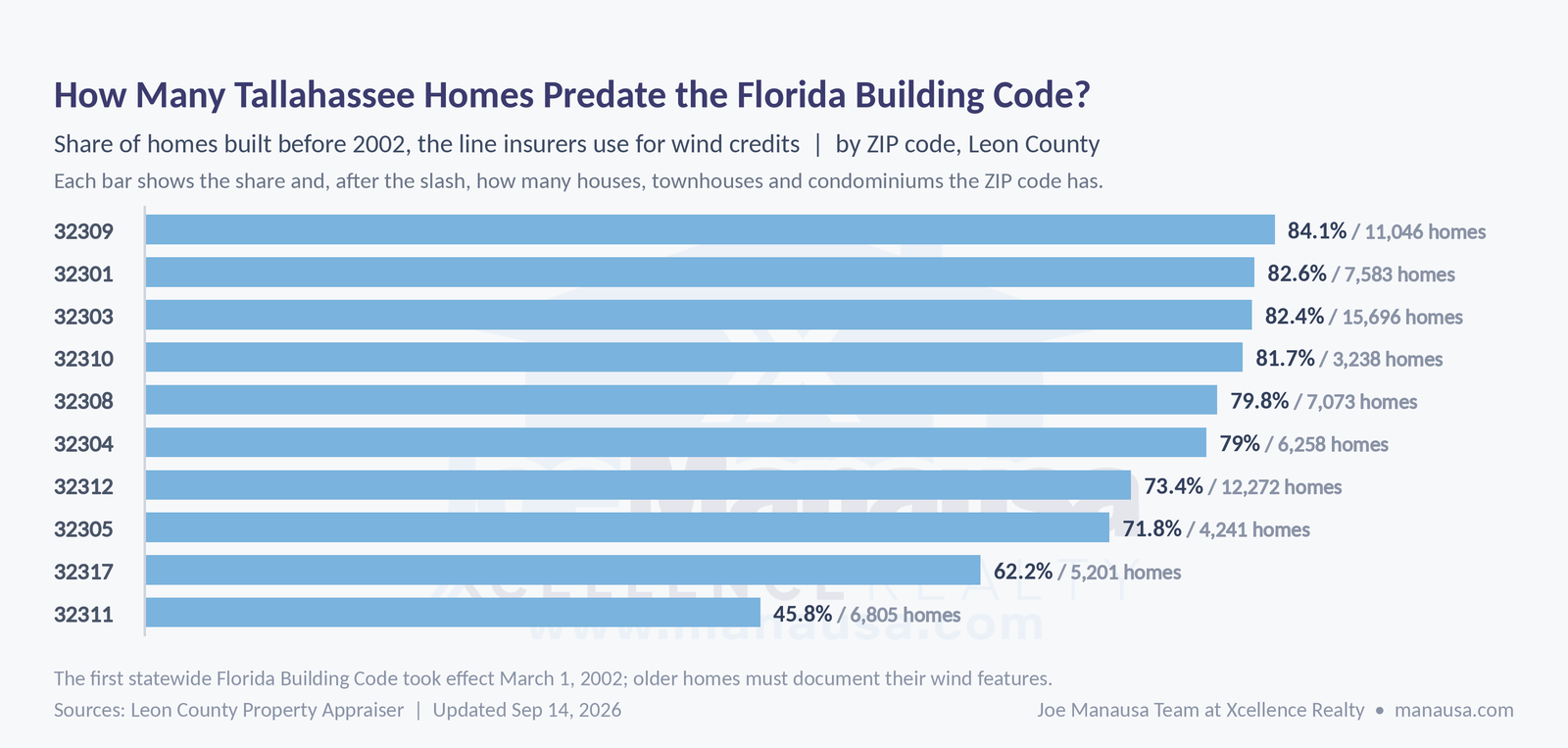
About three of every four Leon County houses, townhouses and condominiums were built before 2002. In most ZIP codes it is closer to eight in ten, from 84.1% in 32309 down to 45.8% in 32311, where more of the housing is newer construction.
For most Tallahassee buyers, then, the wind mitigation inspection is where the insurance savings are won or lost. The inspection does not create a discount. It records facts, and the insurer plugs those facts into its own approved rate plan.
Florida law: the state sets a standard inspection form, the Uniform Mitigation Verification Inspection Form known as OIR-B1-1802, and revises it from time to time. It records the building code, roof covering, how the roof deck is nailed down, how the roof is tied to the walls, roof shape and slope, a secondary water barrier, protection over windows and doors, and any FORTIFIED certification. The current version took effect April 1, 2026. A completed report is generally good for up to five years unless the house changes.
Carrier rule: what each feature is worth is set by each insurer’s rating plan, so no honest statewide table of discount percentages exists. Ask the seller for an existing report to use for early quotes, and plan to order your own if it is old, incomplete, missing photos or not accepted by your insurer.
A common misconception is that brick means stronger against wind. In Tallahassee most brick homes are wood frame with a brick face, and the wind form looks at how the roof, walls and openings are connected, not at what covers the walls.
What a Four-Point Inspection Covers
On an older house, a four-point inspection looks at the roof, the electrical system, the plumbing and the heating and air conditioning. Insurers use it to decide whether an older house carries risks they will not write.
Carrier rule: there is no Florida law that requires a four-point at a certain home age. Each insurer sets its own trigger, and older homes are simply more likely to need one.
What causes trouble is rarely age by itself. It is evidence of risk in one of the four systems: a roof near the end of its life, an electrical panel the company refuses, a leak or a disfavored pipe, an air conditioner that does not work. Schedule the four-point alongside your general inspection and the wind report, so you learn about a problem while you can still negotiate it.
How Many Tallahassee Homes Were Built While Problem Pipes Were Common?
Year built is not a plumbing inspection, but it tells a buyer which questions to ask. The materials insurers flag were common in different eras, and Leon County has a lot of homes from each one.
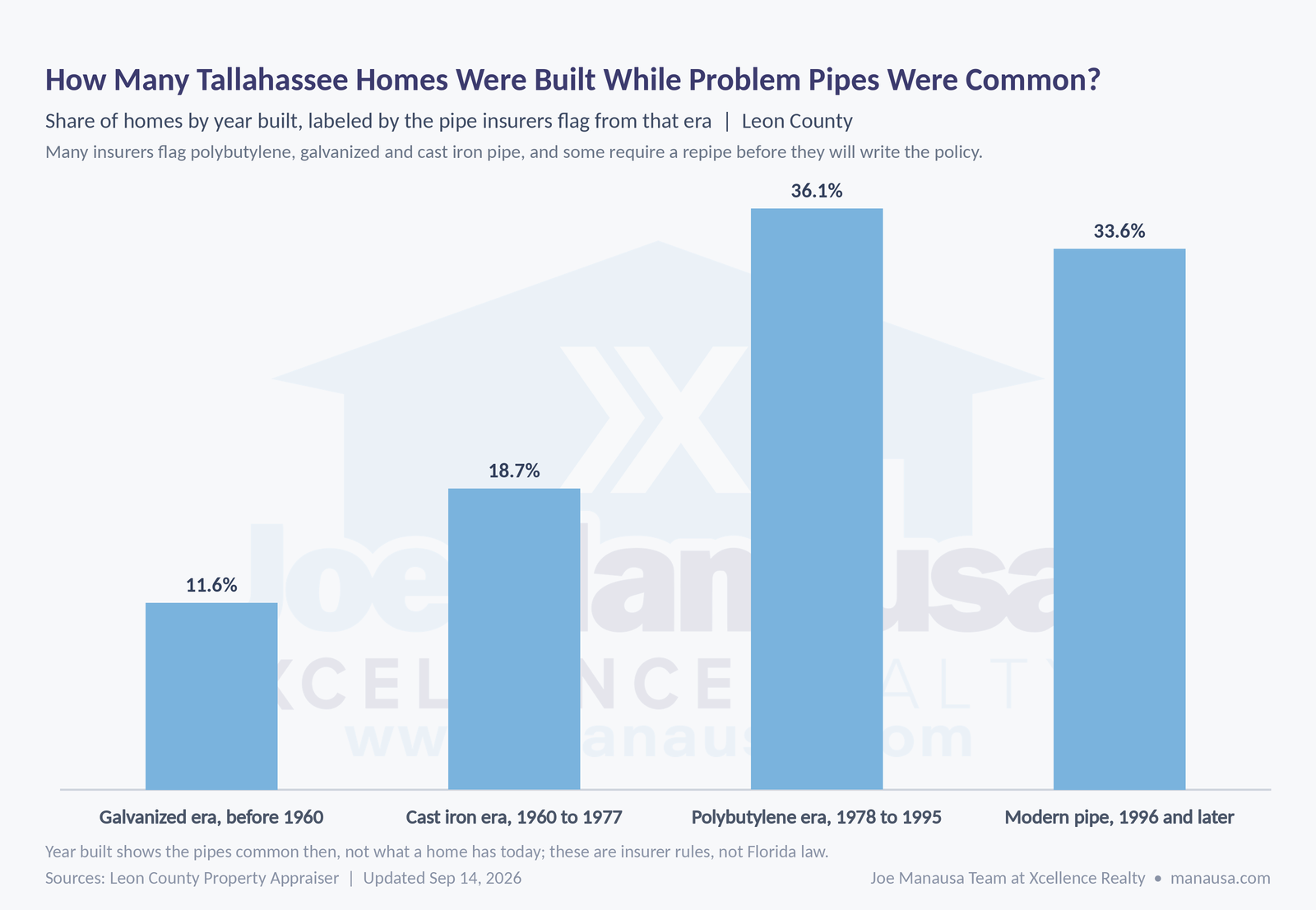
About 36 of every 100 Leon County homes were built from 1978 through 1995, the years polybutylene pipe was manufactured. Another 30 of every 100 were built before 1978, when galvanized supply lines and cast iron drains were common. Many of those homes have been repiped, so the chart tells you what to check, not necessarily what you will find.
Carrier rule: Florida has no statewide list of banned pipes or panels. Each insurer decides, which is why a buyer needs an answer from the actual company quoting the house.
| System | Why an insurer cares |
|---|---|
| Polybutylene supply pipe | One of the strongest plumbing red flags. It can narrow your choice of insurers and lead to a repipe requirement, even with no visible leak. |
| Galvanized supply pipe | Corrodes from the inside and restricts flow. Treatment varies widely by company. |
| Cast iron drain pipe | Depends on condition: cracking, corrosion, backups and past leaks matter more than the material alone. |
| Federal Pacific or Zinsco electrical panels | A frequent reason for a required repair or a declined policy. |
| Aluminum branch wiring, fuses, knob and tube | Reviewed company by company, never under one blanket rule. |
| Older water heater or air conditioner | Judged on condition and function. Florida law sets no replacement age. |
A Home’s Claims History Follows the House
Insurers check a shared database of past claims called CLUE, which generally reaches back seven years. A prior claim on the house can affect both the price and whether a company will write it, even though the claim was the seller’s.
A buyer cannot order the seller’s personal report, but the seller can request their own CLUE report from LexisNexis and share it. The National Association of REALTORS explains how it works. Ask for it along with repair invoices, permits and photos for any major claim.
Context matters more than the count. A past hurricane roof claim that produced a permitted new roof can work in your favor. Repeated water claims with the original plumbing still in place are a different story, and that is exactly what a seller’s property disclosure should help you uncover.
How Many Tallahassee Homes Sit in a Flood Zone?
Tallahassee flood risk comes from creeks, low ground and heavy rain rather than storm surge. It sits in pockets of each ZIP code and each quadrant of the county. The FEMA map shows where it is highest.
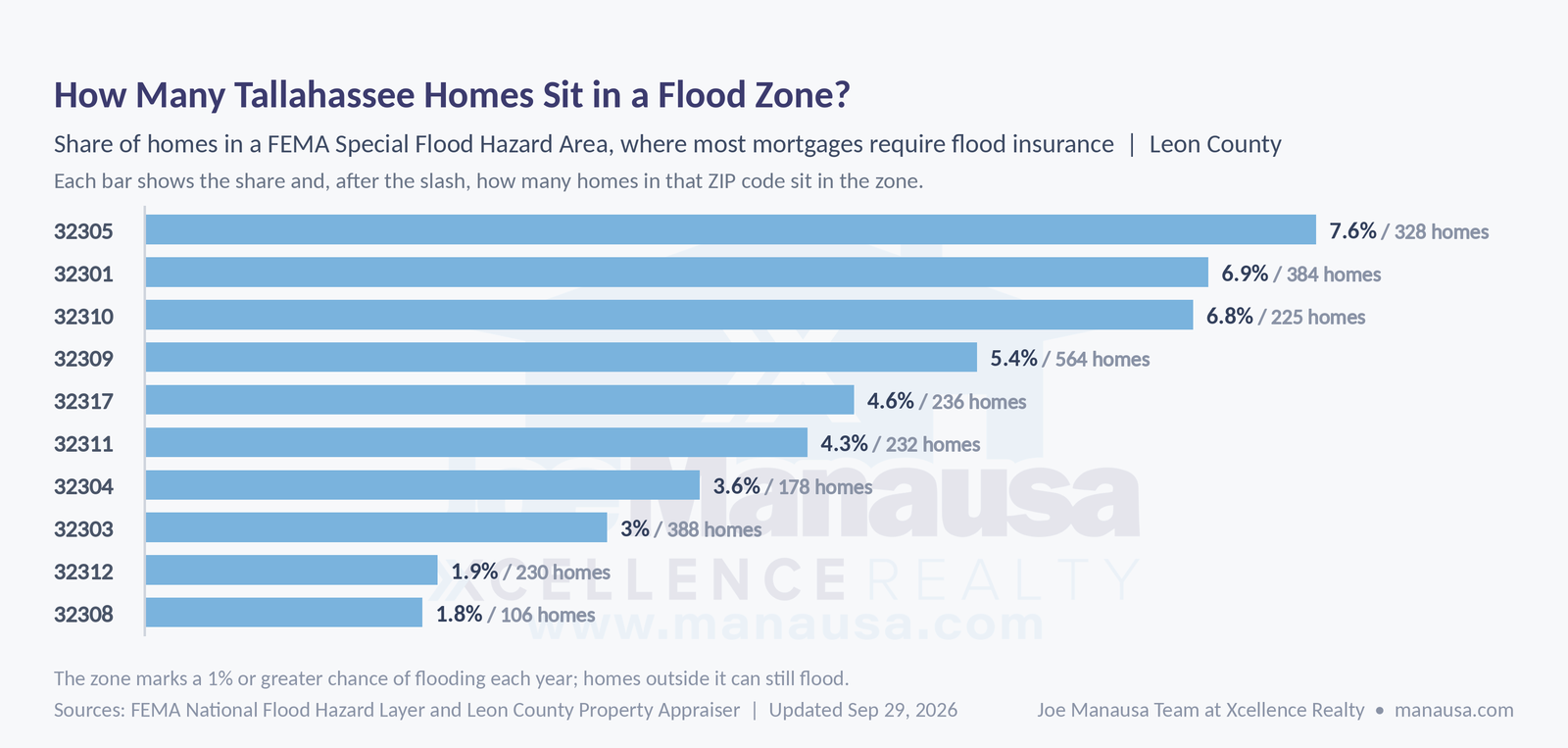
About 4 of every 100 homes in Leon County sit in a FEMA Special Flood Hazard Area, based on FEMA’s current flood map for Leon County. The share runs from 7.6% in 32305 to 1.8% in 32308, so even the highest ZIP code has fewer than one home in ten inside the zone.
Being outside the zone is not the same as being safe. FEMA reports that a meaningful share of flood insurance claims come from outside the high-risk zones, and a standard homeowners policy does not cover flood.
| FEMA zone | What it means |
|---|---|
| Zone A | At least a 1% chance of flooding each year, with no detailed flood elevation set. |
| Zone AE | At least a 1% chance each year, with a base flood elevation set, meaning the height floodwater is expected to reach. |
| Shaded Zone X | About a 0.2% chance each year, often called the 500-year floodplain, plus some shallow-flooding and levee-protected areas. |
| Unshaded Zone X | Lower mapped risk. Not zero risk. |
A 1% annual chance is not a flood once a century. It is the same chance every year, which adds up to roughly one in four over a 30-year mortgage.
How to Find a Tallahassee Home’s Flood Zone
Checking the flood zone takes a few minutes and belongs at the start of your search. Two public websites show the zone for any Leon County property, and two local offices answer the harder questions.
Type any Leon County address or tap a spot on the map below to learn if it sits in a FEMA flood zone.
See flood zones alongside every Tallahassee neighborhood on our full map
Start with the address or parcel number on the Leon County Property Appraiser's site, then look the address up on FEMA's Flood Map Service Center, which shows the official map panel and zone. For a closer read, Leon County's Development Support and Environmental Management office answers flood zone questions for unincorporated Leon County, and the City of Tallahassee does the same inside city limits.
Those offices can tell you whether a lot sits inside the flood zone, its base flood elevation, known drainage problems, and whether an elevation certificate is on file. If the seller has an old elevation certificate or a FEMA letter changing the map, keep a copy and give it to your insurance agent.
When Flood Insurance Is Required
Whether you must buy flood insurance and whether you should are two separate questions. The law answers the first one. Your own risk answers the second.
Federal law: a home in a Special Flood Hazard Area, bought with a federally regulated or backed mortgage, in a community that takes part in the National Flood Insurance Program, must carry flood insurance. The lender cannot close the loan without it. A home in Zone X with a conventional loan usually has no federal requirement, although a lender may add one, and a cash buyer faces no requirement at all.
Florida law: Citizens Property Insurance, the state's insurer of last resort, requires flood coverage on its homeowners policies that include wind, phased in by home value. Starting January 1, 2027, the rule reaches nearly every such policy, inside a flood zone or not. Ask what applies when you get your quote.
The National Flood Insurance Program caps a typical home at $250,000 of building coverage and $100,000 of contents. Private flood policies can offer higher limits or different terms, and lenders must accept private policies that meet the federal definition. Compare limits, deductibles and exclusions as well as the premium, using FloodSmart, FEMA's flood insurance site.
Since FEMA's Risk Rating 2.0, the flood zone no longer explains the premium on its own. Pricing now weighs distance to water, the type of flooding, the building's features and its rebuild cost. The zone still decides whether coverage is required, but the house decides what it costs.
An elevation certificate documents how high the building sits. A Letter of Map Amendment from FEMA can remove the federal requirement when FEMA finds the ground at the structure sits at or above the base flood elevation, though a lender may still require coverage. The certificate alone does not.
When Citizens Becomes the Insurer
Citizens Property Insurance exists for homeowners who cannot find qualifying private coverage. A Tallahassee buyer usually lands there when private companies will not write the house or will only write it at a much higher price.
Florida law: under section 627.351, a home is generally not eligible for Citizens if a private insurer offers comparable coverage with wind at no more than 20% above the Citizens premium. Citizens coverage is not always permanent, either. Private companies can offer to take policies out of Citizens, and an eligible offer can end a home's Citizens eligibility.
The Tallahassee Homeowners Insurance Timeline for Buyers
The single most expensive insurance mistake is learning about a problem after your inspection period has ended. A buyer who runs insurance alongside the inspection keeps every option open.
| When | What to do |
|---|---|
| Before you offer | Ask the roof age and type, permit history, flood zone, plumbing and electrical updates, current insurer and known claims. On an older home, get a rough quote. |
| The day the contract is signed | Send the address and details to an independent agent and any companies you want to compare. Do not wait for the appraisal. |
| During the inspection period | Order the wind mitigation report and any four-point the insurer requires, alongside the general inspection. |
| Before the inspection deadline | Have at least one quote that reflects what the inspectors found. |
| Before closing | Confirm the policy is issued and in force on the closing date, the lender is listed correctly, and any required flood policy is active. |
A quote is not coverage until the company issues the policy. An insurer can withdraw a quote after it sees the four-point, the roof or the claims history, which is why these reports need to reach the company early.
The standard Florida Realtors/Florida Bar contracts let you cancel if flood insurance cannot be obtained at all. To cancel over the cost of homeowners or flood insurance, your contract needs Addendum H with a maximum premium written in, so ask for it before you sign. The many cash buyers in Leon County need the same care, because closing on an uninsured house turns an insurance problem into a personal financial one.
Your lender counts the premium when it qualifies you, so a higher quote raises the income you need to qualify and changes your home affordability math. Budget for it the way you budget for closing costs and title insurance costs. Title insurance protects your ownership; hazard insurance protects the house.
What Sellers Should Have Ready
Sellers control more of a buyer's insurance than they think. The documents that make a house easy to insure also make it easier to sell at full value.
Gather the roof permit and invoice, any wind mitigation report under five years old, receipts for plumbing, electrical and air conditioning updates, and their own CLUE report. A buyer with a firm quote in the first few days rarely renegotiates later. Our advice on home inspections for sellers covers each item.
What Could Your Home Sell For?
If you own an older Tallahassee home, its roof, wiring and plumbing records now shape what a buyer will pay as much as its size. This tool gives you a current value estimate from recent nearby sales.
Frequently Asked Questions
What is the difference between hazard insurance and homeowners insurance? Hazard insurance is the part of a homeowners policy that covers the structure against damage such as wind, fire and hail. Lenders often use the term for the coverage they require. Flood is not part of a standard policy and needs its own coverage.
Why is Tallahassee homeowners insurance different from South Florida's? Leon County is inland and outside the high-wind building zone that covers Miami-Dade and Broward, so its building rules are less strict. North Florida and the Big Bend still take hurricane wind and rain, as Hurricane Michael and Hurricane Hermine showed in Tallahassee.
Does a home outside a flood zone need flood insurance? Usually no lender requires it, but the risk is real. FEMA's program sells coverage outside the high-risk zones, often at a lower price than inside them.
Get the Weekly Market Report
We publish this kind of analysis every week, built from Leon County records rather than national headlines. Subscribe and it arrives before you need it.
 Weekly Market ReportThe Tallahassee numbers local agents watch, in your inbox every Monday.Free. Unsubscribe anytime. Privacy policy
The first issue arrives the Monday after you sign up.
We Are Here to Help
Tallahassee homeowners insurance is decided by the house, and most of the answers sit in documents a buyer can gather in the first week of a contract: the roof permit, the wind report, the four-point, the claims history and the flood zone. Knowing which rules are Florida law and which are one company's preference keeps a good house from being dismissed for the wrong reason.
Related reading: Buying a home in Tallahassee | Selling a home | Leon County homes for sale | Tallahassee neighborhoods | Home supply by ZIP code | Buyer demand by area | Home inspection tips | About our team
Send us the address of a home you are considering, and a Joe Manausa Team member will help you sort out which of these questions matter for that house before your inspection period ends.
Sources
Home counts, year built and ZIP codes come from the Leon County Property Appraiser. Flood zone shares come from the FEMA National Flood Hazard Layer matched to Leon County parcels. Premium history comes from the National Association of Insurance Commissioners through the Insurance Information Institute, with later rate changes from S&P Global and the Florida Office of Insurance Regulation. Florida rules are cited from the Florida Statutes, and flood rules from FEMA's National Flood Insurance Program.