Summary
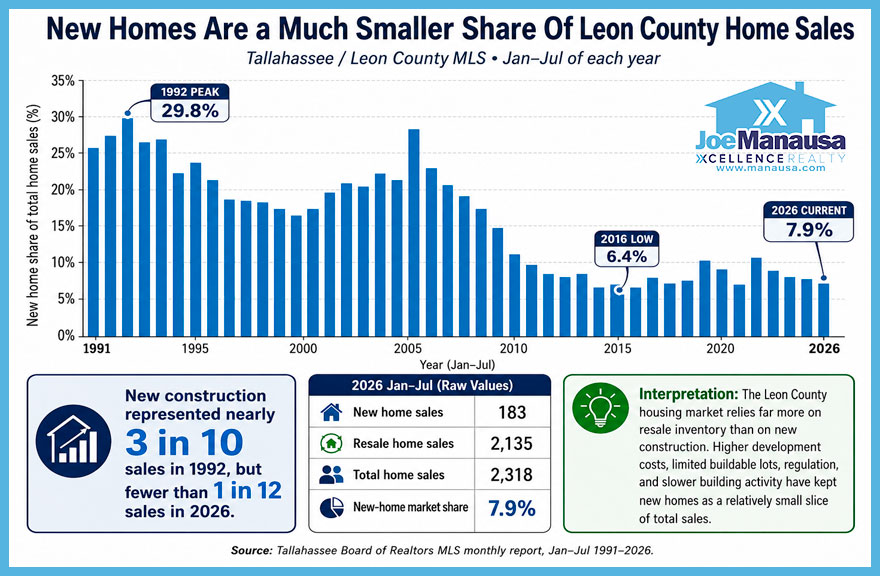
This Tallahassee real estate graph report reveals a widening divide between the homes Leon County buyers purchase and the new homes the market is producing. New construction represented just 7.9% of local home sales through July 2026, down from 29.8% at its 1992 peak. Meanwhile, the median new home sold for 53.5% more than the median resale home, even though it was only 16.3% larger.
That gap explains why the resale market carries nearly the entire burden of local housing demand. New homes can expand supply, but at current prices they are not substitutes for the resale homes most buyers can afford. Mortgage rates near 6.7% magnify that problem by turning an already large purchase-price difference into an even larger monthly-payment difference.
The result is a market in which replacement housing costs far more than much of the existing housing stock. Buyers, sellers, homeowners, builders, and local policymakers should understand that divide because it helps explain why resale prices can remain firm even when sales activity slows.
Key Takeaways
- New construction has lost most of its former market share. New homes accounted for 7.9% of Leon County sales through July 2026, compared with 29.8% in 1992.
- The new-home price premium greatly exceeds the size premium. New homes were 16.3% larger than resale homes but cost 53.5% more.
- Resale homes are doing most of the market’s work. Existing homes represented 2,135 of Leon County’s 2,318 sales through July.
- The price gap is not merely a size effect. New construction also cost 31.6% more per square foot than resale housing.
- Higher mortgage rates make the divide more consequential. Buyers must finance the larger new-home price at rates near 6.7%.
- Countywide averages can obscure the market midpoint. The July trailing average resale price was $341,919, while the median was $284,000.
- Limited affordable construction helps support resale values. Slower sales do not automatically create falling prices when replacement housing remains substantially more expensive.
New Construction No Longer Serves Most Leon County Buyers
The Tallahassee real estate graph data for August 2026 exposes a structural problem that ordinary sales and price reports can miss. Leon County is producing relatively few new homes compared with the number of resale homes changing hands, and the new homes that reach the market cost far more than the existing homes most buyers purchase.
This is different from the recent analysis of Tallahassee housing supply and demand, which focused on recovered inventory, restrained sales, and differences among price ranges. It also differs from the recent reports on rising real estate market time, market friction rather than distress, and home affordability in Tallahassee. Those reports explain how the current market is functioning. This report examines why so little of the housing market is being supplied by newly built homes.
New construction accounted for only 183 of the 2,318 Leon County sales recorded from January through July. Resale homes accounted for the other 2,135 transactions.
In other words, more than nine of every ten local buyers purchased a home that already existed.
That would be less significant if new and resale homes occupied similar price ranges. They do not. The July median new-home sale price was $435,981, compared with $284,000 for a resale home.
The $151,981 difference represents a major change in the income, down payment, mortgage qualification, and monthly payment required to move from the middle of the resale market into the middle of the new-home market.
New Homes Once Supplied a Much Larger Share of the Market
Leon County was not always so dependent on resale housing. During the early 1990s, newly built homes represented more than one-quarter of local sales.
The following Tallahassee real estate graph tracks the new-construction share of all Leon County home sales from 1991 through July 2026.
New construction reached a 29.8% market share in 1992. At that point, nearly three of every ten Leon County home purchases involved a newly built property.
The share declined during the late 1990s before briefly returning above 25% during the mid-2000s building boom. After 2006, it fell sharply and eventually reached 6.4% in 2016.
There have been modest rebounds since then, but nothing resembling the role new construction played during earlier decades. Through July 2026, new homes represented only 7.9% of sales, fewer than one in twelve.
The Tallahassee real estate graph does not prove that Leon County should restore the precise construction share recorded in 1992. Household growth, development patterns, land availability, financing, building standards, consumer preferences, and the age of the existing housing stock have all changed.
However, the graph shows that new construction now accounts for a much smaller share of local housing transactions than it did historically.
Why the Market Share Matters
A housing market has several ways to create availability. Existing homeowners can sell, vacant homes can return to use, rental properties can convert to ownership, and builders can add new units.
When new construction contributes less than 8% of sales, Leon County becomes heavily dependent on existing owners deciding to move. That dependence creates a vulnerability because many existing owners have mortgage rates far below what they could obtain today.
A homeowner with a 3% mortgage may have substantial equity and still decide not to move because replacing the loan at a rate near 6.7% would sharply increase the monthly payment. That choice limits resale turnover.
At the same time, builders cannot necessarily respond by producing homes at the prices most resale buyers are paying. Land acquisition, development, infrastructure, labor, materials, financing, insurance, building requirements, and business risk all affect the final price of a newly built home.
The result is a market with two separate constraints:
- Many existing homeowners are reluctant to replace their current mortgages.
- Builders struggle to replace existing homes at comparable prices.
The U.S. Census Bureau’s New Residential Sales report provides useful national context on new-home sales, prices, inventory, and supply. Still, national statistics should not be applied directly to Leon County because local land costs, development requirements, wages, infrastructure, insurance expenses, and household incomes determine what can be built profitably here.
A 53.5% Price Premium Cannot Be Explained by Size
The next Tallahassee real estate graph shows why newly built homes have not captured a larger share of demand in Leon County. New homes are larger than resale homes, but the additional space explains only a fraction of the price difference.
The median new home sold in July contained 1,749 square feet. The median resale home contained 1,504 square feet. New construction therefore provided approximately 245 additional square feet, a size premium of 16.3%.
Yet the median new-home price was $435,981, compared with $284,000 for resale housing. That created a 53.5% purchase-price premium.
The same imbalance appears in the price-per-square-foot figures. New homes sold at a median of $250 per square foot, compared with $190 for resale homes. New construction therefore costs 31.6% more per square foot of living area.
The Tallahassee real estate graph does not prove that builders are earning excessive profits. A new home must absorb current land, site work, permitting, infrastructure, labor, material, financing, insurance, code compliance, marketing, and business-risk expenses.
By contrast, a resale home may reflect land and construction costs incurred decades ago. Its owner does not have to recreate the property at today’s cost before selling it. That allows much of the existing housing stock to trade below the amount required to produce a comparable replacement.
This is the central finding of the report:
Much of Leon County’s existing housing stock sells for less than the market requires to produce a new substitute.
That difference helps explain why limited new construction can coexist with long-term housing demand. Builders may be able to produce homes, but not at prices that compete directly with the resale median.
Buyers Receive More Than Additional Square Footage
Part of the new-home premium reflects characteristics that buyers value.
New homes may offer modern layouts, current building codes, new roofs and mechanical systems, lower immediate repair needs, builder warranties, energy-efficient equipment, updated finishes, and community amenities.
At the same time, buyers should not assume that every resale home is less expensive after accounting for repairs. A lower-priced property that needs a roof, HVAC replacement, electrical work, plumbing repairs, windows, flooring, and extensive remodeling may narrow the true cost difference.
Still, the countywide medians are too far apart to dismiss. A buyer moving from $284,000 to $435,981 is not simply purchasing a slightly larger or newer version of the same home. That buyer is entering another price tier.
The Average Price Overstates What the Typical Resale Buyer Paid
The resale median is especially important because the countywide average tells a different story.
The following Tallahassee real estate graph compares trailing average and median resale prices. It also tracks the percentage by which higher-priced transactions lift the average above the midpoint.
In July 2026, the trailing average resale price was $341,919. The median was $284,000. The average therefore exceeded the median by 20.4%.
That premium has been persistent. Since 2023, the typical monthly gap has been approximately 19.9%.
The average is useful for measuring the total dollar volume of transactions divided by the number of sales. However, it can be pulled upward by a relatively small number of expensive properties.
The median identifies the midpoint. Half the transactions occurred above the median and half occurred below it.
For this analysis, the median is the more useful comparison because it shows the distance separating the middle resale transaction from the middle new-home transaction.
Comparing the $435,981 new-home median with the $341,919 resale average would make the new-home premium appear much smaller. Comparing median with median reveals the divide facing the household in the center of each market.
Broad Price Statistics Hide Local Differences
Neither the median nor the average should be used to estimate the value of an individual property without additional analysis.
A $284,000 resale home and a $435,981 new home may differ in location, age, land, condition, energy efficiency, school assignments, community amenities, and expected repair costs.
The recent report on Tallahassee MSA home prices by ZIP code demonstrated how widely housing prices differ across the region. Countywide numbers provide context, but they do not replace neighborhood and property-level comparisons.
A buyer should compare the price, condition, size, location, insurance cost, and expected maintenance of the specific choices available. Nevertheless, the medians reveal how large a financial step is generally required to access new construction.
Slower Sales Have Not Closed the Replacement-Cost Gap
Leon County home sales are slightly behind last year, but prices have not fallen enough to make new and resale homes interchangeable.
The next Tallahassee real estate graph compares monthly closed sales and median prices during the first seven months of 2025 and 2026.
Leon County recorded 2,318 sales from January through July 2026, compared with 2,371 during the same period in 2025. The difference was 53 sales, or 2.2%.
July produced the largest year-over-year decline. Sales fell from 441 in July 2025 to 319 in July 2026, a decrease of 27.7%.
However, the July median price increased from $289,000 to $292,000.
This Tallahassee real estate graph should not be used to claim that every property increased in value. Monthly median prices change with the mix of homes sold. A month containing more large, new, or expensive properties can produce a higher median even when comparable homes are not appreciating uniformly.
Still, the Tallahassee real estate data show that reduced sales have not yet forced a broad repricing of the market.
The replacement-cost divide offers one explanation. When newly produced homes cost substantially more than existing homes, buyers cannot automatically turn to an equally priced supply of new properties when resale sellers resist lower offers.
That does not make resale homes immune to price reductions. Sellers still compete with other available properties, and individual listings can be overpriced. However, the absence of a similarly priced new-home substitute gives much of the resale market support that raw sales totals do not reveal.
Lower Activity Does Not Guarantee Buyer Control
A falling sales count can indicate reduced purchasing capacity, but it does not establish that buyers control every transaction.
Buyer leverage depends on the property’s price, condition, location, time on market, competing inventory, insurance characteristics, and the seller’s circumstances.
The recent report on friction rather than distress in Tallahassee real estate showed why this distinction matters. More negotiations, longer marketing periods, and greater buyer selectivity are not the same as a market dominated by owners who must sell regardless of price.
A well-priced resale home that offers an attractive alternative to much more expensive new construction can still receive strong attention. An overpriced resale home with substantial deferred maintenance may sit despite the replacement-cost gap.
Today’s Sales Pace Is Low, but the Housing Stock Is Not Being Replaced Quickly
The long-term sales graph places the 2026 total within Leon County’s broader housing cycle.
The 12-month moving average remains far below the mid-2000s peak and the 2021 pandemic surge. Current sales are also well above the depths of the previous housing downturn, when monthly closings fell to 106 in January 2010.
This report is not arguing that Leon County needs to recreate the transaction volume of 2005. That period was supported by lending and construction conditions that proved unsustainable.
The more useful comparison is between housing turnover and housing replacement.
Every resale transaction transfers an existing unit from one household to another. It does not increase the total housing stock. New construction is the primary source of additional ownership inventory, yet it accounts for less than 8% of current sales.
Consequently, most buyers are competing for homes that already exist. The available selection depends heavily on whether current owners are willing and able to move.
A low-rate homeowner who sells must either become a renter, leave the area, pay cash, assume a mortgage, or finance another property at today’s rates. That replacement decision can discourage listings even when the owner has substantial equity.
Leon County Faces Two Replacement Problems
The market faces two constraints that reinforce each other.
First, builders cannot easily replace existing homes at prices comparable with the resale median.
Second, homeowners cannot easily replace low-rate mortgages with payments comparable to the ones they currently have.
The first constraint limits new supply. The second constraint limits resale turnover.
Together, they help explain why transaction volume can remain low without creating the kind of broad excess inventory that would normally force prices sharply downward.
The Tallahassee real estate market supply report found that inventory has recovered from the extreme shortage years, but it remains far removed from the oversupplied conditions following the previous housing downturn. The new-construction data provide another layer of explanation: most of the available supply still comes from homes that already exist.
Mortgage Rates Turn the Price Gap Into a Payment Gap
The final Tallahassee real estate graph shows the financing environment facing buyers who compare resale housing with new construction.
The 30-year fixed mortgage rate fell below 3% during portions of 2020 and 2021. It rose sharply during 2022 and has remained predominantly above 6% since then.
Readers can monitor the current weekly average through the Freddie Mac Primary Mortgage Market Survey and review the historical series through the Federal Reserve Bank of St. Louis 30-year mortgage-rate database.
At an illustrative 6.7% interest rate with 20% down, the difference between the July median resale price and median new-home price produces a principal-and-interest payment gap of approximately $784 per month.
The comparison is roughly:
- Median resale home: $284,000 price, $227,200 mortgage, and approximately $1,466 in monthly principal and interest
- Median new home: $435,981 price, $348,785 mortgage, and approximately $2,250 in monthly principal and interest
This is an illustrative comparison, not a quoted loan offer. Actual payments depend on the interest rate, down payment, loan program, credit profile, fees, and other borrower-specific factors.
More importantly, principal and interest understate the full affordability burden. The calculation excludes property taxes, homeowners insurance, mortgage insurance when applicable, HOA assessments, maintenance, utilities, and repairs.
In Florida, homeowners insurance and property taxes can materially increase the cost of ownership. Therefore, the actual difference between purchasing the median resale home and the median new home may be greater than the mortgage payment comparison suggests.
Higher Rates Magnify the New-Home Premium
The purchase-price difference matters in any interest-rate environment. However, higher rates make it more difficult for buyers to bridge.
A $151,981 price difference is not merely an additional amount due when the home is sold years later. Much of that difference must be financed today, producing a larger monthly payment.
Some households can absorb that increase. Others must choose a smaller home, increase their down payment, move farther from a preferred location, accept an older property, or postpone purchasing.
The recent report on home affordability in Tallahassee explained how higher payments have reduced buyer capacity. In this report, financing serves a narrower role. It shows why new construction struggles to function as a practical substitute for the resale home in the middle of the local market.
What Buyers Should Compare
Buyers deciding between new and resale housing should compare the full cost of ownership rather than the sale prices alone. The Consumer Financial Protection Bureau’s Loan Estimate explainer can help buyers compare projected payments, taxes, insurance, closing costs, and other financing details.
A new home may justify part of its premium through lower near-term maintenance, efficient systems, builder warranties, current construction standards, and desired community features.
A resale home may offer a lower purchase price, larger lot, more established location, mature landscaping, and access to neighborhoods where little or no new construction is possible.
However, buyers should estimate the cost and timing of major replacements. A resale property needing a roof, HVAC system, windows, plumbing updates, electrical work, flooring, and extensive remodeling may not remain the less expensive option.
A meaningful comparison should include:
- Down payment
- Principal and interest
- Property taxes
- Homeowners insurance
- Mortgage insurance
- HOA assessments
- Immediate repair costs
- Expected long-term maintenance
- Energy expenses
- Commuting costs
- Lot and location value
- Likely length of ownership
Buyers should also avoid using the countywide average as their budget benchmark. The median, neighborhood, age, condition, size, and closest competing sales provide more useful guidance.
What Sellers Should Understand
Resale sellers benefit from the high cost of replacement housing, but they should not mistake that support for unlimited pricing power.
A buyer may prefer an existing home because it costs much less than new construction. However, that buyer will still compare the property with other resale choices.
Older systems, deferred maintenance, weak presentation, insurance complications, and an unrealistic asking price can erase the resale home’s apparent value advantage.
Sellers should ask a practical question:
After accounting for condition and needed improvements, does this home still offer a compelling alternative to newer construction and competing resale properties?
When the answer is yes, the replacement-cost gap can strengthen the seller’s position.
When the answer is no, buyers may choose another resale property, purchase a smaller new home, continue renting, or make no purchase at all.
The recent rise in Tallahassee real estate market time reinforces the need for pricing discipline. Homes are taking longer to sell than they did during the most competitive years, which gives buyers more opportunity to compare value and reject listings that miss the market.
What Homeowners Should Consider Before Moving
A homeowner’s equity position tells only part of the story.
Many owners purchased or refinanced when mortgage rates were between 2.5% and 4%. Selling the current home may release substantial equity, but purchasing the next property can still produce a much higher payment, so homeowners should compare scenarios with a mortgage calculator before deciding.
Homeowners should evaluate:
- The payment on the current mortgage
- The likely net proceeds from selling
- The down payment available for the next purchase
- The new interest rate
- Property-tax changes
- Insurance costs
- Repair and maintenance differences
- How long the next home is expected to meet their needs
Remaining in place can make financial sense, but a low mortgage rate should not control every life decision. Space, location, family needs, employment, accessibility, maintenance demands, and quality of life also matter.
The important point is that replacing an existing home now involves replacing both the property and its financing.
What Investors Should Take From the Data
Investors should recognize that the replacement-cost gap can support existing-home values, but it does not guarantee profitable cash flow or appreciation.
Higher mortgage rates increase acquisition costs. Insurance, taxes, maintenance, renovation expenses, and vacancy risk can further compress returns.
A resale property purchased below replacement cost may still be a poor investment if the rent does not support the total monthly expense or if major repairs are approaching.
Conservative underwriting should include:
- Realistic market rent
- Vacancy allowance
- Property-management expense
- Insurance increases
- Property taxes
- Maintenance reserves
- Capital expenditures
- Financing costs
- Selling expenses
- A cautious resale assumption
The structural shortage of affordably produced homes may support long-term demand for existing properties, but investors still need to buy the individual asset correctly.
What Builders and Local Leaders Should Notice
The low new-home share is not merely a real estate statistic. It is evidence that current production serves a limited portion of local demand.
Builders generally cannot sell homes below the combined cost of land, development, construction, financing, overhead, and risk. Asking builders simply to produce cheaper homes does not resolve the underlying economics.
Meaningful approaches may include:
- Expanding the supply of buildable land
- Creating faster and more predictable approvals
- Reducing unnecessary development uncertainty
- Supporting smaller lots and smaller homes
- Allowing a broader range of housing types where appropriate
- Reviewing infrastructure and utility costs
- Increasing appropriate residential density
- Investing in infrastructure that opens additional land
- Aligning development requirements with local household incomes
Each proposed change carries costs and tradeoffs that should be evaluated carefully. Nevertheless, the market-share graph shows the result of the current system: relatively few newly built ownership units, most of which enter the market far above the resale median.
The issue is not that nobody is building. The issue is that the homes being built are at prices far above what the bulk of the market is demanding.
Frequently Asked Questions
Why are new homes in Leon County so much more expensive?
New homes must absorb current land, development, labor, material, financing, insurance, regulatory, infrastructure, and construction costs. Existing homes may reflect much lower costs incurred decades earlier.
Are new homes more expensive only because they are larger?
No. In July 2026, the median new home was 16.3% larger than the median resale home but sold for 53.5% more. New homes also sold for 31.6% more per square foot.
What percentage of Leon County sales are new homes?
New construction represented 7.9% of Leon County home sales from January through July 2026. New homes accounted for 183 of the county’s 2,318 transactions.
Why has the new-home share declined so much?
The Tallahassee real estate graphs establish that the share declined, but they do not isolate one cause. Current land, development, construction, financing, regulatory, and infrastructure costs all affect what builders can produce, and the prices buyers must pay.
Does expensive new construction protect resale home prices?
It can provide support because buyers lack an equally priced new substitute. However, resale values still depend on supply, buyer capacity, condition, location, financing, competing listings, and the circumstances of individual sellers.
Is a resale home always a better value?
No. A resale home may require costly repairs or renovations. Buyers should compare the complete purchase and ownership cost of each property rather than assuming that the lower sale price guarantees better value.
Why does the median matter more than the average in this comparison?
The average resale price is pulled upward by expensive transactions. The median represents the midpoint of the market and provides a cleaner comparison with the median new-home price.
Are Leon County home prices falling because sales have slowed?
The July 2026 median price was $292,000, compared with $289,000 in July 2025. Sales slowed, particularly in July, but the available countywide figures do not show a corresponding broad price decline.
The Bottom Line
The most important finding in this Tallahassee real estate graph report is not that sales declined 2.2% or that July’s median price reached $292,000.
It is that Leon County’s housing market depends overwhelmingly on homes that already exist.
New construction represented only 7.9% of sales through July. The median new home cost 53.5% more than the median resale home, even though it was only 16.3% larger. New construction also carried a 31.6% price-per-square-foot premium.
Those figures reveal a market in which the existing housing stock often sells for substantially less than the cost of producing a new substitute.
At the same time, many existing homeowners are reluctant to surrender low mortgage rates, which limits resale turnover. Builders struggle to replace affordable homes, while homeowners struggle to replace affordable financing.
This does not mean every resale home is a bargain, every builder is overpriced, or home values cannot decline. It means buyers and sellers should understand the economic structure beneath the current market.
Buyers must compare the full cost of new and resale housing. Sellers must preserve the value advantage their homes offer. Homeowners should consider the cost of replacing both their property and mortgage. Investors must underwrite conservatively. Local leaders should recognize that a market producing fewer than one in twelve sales as new homes is not creating many affordable alternatives.
We Are Here to Help
Countywide Tallahassee real estate data provides essential context, but it cannot determine the right price, offer, or moving strategy for a specific property.
The Joe Manausa Team at Xcellence Realty can help you compare recent sales, current competition, property condition, financing costs, new-construction alternatives, and neighborhood-level trends before you make a decision.
We Are Here To Help
The Greater Tallahassee housing market is more local, more payment-sensitive, and more segmented than the headline numbers suggest. That makes good interpretation more valuable, not less.
If you are buying, selling, or deciding whether to hold, get a local read before you act. The Joe Manausa Team at Xcellence Realty can help you compare your ZIP code, price range, property type, and timing against the current data so you can make a better decision.













 Don't be the one that doesn't know what's going on when you sell a home or buy a home in Tallahassee.




 Have you heard about my new book "The Business of Getting Business?" It's a comprehensive guide for small businesses to help them make the move to digital. For those of us who want to survive and thrive in a world where large corporations are taking over, it is a must-read. It's also the perfect guide for how to sell a home in the digital age. You can find The Business Of Getting Business by clicking on any of the trusted retailers below.