
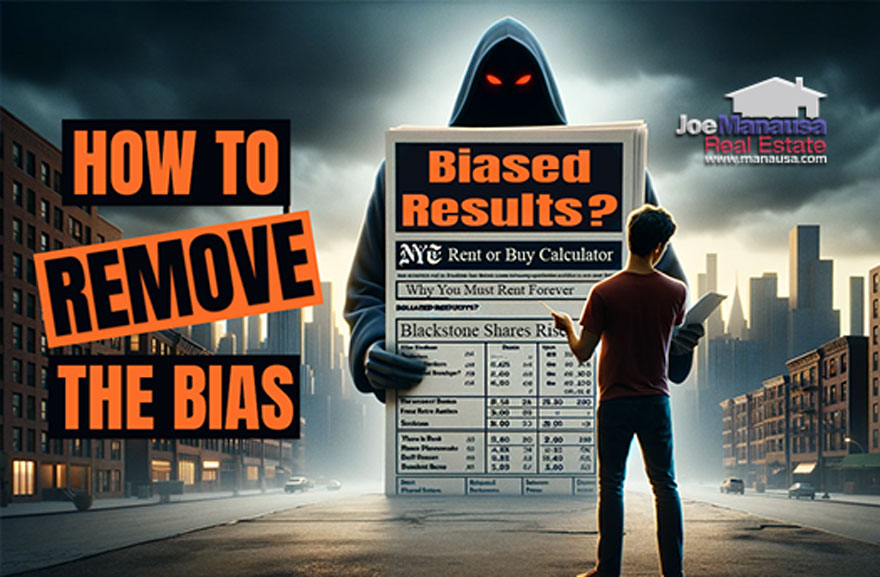
 The New York Times offers a free financial calculator that readers can use to answer the question, “Is it better to rent or buy a home?”
Recently, a long-time reader asked my opinion about the tool, and I thought I would share my quick analysis and answers on the Tallahassee Real Estate Blog.
The short answer is that I think it is a great tool, and it factors in many components that will help deliver accurate results. A longer answer, though, would include a warning about the assumptions bias built into the tool. “Assumption bias” in numerical analysis refers to the potential errors or inaccuracies that arise from incorrect, oversimplified, or unverified assumptions used in mathematical models and calculations. This type of bias can significantly impact the outcomes and reliability of a numerical analysis.
Simplified, I think a lot of users of the tools will merely use the New York Times assumptions, and those assumptions will lead to faulty conclusions. To point out the impact these assumptions produce, I’ve used a real property in Tallahassee (one that I know its current rental rate and current value) where we can do a proper, unbiased evaluation using the New York Times excellent financial calculator.
The Basics
The tool begins by asking the user to compare a purchase price to a rental rate.
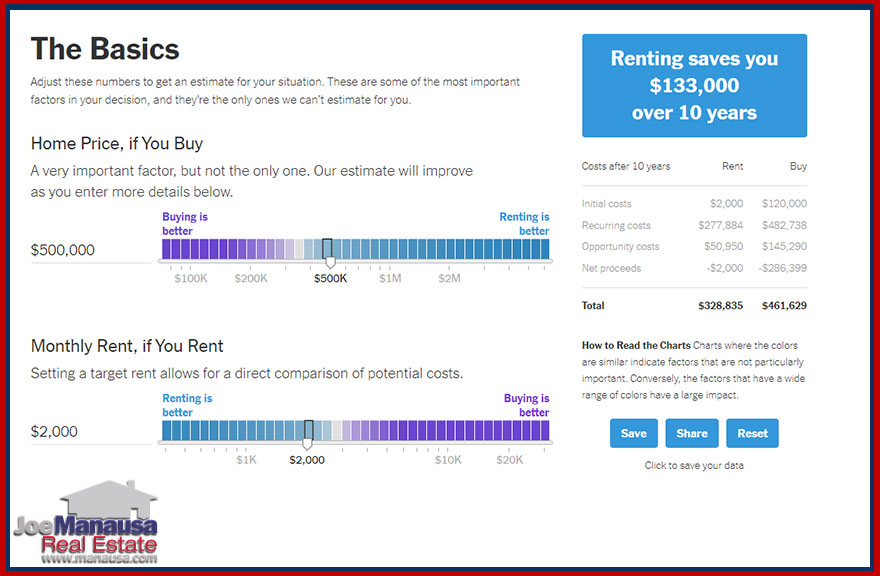
The calculation is live and shown in the blue box. If you do not modify the assumptions, renting will save you $133,000 over ten years. But let’s examine the assumptions they use for price and rent.
I can tell you that the price and rent they use are for different properties. In most markets, a $500K home will not rent for $2,000 per month.
Many people who do not work in our industry, but perhaps are mathematically inclined, often compare the median home rent with the median home price thinking that each represents the same type of property. This is incorrect.
The median home in most areas is a single-family home, whereas the median rent in most areas is for an apartment unit. These are not comparable properties. So how does this tool work when we use a rent versus buy analysis on a single property?
Let’s look at what happens when we use a property listed on Zillow today.
Unbiased Basics
I’ve taken a home currently available “for rent” on Zillow, and I know what homes in its neighborhood are worth. The next slide changes the New York Times’s assumptions bias to produce a different result.
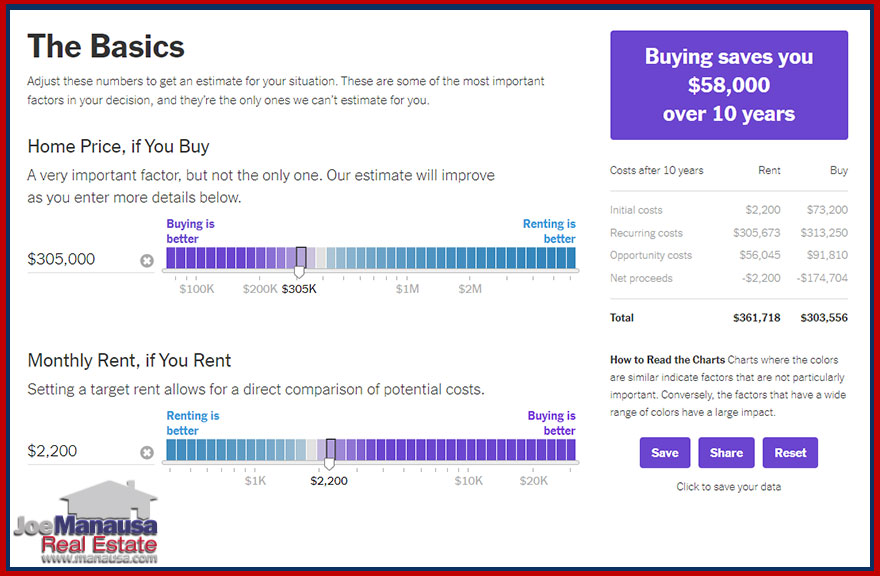
Now that we compare apples to apples, the analysis tool begins from a radically different premise. Initially favoring renting, our consumer’s scenario now shifts almost $200,000 in favor of buying. But several more adjustments are needed.

Buy Now Or Wait? The 91.6% Rule
Biased Results? The New York Times Rent Or Buy Calculator

Do's And Don'ts During The Home Loan Process

6 Real Estate Contract Terms You Should Not Overlook

7 Tips On Buying A Home With A Pool
How much house can you actually afford (By Income)?

What Does "Marry The House Date The Rate" Mean In Real Estate?

Why Fixer Uppers Are the New Gold | Home Renovation Guide

8 Tips For Buying An Affordable Florida Vacation Home
Biased Purchase Assumptions
The calculator assumes a ten-year duration, a mortgage interest rate of 7.25%, and a 20% down payment.

I have no significant concerns with the first two assumptions, but the third one—assuming a 20% down payment—does not align with my experience. Most individuals comparing renting to owning are often younger, first-time homebuyers without substantial cash reserves.
Unbiased Purchase And Duration Assumptions
What happens when we apply current market data and adjust the down payment to 4%? I originally wanted to use 3.5%, which is accessible to many first-time homebuyers through FHA loans, but the tool only accepts whole numbers.

We find that adjusting the down payment slightly strengthens the case for buying. This is an excellent outcome, indicating that the size of a buyer’s down payment does not significantly impact the decision between renting and buying.
Market Assumptions
This next set of assumptions centers on predicting future market movements. Here, I find the tool’s creators to be either sloppy or intentionally guiding consumers toward a predetermined conclusion.

Anyone with internet access can get historical data for these assumptions, but the tool’s creators used arbitrary numbers.
Unbiased Market Forecast
Without delving deeply into the supply-and-demand imbalance causing soaring home prices and rents, I can tell you that a 3% growth rate on either would be a win for home affordability, but is highly unlikely.

Unfortunately, over the past 80 or so years, home prices have grown nationally at a 4.7% rate, while Zillow shows a rental growth rate of 4.9% over the past 11 years. When these numbers are used in the calculator, we see a huge strengthening for buying, from $60K to $153K over the next ten years.
Get Our Free Market Update
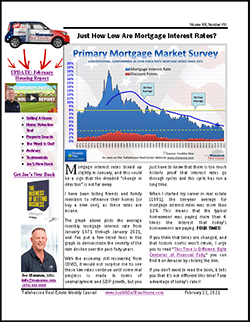
Other buyers, sellers, lenders, and real estate agents have this critical information, and now you can too!
Get immediate access to our most recent newsletter.
Let more than 30 years of experience work for you with charts, graphs, and analysis of the Tallahassee housing market.
Each Monday morning we send out a simple, one-page report that provides a snapshot of the Tallahassee housing market. It only takes 2 minutes to read, but it gives you better market intelligence than most real estate agents possess. Just tell us where to send it below!
Taxation’s Impact On Housing
The next step in the calculator allows the user to input tax rates to see how taxation impacts the decision to buy or rent.

Instead of using the standard assumptions provided by the calculator, I’ve tested two extremes—0% and 50% for the marginal tax rate—to assess the impact of taxation on the buy versus rent decision. For someone who pays no federal income tax, the financial advantage of buying decreases slightly, though still heavily in favor of buying.
Extreme Taxation Assumption
So what happens when we calculate the impact of the maximum income tax rate?

When the marginal tax rate is increased to 50%, we see the same and opposite result as when we used zero percent. The financial advantage of buying increased slightly. For what its worth (and it’s not shown here), switching from a joint return to an individual return moved the needle towards buying.
Closing Costs Bias
Buying a home and selling a home include fees that renters never face, so the calculator includes these in its rent versus buy assessment.

Having brokered for more than 30 years, I can tell you that sellers historically pay 7% to 10% in closing costs in the North Florida area. This is the first time the creator’s bias has strengthened the case for buying.
Accurate Closing Costs Estimate
Adjusting seller closing costs 1.5% higher aligns the assumptions with my experience.

Higher closing costs affect homeowners but not renters, so while the benefit of buying remains strong, it’s marginally reduced compared to earlier estimates with less accurate closing cost assumptions.

The Best Time To Lower The Price In A Home Sale

Want to Sell Your Home Quickly and Profitably? Watch This Now
Time-Lapse Tree Removal!

What Does A Realtor Earn?

How To Sell Your House When You Are In A Hurry
Do's And Don'ts During The Home Loan Process
7 Tips On Buying A Home With A Pool
How much house can you actually afford (By Income)?

What Sellers Need To Know About Robo-Offers In Real Estate
Maintenance And Fees Assumptions
The final calculation entry is designed to assess the impact of maintenance and fees, which are expenses borne by owners but not by renters.

Using the calculator’s assumptions, we find that it strongly endorses buying versus renting, but what about the hidden bias in maintenance and fees.
The Hidden Bias In The Calculator
We find that there are three entries in the Maintenance And Fees segment of the calculator, but this is where practical, on-the-ground experience supersedes purely mathematical modeling.

The third entry in the Maintenance and Fees section serves as a catch-all for any utilities paid by the landlord for the tenant. While it initially seems logical to account for utility splits in some leases, I have chosen to zero out this entry, which increases the buying advantage to over $150K.
The model defaults to assuming that the landlord absorbs $100 per month for utilities, which isn’t typically the case in practice. From my experience, landlords purchase properties with the intention of covering costs through rent. If a landlord incurs additional costs, such as utilities, these are usually passed on to the tenant. For instance, a property renting for $2,200 per month with no additional owner fees would likely rent for $2,300 if the landlord were paying $100 in utilities.



How To Sell Your House On Your Own

10 PROVEN Strategies To Increase A Home's Selling Profit
2025s HOTTEST Home Selling Strategies You Need NOW

The 3-DAY Method To Sell Your Home For More (2025)
The Best Time To Lower The Price In A Home Sale

How FOMO Makes Your Home Sale More Profitable