
Leverage – The Math

Now that we’ve discussed the power of leverage let’s break down the math behind this real estate magic. You might be wondering, “How exactly does leveraged appreciation work?” Well, I will show you why this strategy is a game-changer for smart investors.
Leveraged appreciation is like having a financial superpower in the real estate world. It’s when you use borrowed money to amplify your returns on a property’s value increase. Sounds simple, right? But the impact can be massive.
Leverage Example
Let’s walk through this step-by-step. Imagine you’ve got that $50,000 we mentioned earlier. Instead of buying a $50,000 property outright, you use it as a 20% down payment on a $213,000 home. You’re now controlling an asset worth nearly five times your initial investment.

Here’s where
it gets interesting. Let’s say the property value increases by the 74-year average of 4.51% per year. That’s $9,596 in appreciation. Now, if you’d bought a $50,000 property cash, that 4.51% would only be $2,255. But because you leveraged your investment, you’ve gained $9,596 on your $50,000 – that’s a 19.2% return!
But wait, there’s more. Remember, your tenant is also paying down the mortgage principal each month. Let’s say that adds up to $1,476 in the first year. Add that to your appreciation, and you’ve gained $11,072 on your $50,000 investment. That’s a 22% return in just one year!
Now, I know what you’re thinking. “Joe, this sounds too good to be true.” And you’re right to be cautious. There are risks involved, which we’ll get into later. But for now, let’s compare this to a non-leveraged investment.
If you put that $50,000 into a stock market index fund, historically you might expect an average annual return of about 7%. That’s $3,500 in a year. Not bad, but it pales in comparison to the $11,072 you could gain through leveraged real estate investing.
The power of leveraged appreciation becomes even more apparent over time. In 10 years, assuming steady appreciation and mortgage paydown, your $50,000 could potentially turn into $216,000 or more. That’s a 400% return!
Now, I’m not saying the stock market is bad. It has its place in a diversified portfolio. But when it comes to turning $50,000 into $500,000, leveraged real estate investing has some serious advantages.
Of course, these numbers are simplified examples. Real estate markets can be unpredictable, and there are costs and risks to consider. But that’s exactly why understanding leveraged appreciation is so crucial. It’s a tool that, when used wisely, can significantly accelerate your wealth-building journey.
So, next time someone tells you that real estate investing is all about location, you can smile knowing that leverage is your secret weapon. But before you rush out to buy property, stick around. We’re about to dive into the risks and rewards of this strategy, and trust me, you won’t want to miss it.
Keep Up With New Trends In Tallahassee!
Get The Tallahassee Real Estate Newsletter
 Don't be the one that doesn't know what's going on when you sell a home or buy a home in Tallahassee.
Other buyers, sellers, lenders, and real estate agents have this critical information, and now you can too!
Get immediate access to our most recent newsletter.
Let more than 30 years of experience work for you with charts, graphs, and analysis of the Tallahassee housing market.
The Risks And Rewards Of Leveraging
 I know we’ve been talking about the incredible potential of leveraged appreciation, but let’s pump the brakes for a second. You might be wondering, “if this is so great, why isn’t everyone doing it?” Well, that’s a smart question, and it brings us to an important point: leveraged real estate investing is a double-edged sword.
Sure, it can supercharge your returns, but it also comes with risks that you need to understand. Remember, we’re dealing with borrowed money here, and that can be a powerful tool or a dangerous weapon, depending on how you use it.
Let’s talk about market volatility. The real estate market isn’t always a smooth ride. It can be like a rollercoaster, with ups and downs that can make your stomach churn. When you’re using leverage, those ups and downs are amplified. A 5% drop in property value might not seem like much, but when you’re leveraged, it could wipe out a big chunk of your equity.
Here’s something that keeps many investors up at night: negative equity. Imagine owing more on your mortgage than your property is worth. It’s not a pleasant thought, is it? This can happen if property values drop significantly, and it’s a risk you need to be aware of when using leverage.
But wait, there’s more to consider. Cash flow is king in real estate investing. When you’re leveraged, you’ve got mortgage payments to make, regardless of whether your property is occupied or not. If you can’t cover your mortgage and other expenses with your rental income, you could find yourself in a tight spot real quick.
And let’s not forget about interest rates. They might be low now, but what happens if they rise? Higher interest rates mean higher mortgage payments, which can eat into your profits or even push you into negative cash flow.
So, am I trying to scare you off leveraged real estate investing? Not at all. I’m just making sure you go in with your eyes wide open. Because here’s the thing: with the right strategies, you can mitigate these risks and still reap the rewards of leverage.
First off, do your homework. Research the market you’re investing in. Look at historical trends, future growth projections, and economic indicators. The more you know, the better equipped you’ll be to make smart investment decisions.
Next, don’t overleverage. Just because you can borrow 80% doesn’t mean you should. Consider putting down a larger down payment to give yourself a cushion against market fluctuations.
Diversification is another key strategy. Don’t put all your eggs in one basket. Spread your investments across different properties or even different markets to reduce your risk.
And here’s a big one: always have a cash reserve. This can be a lifesaver if you face unexpected vacancies or repairs. Aim to keep at least six months of expenses set aside for each property.
Lastly, consider fixed-rate mortgages over adjustable-rate ones. They might cost a bit more upfront, but they protect you from interest rate hikes down the road.
Remember, leveraged real estate investing isn’t a get-rich-quick scheme. It’s a long-term strategy that requires careful planning, diligent management, and a solid understanding of the risks involved. But if you approach it wisely, it can be a powerful tool for building wealth.
So, now that we’ve looked at both sides of the leverage coin, you might be wondering how to time your entry into the market. Is there a perfect moment to jump in? Well, that’s exactly what we’re going to explore next.

How To Get 20% Or More With Leveraged Real Estate

8 Tips For Buying An Affordable Florida Vacation Home

Should you sell your home or rent it out?

Is turning your college student into a homeowner a wise investment or a financial faux pas?

6 Real Estate Investing Lessons from the 2008 Housing Bubble

How To Avoid Common Legal Issues When Buying Or Selling A Home

Should You Buy A House For Your Child?

How To Use Price Per Square Foot When Valuing A Home

Is Home Ownership A Hedge Against Inflation?
Market Timing In Real Estate
 So we’ve covered the power of leverage and the risks involved. But there’s one question that keeps popping up in my inbox: “Joe, when’s the right time to jump into the real estate market?” It’s a great question, and today we’re going to tackle the age-old debate of market timing in real estate.
You’ve probably heard the saying “time in the market beats timing the market.” But does this apply to real estate too? Well, let’s look at some cold, hard facts.
Historically, real estate markets have shown cyclical patterns. We’ve seen boom periods where prices skyrocket, followed by corrections or even crashes. The 2008 housing crisis is a prime example. But here’s the kicker – despite these ups and downs, U.S. home prices have consistently trended upward over the long term.
Now, you might be thinking, “if I can predict these cycles, I can make a killing!” And sure, if you had a crystal ball, that’d be great. But here’s the reality – even the experts struggle to accurately predict market turns. It’s like trying to time the stock market – sounds great in theory, but it’s incredibly tough in practice.
So what’s the alternative? Well, let me introduce you to a concept called dollar-cost averaging in real estate. It’s a strategy where you invest consistently over time, regardless of market conditions. This approach can help smooth out the impact of market fluctuations.
Here’s how it might work in real estate: Instead of waiting for the “perfect” moment to buy, you invest in properties at regular intervals. Maybe you buy a property every year or two. Some years you might buy at higher prices, others at lower prices. But over time, you’re likely to average out to a good entry point. Remember, the average annual appreciation rate is about 5%, so time will take care of timing.
Now, I know what some of you are thinking. “But Joe, what if I buy right before a market crash?” It’s a valid concern. But remember, real estate is typically a long-term investment. If you’re in it for the long haul, short-term fluctuations become less significant. Let’s look at some numbers.
134 Years Of Home Prices
According to the Federal Reserve Bank of St. Louis, the median home price in the U.S. has increased by about 1,070% since 1963.
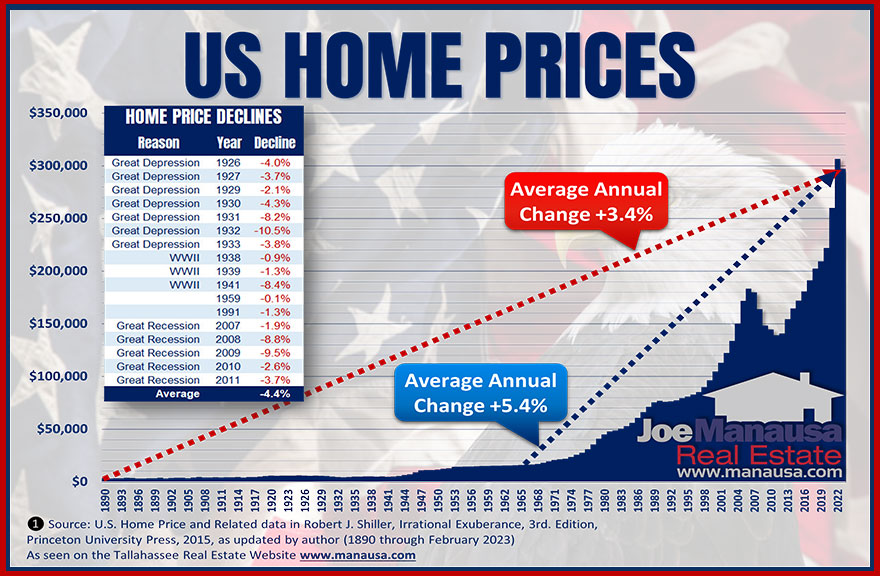
That’s an average annual increase of about 5.4%. Now, this doesn’t mean every year saw a 5.4% increase. Some years were higher, some were lower, and some even saw declines. But over the long term, the trend has been upward.
So, what’s the takeaway here? While timing the market perfectly would be ideal, it’s not realistic for most investors. Instead, focus on time in the market. The longer you hold your real estate investments, the more likely you are to benefit from overall market appreciation.
But here’s a pro tip: While you shouldn’t obsess over timing the entire market, you can focus on timing your local market. Pay attention to local economic indicators, job growth, and development plans. These factors can give you insights into potential up-and-coming areas where your investment might see stronger appreciation.
Remember, real estate investing is a marathon, not a sprint. It’s about making informed decisions based on your financial goals, risk tolerance, and local market conditions. So don’t get too caught up in trying to time the perfect entry. Instead, focus on finding good deals, managing your properties well, and holding for the long term.
Now, you might be wondering how real estate stacks up against other investments over the long haul. Well, that’s exactly what we’re going to dive into next. And let me tell you, the numbers might surprise you.

The Best Time To Lower The Price In A Home Sale

Want to Sell Your Home Quickly and Profitably? Watch This Now

Time-Lapse Tree Removal!

What Does A Realtor Earn?

How To Sell Your House When You Are In A Hurry

Do's And Don'ts During The Home Loan Process

7 Tips On Buying A Home With A Pool

How much house can you actually afford (By Income)?

What Sellers Need To Know About Robo-Offers In Real Estate
The Housing Market vs. The Stock Market
 Alright, we’ve covered a lot of ground, but I’ve saved the best for last. You might be thinking, “how does real estate really stack up against other investments?” Well, I’m about to show you something that might just blow your mind.
Let’s talk about real estate versus stocks. Now, I know what you’re thinking – stocks have been the go-to for building wealth for decades. But here’s the kicker: when we look at the numbers since 1963, leveraged real estate has been quietly outperforming stocks, and not by a small margin.
Here’s the deal: since 1963, median home prices in the U.S. have shot up by about 1,070%. That’s an average annual increase of 5.4%. Now, that might not sound earth-shattering, but remember – we’re talking about leveraged appreciation here.
Let’s break it down. If you put 20% down on a house, that 5.4% annual appreciation turns into a 27% return on your initial investment. And that’s before we even factor in rental income or tax benefits.
But wait, there’s more. When we compare the annual real estate appreciation rate to inflation (with housing removed from the inflation equation), we see that real estate has consistently outpaced inflation. This means your investment is not just growing – it’s growing in real terms.
Now, let’s talk taxes. Real estate investors get some sweet tax advantages. You can deduct mortgage interest, property taxes, and depreciation. These deductions can add up to another 2-3% in annual benefits when leveraged.
So, what’s the bottom line? When you add it all up – appreciation, leverage, rental income, and tax benefits – real estate can potentially deliver returns that make the stock market look like small potatoes.
But here’s the thing – I’m not telling you to dump all your stocks and go all-in on real estate. Diversification is still key. What I am saying is that if you’re not considering real estate as a serious part of your investment strategy, you might be leaving money on the table.
Want to dive deeper into real estate investing? Check out my previous video, ‘6 Real Estate Investing Lessons From The 2008 Housing Bubble.’ Discover how a crisis that wiped out fortunes can actually provide invaluable insights for successful investing. Join us on this journey through the 2008 housing crash and uncover the wisdom that could safeguard your investments and set you up for unprecedented success.