The Surprising Strength Beneath the Housing Market
Why are home buyers showing increased activity when mortgage rates remain elevated? Historically, higher mortgage rates discourage buyers and reduce affordability, making the current increase in buyer activity particularly puzzling. Yet, recent data tells us a different story—one that highlights the unexpected strength and resilience of the housing market in 2025.
The housing market continues to face significant challenges. For many potential buyers, the higher cost of borrowing should translate into reduced enthusiasm for home purchases. Typically, when rates are elevated, buyer activity stalls.
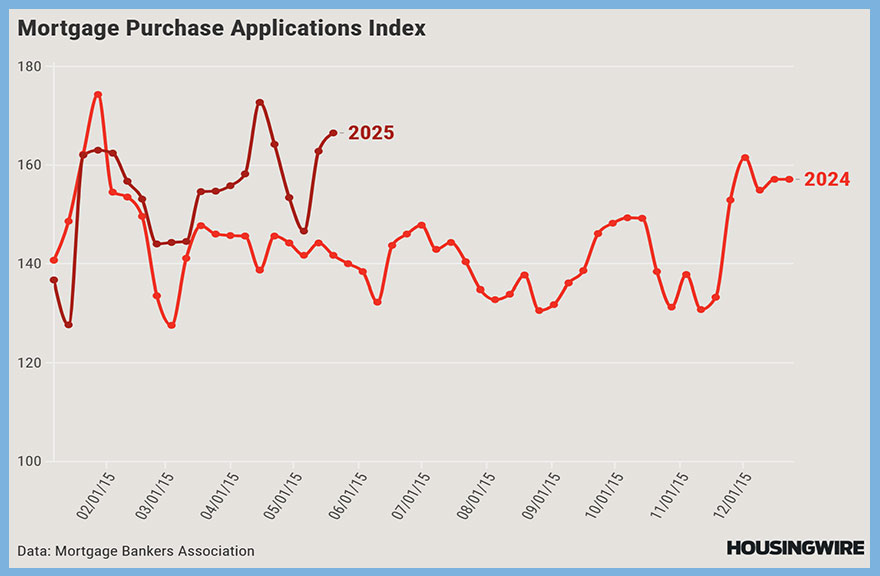
However, this unexpected buyer activity strongly indicates the market’s resilience, supported by an 18% year-over-year increase in purchase applications over 15 consecutive weeks. This isn’t a one-off occurrence—it’s a consistent trend that points to underlying, pent-up demand.
Purchase applications, often an early indicator of market activity, provide insight into what’s ahead. Even as rates remain high, buyers are staying active, suggesting that certain factors are helping to offset the affordability challenges. One of the key factors is the improvement in mortgage spreads.

Think of mortgage spreads as the difference between the interest rate on a home loan and a benchmark like the 10-year Treasury yield. When spreads widen, borrowing becomes more expensive; when they narrow, it helps reduce rates. In 2023, spreads were unusually high, adding to affordability concerns. Since then, spreads have narrowed, helping to offset some of the pressure from elevated rates. If spreads had stayed at their 2023 peak, today’s mortgage rates would be near 8%, making it significantly harder for buyers to afford homes.
Despite improving spreads, mortgage rates are still high compared to the past ten years. However, if spreads return to their historical norms, experts predict rates could drop by another 0.55% to 0.75%, potentially bringing them closer to 6%. A shift like this would provide further relief for buyers and spur even more demand, especially among those eager to lock in rates before they change again.
Pending home sales offer further evidence of the market’s resilience.

Recent data shows that pending sales are slightly higher than last year, despite the elevated rates. For example, the most recent weekly pending home sales data stands at 409,896, compared to 400,653 at the same point in 2024 and 387,251 in 2023. This stability in pending sales underscores the persistence of buyer demand, even in a challenging rate environment.
It’s also important to consider the long-term implications of these trends. Purchase applications represent activity that plays out over the next 30 to 90 days. For instance, last week’s data showed an 18% year-over-year increase, following a 13% increase the week before. While this doesn’t immediately show up in sales reports, it signals a growing pipeline of activity, reinforcing the market’s unexpected strength.
As we approach 2025, the improvement in mortgage spreads and the consistent buyer activity suggest that the housing market is navigating its challenges with surprising resilience. While affordability concerns remain, the steady growth in demand indicates that the market is far from a downturn. If spreads improve further, they could provide an additional boost, making home purchases even more accessible.
This data challenges the idea that elevated rates are suffocating the housing market. Instead, buyers are adapting, and demand remains robust enough to support ongoing activity. While challenges persist, the market’s foundation appears solid, making fears of a crash increasingly unlikely.
But what about supply? To truly understand where the market is heading, we need to examine inventory levels and price trends. Let’s explore those dynamics next.
Keep Up With New Trends In Tallahassee!
Get The Tallahassee Real Estate Newsletter
 Don't be the one that doesn't know what's going on when you sell a home or buy a home in Tallahassee.
Other buyers, sellers, lenders, and real estate agents have this critical information, and now you can too!
Get immediate access to our most recent newsletter.
Let more than 30 years of experience work for you with charts, graphs, and analysis of the Tallahassee housing market.
Inventory, Price Cuts, and What They Mean for 2025
Could rising inventory and price cuts mean the housing market is stabilizing—or are these signs pointing to bigger trouble ahead? To answer this, we need to examine some critical market data that highlights how the supply side of the housing market is evolving.

Rising inventory levels are balancing the market. Active single-family home listings have increased to 767,274 homes nationwide, nearly double the 387,251 in 2023. This growth marks an important step toward normalizing market conditions. While current levels don’t compare to pre-pandemic peaks of 1.12 million active listings in 2015, the shift suggests progress. Buyers who faced limited options and bidding wars now have more choices, creating a less competitive environment. More inventory gives buyers long-awaited opportunities while also preventing runaway price increases.
Weekly new listings are also on the rise.

In 2023, the average was 59,072 per week. By 2024, it climbed to 67,530, and in 2025, it reached 76,112 weekly. While this is a clear improvement, it’s still far from the extreme highs of the late 2000s housing crash, when weekly listings exceeded 250,000. Today’s numbers represent a steady return to seasonal peaks, ranging from 80,000 to 110,000 per week, aligning with a market moving toward balance rather than oversupply.
With more homes available, sellers are adjusting their prices to attract buyers.

Through April 2025, 37.4% of homes for sale have seen price reductions, up from 30% in 2023 and 34% in 2024. Think of it like a grocery store: when shelves are fully stocked, prices drop to encourage sales. Similarly, as inventory grows, sellers are more willing to negotiate, especially with higher mortgage rates limiting buyers’ budgets. For instance, imagine a seller listing their home at $450,000. After weeks with no offers, they reduce the price to $425,000—and within days, they secure a buyer. This scenario reflects how sellers are adapting to a more balanced market.
Some may view rising price cuts as a warning sign, but they’re better understood as part of the market’s return to normalcy. During years of low inventory and historically low interest rates, price reductions were rare because sellers could command top dollar. Now, with inventory climbing and borrowing costs higher, sellers are finding that pricing aggressively doesn’t always lead to quick offers. Adjusting prices is a natural response to these conditions, not necessarily a sign of weakness.
These trends—rising inventory and increasing price reductions—highlight how supply and demand are interacting today. For much of the past several years, demand far outpaced supply, driving extreme competition and price growth. Now, as inventory grows and buyers adjust to higher mortgage rates, the market is behaving more predictably. New listings are entering at a steady rate, and price cuts reflect sellers acknowledging increased competition. Together, these signs point to stabilization, not a severe downturn.
Although current single-family home listings are just under 770,000, that’s still 50% below the balanced market norm of over 1 million active listings pre-pandemic. However, the steady increase in inventory indicates a move toward equilibrium rather than oversupply. Supply is recovering after years of being historically low, but there’s still room to grow before reaching typical levels.
So, what does all of this mean for 2025? Increasing inventory and price cuts suggest a market transitioning toward balance. Buyers may find relief with more options, and sellers adjust their strategies to secure deals. While price cuts might seem alarming, they signal a market behaving more rationally than it has in years. Conditions point to stabilization, not distress.
As encouraging as the data seems, the broader economy remains the key factor.

There has been only one housing market crash since 1960, and it was at the onset of the Great Recession nearly 20 years ago. Economic indicators like job creation and unemployment will ultimately shape housing demand. For example, stable employment and wage growth can sustain buyer confidence, helping the market continue its path toward balance. In our final section, we’ll explore how these economic trends impact housing in 2025—and why they suggest resilience, not collapse. Let’s break it down.





Fannie Mae Report: It's The TRUTH About The Housing Market

Real Estate Meltdown: Starter Homes at $1M in 233 Cities

Is the Housing Market Crashing? | Redfin April 2025 Update

Is This The CALM Before The CRASH? Volatility Rocks Housing