Get Our Free Market Update
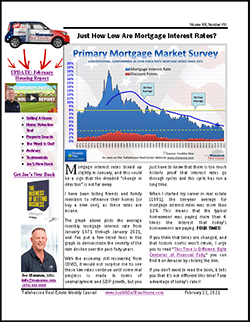
Other buyers, sellers, lenders, and real estate agents have this critical information, and now you can too!
Get immediate access to our most recent newsletter.
Let more than 30 years of experience work for you with charts, graphs, and analysis of the Tallahassee housing market.
Each Monday morning we send out a simple, one-page report that provides a snapshot of the Tallahassee housing market. It only takes 2 minutes to read, but it gives you better market intelligence than most real estate agents possess. Just tell us where to send it below!
Today’s Market: Low Supply, Moderate Demand
You might be surprised that today’s housing market looks nothing like it did during the last crash. The current inventory of homes for sale is less than a third of what it was in 2007. This dramatic shift in the market landscape is reshaping the real estate game in unexpected ways.

Let’s break down what’s really happening. Currently, only about 1.3 million homes are for sale in the United States. That’s a far cry from the more than 4 million homes available during the 2007 housing crisis. This stark difference isn’t just a number—it’s a clear indicator of a more stable market today.
Home prices typically crash when there are far more sellers than buyers. However, in today’s market, with limited new construction, the situation is different: the buyers are also the sellers. When someone feels priced out, they don’t just exit as a buyer—they also stay put as a homeowner, reducing the number of sellers in the market.
But what does this mean for you as a potential buyer or seller? Well, it all comes down to supply and demand. Currently, we’re looking at what’s called a “months of supply” metric of about four months. In simple terms, if no new homes came on the market, it would take about four months to sell all the available homes. Anything under 6 months is considered a seller’s market, where demand exceeds supply.
Now, you might wonder, “Why has demand not improved greatly when rates started coming down?” This is where things get interesting. Despite better rates being available, we’re not seeing a flood of homes for sale. The reason? It’s something called the rate ‘lock-in’ effect.
Imagine you bought a home a few years ago with a 3% mortgage rate. Now, rates are about double that. Would you be eager to sell your home and get a new mortgage at 6%? Probably not. This reluctance to give up low-rate mortgages keeps many homeowners from putting their houses on the market, further constraining the already tight supply.
But here’s where it gets even more intriguing. The Federal Government has been like a one-trick pony regarding housing policy. They’ve primarily focused on demand-side actions to influence the market. Think about it – low interest rates, tax credits for first-time homebuyers, new loan programs, canceling old loan programs, all to boost or slow demand. But what about increasing the supply? That’s been largely overlooked since the Great Recession.
This supply shortage isn’t just a temporary blip. We’re facing a severe housing deficit in the U.S., with some experts suggesting we’re short by about 5 to 20 million homes. This underbuilding trend has been ongoing for many years, with builders being cautious post-2008 and facing rising costs of construction materials.
So, what does all this mean for you? Understanding these market dynamics is crucial whether you’re looking to buy or sell. Low inventory and continued demand are keeping prices stable and even rising in most areas despite higher interest rates.
Buy Now Or Wait? The 91.6% Rule
Biased Results? The New York Times Rent Or Buy Calculator

Do's And Don'ts During The Home Loan Process

6 Real Estate Contract Terms You Should Not Overlook

7 Tips On Buying A Home With A Pool
How much house can you actually afford (By Income)?

What Does "Marry The House Date The Rate" Mean In Real Estate?

Why Fixer Uppers Are the New Gold | Home Renovation Guide

8 Tips For Buying An Affordable Florida Vacation Home
The Construction Conundrum and Affordability Crisis
Now, you might think the obvious answer is to ramp up construction. But here’s a shocking statistic: the U.S. is currently short between 5 and 17 million homes. That’s right, millions. How did we end up in such a massive housing deficit, and why isn’t it being fixed?
The construction industry is facing a perfect storm of challenges. In 2008, when the Federal Government canceled loan programs that had served first-time homebuyers and lower-credit score buyers, builders mostly stopped building entry-level homes. New home construction dropped significantly, but most people do not realize that the lower end of the new construction market was terminated. Now, rising costs of materials, land, and labor have made it increasingly difficult for builders to meet the growing demand for affordable housing. This isn’t just a minor setback – it’s a major roadblock in addressing our housing shortage.
But why does this matter to you as a potential homebuyer or seller? Well, it’s all about supply and demand. With such a significant deficit in housing, prices will likely remain high or continue to rise. As one expert put it, “We need to build more homes or home price appreciation will return to levels above 10 percent.” That’s a sobering thought for anyone hoping for a market crash to make homes more affordable.

Let’s look at the numbers. Since World War II, home prices have increased in 91.6% of the years. That’s a staggering statistic that underscores just how rare sustained price declines are in the housing market. Now, combine that with the fact that the average homeowner stays in their home for about 12 years, and you start to see why timing the market is not a wise strategy.
But here’s where it gets really interesting. The current affordability crisis isn’t just about high home prices – it’s a complex issue involving wages too. Home prices and rents have been outpacing wage growth, making it increasingly difficult for potential buyers to enter the market. This widening gap between housing costs and incomes is a key factor in why so many people are feeling priced out of homeownership.
So, what does this mean for you? If you’re holding out for a major price drop before buying a home, you could be in for a long wait. Leverage history to guide your decision. For example, someone in 1963 who thought home prices were too high would have had to wait 28 years for prices to fall, and even then, the average home price was 387% higher than in 1963!
Understanding home prices becomes clearer when you recognize that inflation is a constant reality and will likely remain so. The shortage of available homes is not expected to improve soon. As one industry expert put it, “We need more homes to meet the growing demand.” However, with the construction industry facing challenges in keeping up, the imbalance between supply and demand is set to continue.
Recently, many people are asking, “Surely prices can’t keep rising forever, right?” It’s natural to be skeptical. While historical trends often show price increases, it’s crucial to remember that real estate is local. Some markets may experience price corrections, while others continue to grow. Consider housing like any other commodity.
In the 1960s, a bottle of Coca-Cola typically cost between 10 to 15 cents, but today, it’s over a dollar! Do you expect to buy a Coke for less than $2 in 2040? Likely not, because inflation drives up prices and affects purchasing power. Just as Coca-Cola prices rise, so will home prices. My concern is this: “If homes become unaffordable, Wall Street might buy them up and rent them back to us at a premium!”
Here’s something to consider: even if you buy at a market peak, if you plan to stay in the home for the average 12 years, you’ll likely come out ahead. Why? Because over time, the power of appreciation tends to overcome short-term fluctuations. It’s not about timing the market perfectly – it’s about time in the market.
Let’s look at a quick example. If you bought a home in 2006, right before the last major crash, you might think you’d be underwater today. But if you held onto that home until now, you’d be sitting on significant equity with a positive annual rate of return above 3.3%. You also would have had multiple opportunities to refinance the home at historically low mortgage interest rates.



How To Sell Your House On Your Own

10 PROVEN Strategies To Increase A Home's Selling Profit
2025s HOTTEST Home Selling Strategies You Need NOW
The 3-DAY Method To Sell Your Home For More (2025)

The Best Time To Lower The Price In A Home Sale

How FOMO Makes Your Home Sale More Profitable

Home Sale Sabotage: Top 10 Mistakes Sellers Make
The 12-Year Perspective: A Game-Changer for Buyers
You might be thinking, “That’s great for long-term investors, but what about the rest of us?” If you expect to move within a few years, buying a home might not be the best choice right now. Typically, homeowners who stay put for at least five years sell at a profit, covering all closing costs from buying and selling—and then some. Renters, on the other hand, never enjoy this financial advantage, regardless of how long they rent.
If you have a renter’s mindset, five years may seem like a long commitment, but did you know most homeowners sell their homes after about 12 years? Understanding this can significantly change your perspective on homeownership. This 12-year average shifts our focus from trying to time the market perfectly to considering the benefits of owning a home for a more realistic timeframe.

This graph plots the twelve-year cost of renting (in blue) and the twelve-year cost of owning (in red). When comparing the living costs between owning a median-priced home and renting a median rental unit, it’s essential to adjust for the differences in living standards. Here’s a basic summary of how I adjusted the data:
- Increased the median home price by 6% to address the fact that median priced homes are typically larger than median rental units.
- Decreased the median home price by 5% to address the additional maintenance costs and the higher quality condition of the properties (median rentals are not maintained as nice as median priced owner-occupant homes, so the overall negative adjustment address the negative cost and the positive benefit homeowners receive.
- Increased the median home price by 2% because homes typically offer amenities like private yards, garages, and multiple bathrooms, which enhance the quality of life, versus the median rental unit which is often in an apartment complex.
Time In The Market (not) Timing The Market
 Remember, successful homeownership isn’t about timing the market perfectly. It’s about getting in the game and staying there long enough to ride out the ups and downs. And with that 12-year average in mind, you’ve got a pretty good chance of coming out ahead.
Now, I know what some of you are thinking. “But what about the risk? What if I buy at the wrong time?” Here’s the thing – there’s always going to be some level of risk in any investment. But when you look at the long-term trends in the housing market, the odds are in your favor. Remember that 91.6% statistic we talked about earlier? That’s a pretty strong track record.
Plus, when you own a home, you’re building equity with every mortgage payment. That’s something you just can’t do when you’re renting. And let’s not forget about the other benefits of homeownership – things like stability, the freedom to customize your space, and potential tax advantages.
But here’s the kicker – waiting for the perfect moment to buy could mean missing out on years of potential appreciation and stability. While you’re sitting on the sidelines, trying to predict the market, others are building equity and enjoying the benefits of homeownership.
So, what’s the takeaway here? It’s simple. Don’t let fear of market fluctuations hold you back. Instead, focus on your personal goals and circumstances. Are you in a position to buy? Do you plan to stay in the area for a while? If the answer is yes, then it might be time to seriously consider making that move.





Housing Crash or Boom? Here’s What’s Coming in 2025