
According to recent data, foreclosure starts jumped 30%, and foreclosure sales increased 25% nationwide. With housing crash predictions circulating on YouTube since before 2020, many wonder if the doomsayers were right all along.

I’ve analyzed the ICE Mortgage Monitor Report – the most authoritative data source in the mortgage industry – to understand what’s really happening.
In the video and narrative below, I break down the numbers to reveal what this surge actually signifies. The VA foreclosure increase is real, but the complete data tells a story that differs significantly from what many alarming headlines suggest.
The VA Foreclosure Surge: What’s Really Happening
Could those alarming foreclosure numbers we’re hearing about lately be the beginning of a housing market crash that so many have been predicting since 2020?
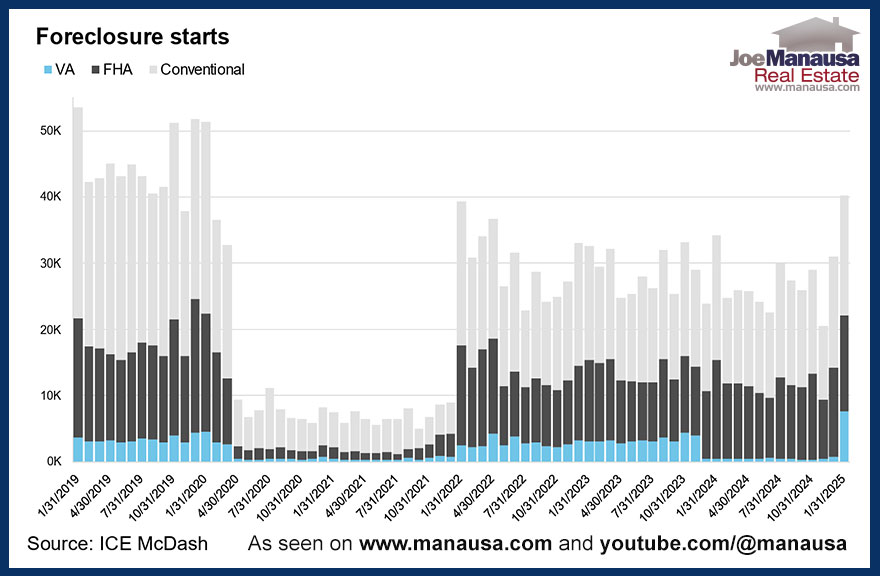
Looking at the January 2025 ICE Mortgage Monitor, we see foreclosure starts jumped by a whopping 30% and foreclosure sales rose 25%, hitting their highest level in 5 years with over 40,000 loans referred to foreclosure.

These statistics appear frightening – exactly the kind of numbers housing crash predictors point to as evidence the market is beginning to crumble.
However, examining the report more carefully reveals something crucial that completely changes the narrative. This surge isn’t driven by widespread market distress. It’s primarily the result of the VA foreclosure moratorium expiration in January 2025. This policy had temporarily halted foreclosures on VA loans during the pandemic to protect veteran homeowners, and its end created a predictable processing backlog.
When we examine the broader context, we see this is a policy-driven event affecting just one segment of the market. Breaking down foreclosure starts by loan type reveals a telling pattern: while VA foreclosures spiked dramatically, FHA loans actually saw foreclosure starts decrease by 2% year-over-year. Even more significantly, conventional loans experienced a 4% drop in foreclosure starts. This stark contrast between loan types raises an important question: why would only veteran homeowners suddenly struggle with payments?
The concentrated nature of this foreclosure surge signals we aren’t witnessing a broad market collapse. The March 2025 Mortgage Monitor confirms this point – the overall increase in foreclosure starts stems almost entirely from the spike in VA referrals.
January’s increase in foreclosure sales primarily reflects the resumption of normal VA foreclosure processing following both the holiday moratoriums and the longer-term VA-specific moratorium. The system is now working through a backlog of already-distressed loans that had been artificially held back.
So yes, the VA foreclosure surge is real, but it represents a return to normal processing after artificial suppression. This isn’t the beginning of a housing crash – it’s the foreclosure system catching up with previously delayed cases.
Keep Up With New Trends In Tallahassee!
Get The Tallahassee Real Estate Newsletter
 Don't be the one that doesn't know what's going on when you sell a home or buy a home in Tallahassee.
Other buyers, sellers, lenders, and real estate agents have this critical information, and now you can too!
Get immediate access to our most recent newsletter.
Let more than 30 years of experience work for you with charts, graphs, and analysis of the Tallahassee housing market.
Delinquency Rates and Natural Disasters: The Full Picture
Here’s a fascinating paradox that challenges the basic narrative about foreclosures – while we’re seeing those rising numbers, fewer homeowners are actually falling behind on their mortgage payments. The national mortgage delinquency rate dropped by 24 basis points to just 3.47% in January, according to the March 2025 Mortgage Monitor. That’s a 6.6% improvement – more than double what we typically see month-to-month. This contradiction presents an important insight into what’s actually happening in today’s housing market.
Looking deeper into the recovery patterns reveals a compelling picture. Nearly half a million previously delinquent borrowers – 490,000 to be exact – returned to current status in January alone, representing the highest volume of recovery in a full year. This is like seeing the housing market’s immune system kick in while minor symptoms appear elsewhere. The improvement extends across all delinquency categories, including the crucial 90+ day serious delinquencies that typically feed into foreclosure. If broad market deterioration were occurring, these serious delinquencies would be rising, not falling.
The recovery is even visible in areas affected by natural disasters. Hurricane-related delinquencies have dropped significantly, falling from 58,000 in November to 40,000 through January. This indicates that homeowners who faced catastrophic events are finding ways to recover and maintain their mortgage obligations.
However, challenges remain in specific regions. The Mortgage Monitor highlights the emerging impacts of California wildfires.

Approximately 680 borrowers in affected areas missed their January payments, with 3.5% of borrowers within the Eaton wildfire perimeter and 3.2% within the Palisades perimeter falling behind. Early February data suggests more significant impacts ahead, with roughly one in six borrowers in Eaton and nearly one in four from Palisades paying more slowly than they did in December.
While these localized events create pockets of concern, the national recovery numbers paint a more balanced picture. What’s particularly striking about these figures is how localized and event-specific they are. We’re observing very specific impacts tied to particular events or policy changes rather than broad-based deterioration across markets or loan types.







Housing Crash or Boom? Here’s What’s Coming in 2025

BIGGEST Housing Market Myth EXPOSED by New Foreclosure Data
The True Cost of Homeownership: PITI, Insurance, and Home Values
Those localized disaster impacts pale compared to the financial burden hitting virtually every American homeowner. Most analysts overlook that the fastest-growing expense in your monthly housing payment isn’t your mortgage interest or even your property taxes. It’s your homeowner’s insurance—and the numbers are staggering.
When we break down the components of PITI (Principal, Interest, Taxes, and Insurance), the average total mortgage payment increased by 6% last year. Property insurance premiums jumped by a record $276 in 2024 alone, representing a 14% annual increase and bringing the average annual premium for mortgaged single-family homes to $2,290.
This represents a concerning multi-year pattern. Since 2020, property insurance premiums have skyrocketed by $872 – a 61% increase in just half a decade, while all other housing payment components increased by only 21-22%. This additional expense is an unexpected weight on homeowners struggling with high housing costs.
These trends are particularly pronounced in Western states, where increases have outpaced national averages. Seattle and Salt Lake City experienced 22% increases in 2024, with Los Angeles at 20%. In the South, the burden is equally heavy in dollar terms, with Dallas homeowners facing a $606 annual increase and Houston close behind at $515.

Several factors drive these dramatic increases. The average annual insurance premium per $1,000 of coverage has jumped to approximately $5.40 in 2024, compared to just $4.66 between 2014 and 2022. Homeowners are attempting to manage these costs by accepting higher deductibles, with new borrowers in 2024 taking deductibles averaging $390 (19%) higher than typical mortgage holders.
In contrast to these increasing costs, the overall market shows signs of cooling.

The ICE Home Price Index indicates annual home price growth has slowed to 3.0% in January, down from 3.4% in December – a moderation rather than collapse.
For potential homebuyers, there is at least one positive development – inventory levels have improved substantially. The national deficit has shrunk from -40% a year ago to -25% today, indicating better supply conditions across nearly every major market.





Fannie Mae Report: It's The TRUTH About The Housing Market

Real Estate Meltdown: Starter Homes at $1M in 233 Cities

Is the Housing Market Crashing? | Redfin April 2025 Update

Is This The CALM Before The CRASH? Volatility Rocks Housing

Warning Signs For Home Buyers And Sellers
Equity Positions: The Market’s Safety Net
The substantial equity position of homeowners is the key stabilizing force in today’s housing market. When we ask why we’re not seeing widespread foreclosures despite rising costs, the answer is written in the balance sheets of American homeowners—they’re sitting on a mountain of equity that creates an entirely different market dynamic than what we saw in 2008.
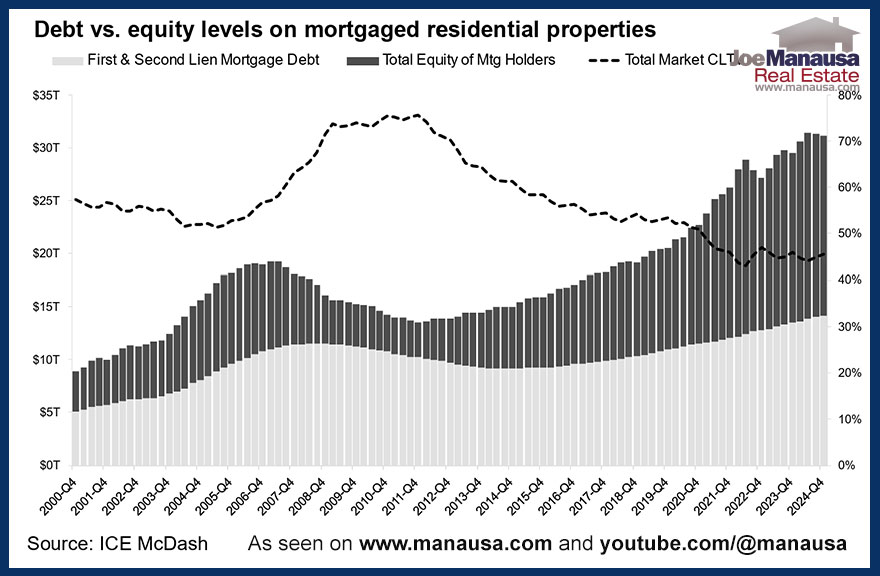
U.S. mortgage holders now possess an astonishing $17 trillion in total home equity entering 2025, up 6% from just a year ago. $11 trillion of that amount is considered “tappable” – meaning homeowners could borrow against it while still maintaining healthy 20% equity positions in their properties.

At the individual level, the average homeowner today has $313,000 of equity, with $203,000 of that available to tap if needed. This creates a powerful financial buffer that was absent during previous housing downturns.
Unlike in 2008, when negative equity snowballed into crisis, today’s substantial positive equity offers homeowners a robust financial cushion. The combined loan-to-value ratio across all mortgaged properties now sits at just 45.5%, down from 45.9% last year. This means the average mortgaged home carries less debt relative to its value than before.
This equity position fundamentally changes how homeowners respond to financial stress. When facing higher insurance premiums or other cost increases, today’s homeowners have options their 2008 counterparts simply didn’t have. Instead of being forced into foreclosure or distressed sales, they can tap their substantial equity if needed.
We’re seeing strategic equity use in action. The improved rate environment in late 2024 led to the strongest fourth-quarter equity withdrawal in three years, with homeowners accessing $46 billion – a 20% jump from the same period in 2023. This came through both second-lien home equity products and cash-out refinances.
Yet homeowners remain historically cautious. The Q4 withdrawal rate represented just 0.41% of available tappable equity – well below the 0.91% average extraction rate we saw in the decade before recent Fed rate hikes. This translates to over half a trillion dollars in untapped home equity that hasn’t flowed back into the broader economy.

The Best Time To Lower The Price In A Home Sale

Want to Sell Your Home Quickly and Profitably? Watch This Now

Time-Lapse Tree Removal!

What Does A Realtor Earn?

How To Sell Your House When You Are In A Hurry

Do's And Don'ts During The Home Loan Process

7 Tips On Buying A Home With A Pool

How much house can you actually afford (By Income)?