
The housing market is facing a paradox. Fewer homes are selling, yet prices remain stubbornly high. How can this be? The answer lies in a complex interplay of supply and demand, creating challenges for buyers and sellers. Let’s unpack the data to see what’s really going on.
Home Sales Continue To Decline

A striking trend emerges when we look at Redfin’s graph showing the number of homes sold from 2012 to 2024. We’re seeing a significant decline in sales, with August 2024 marking a 3.1% drop compared to the previous year. This isn’t just a small dip – we’re talking about the lowest level of existing home sales since Redfin records began in 2012, outside of that brief pandemic shutdown in May 2020.
Now, you might be thinking, “Wait a minute, aren’t mortgage rates down? Shouldn’t that be boosting sales?” And you’d be right to ask that. Mortgage rates have indeed fallen to their lowest level in over a year. But here’s the kicker – pending home sales have still declined by 8.4% annually. It seems lower rates aren’t the magic bullet we might have hoped for.
So what’s going on? Well, it’s a bit like a game of musical chairs, but with fewer chairs and more cautious players. Many potential buyers are sitting on the sidelines, waiting for what they hope will be better conditions. Some are holding out for even lower rates, while others are waiting to see how the upcoming presidential election might affect the market.
But it’s not just about buyer hesitation. The supply side of the equation is equally important. While housing supply has increased somewhat, it’s still nearly 30% below pre-pandemic levels. This creates a situation where competition for available homes remains fierce even with fewer buyers in the game.
Despite the drop in sales, we’re not seeing a corresponding drop in prices. In fact, the average sale-to-list price ratio is sitting at 98.9%. That means homes are selling for just a hair under asking price, even in this challenging market. It clearly signifies that we’re dealing with more than just a simple supply and demand imbalance.
The Federal Reserve’s anticipated interest rate cuts are another wild card in this complex situation. These cuts are expected to influence buyer behavior, but as we’ve seen, lower rates alone aren’t enough to spur significant activity in the current climate.
We’re witnessing a market in flux, struggling to find its new equilibrium. The dramatic shift from the boom times of recent years to the current slump isn’t just about economic factors – it’s also about changing perceptions and expectations among both buyers and sellers.
Redfin’s Homebuyer Demand Index offers a glimmer of hope, showing interest levels near their highest since May. But this renewed curiosity isn’t translating into sales – at least not yet. It’s a reminder that in real estate, as in life, things often move more slowly than we might expect.







Housing Crash or Boom? Here’s What’s Coming in 2025

BIGGEST Housing Market Myth EXPOSED by New Foreclosure Data
You might think fewer home sales would lead to lower prices. But the data tells a different story. Home prices are actually increasing at their fastest rate in months. What’s behind this counterintuitive trend?
Let’s take a look at Redfin’s median sale price graph. It’s a real eye-opener, showing a consistent upward trend that might leave you scratching your head.
Home Prices Keep Rising
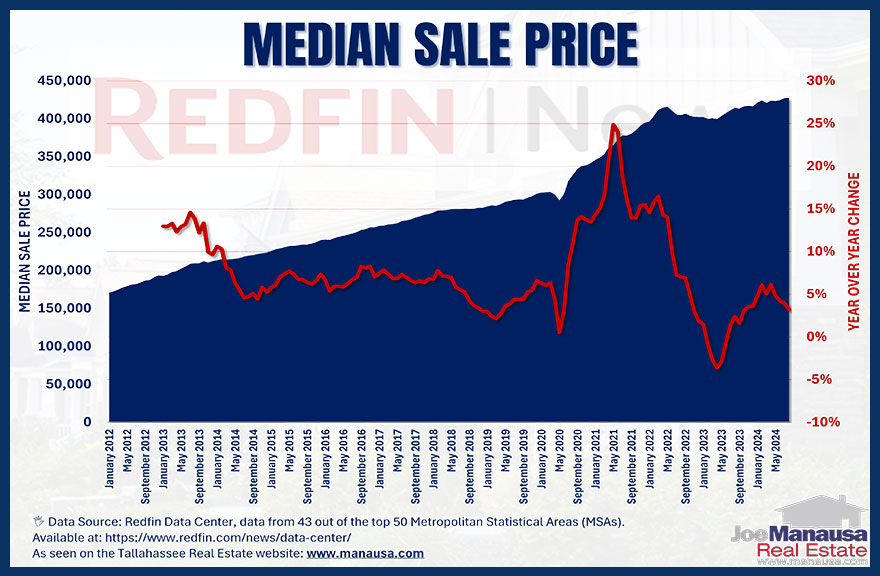
Despite the market slowdown we discussed earlier, the median sale price has climbed to $385K. That’s a 3.9% jump from last year – the biggest increase we’ve seen in two months.
Now, you’re probably wondering how this is possible when fewer homes are selling. It’s all about supply and demand, but not in the way you might expect. Even though demand has cooled off, the supply of homes has dropped even more dramatically. We’re dealing with a severe inventory shortage that’s been brewing for years.
Think about it like this: imagine you’re at an auction where there are fewer bidders but also way fewer items up for sale. Those remaining bidders? They’re still competing hard for the limited options available. That’s what’s happening in the housing market right now.
But it’s not just about the number of homes. External economic factors are stirring the pot too. Mortgage rates have been on a roller coaster ride, and while they’ve come down recently, they’re still higher than what buyers were used to a few years ago. This has created a situation where many homeowners are reluctant to sell and give up their lower-rate mortgages, further tightening the supply.
Redfin Senior Economist Sheharyar Bokhari puts it this way: “Prices kept creeping up during this unusually slow summer for home sales as mortgage rates came down and supply remained stubbornly low.” It’s a perfect storm that’s keeping prices high even as sales volumes drop.
Now, you might be thinking, “Surely buyers aren’t willing to pay these high prices in a slow market?” But here’s where we find the paradoxical results. The average sale-to-list price ratio is sitting at 98.9%. That means homes are selling for just a hair under the asking price. It’s a clear sign that despite the challenges, there’s still intense competition for the limited number of homes on the market.
This price paradox is creating some real challenges for buyers. Even with mortgage rates improving, high home prices and economic uncertainty make it challenging for many to take the plunge. It’s like trying to catch a moving target – just when you think you’ve saved enough for a down payment, prices climb a little higher.
For sellers, it’s a bit of a double-edged sword. On one hand, they can command higher prices for their homes. On the other, they might struggle to find a new place to live if they decide to sell, facing the same high prices coupled with higher loan rates and limited options as other buyers.
So, what does this mean for the future of the housing market? Well, it’s clear that we’re not out of the woods yet regarding affordability issues. The recent price increase, the largest in two months, suggests that the market is cooling slower than some might have hoped.





Fannie Mae Report: It's The TRUTH About The Housing Market

Real Estate Meltdown: Starter Homes at $1M in 233 Cities

Is the Housing Market Crashing? | Redfin April 2025 Update

Is This The CALM Before The CRASH? Volatility Rocks Housing

Warning Signs For Home Buyers And Sellers
The housing market is full of surprises. Just when you think more listings would solve the inventory crisis, the numbers tell a different story. How can there be too few homes when active listings are up 16.7% from last year? Let’s dive into the Redfin data and uncover what’s really happening with housing inventory.
At first glance, the numbers seem promising.
Inventory Remains Far Too Low

Redfin’s graph shows a 16.7% year-over-year increase in active listings. That’s a significant jump, right? Well, not so fast. Despite this uptick, we’re still facing a severe housing shortage. Here’s the kicker: inventory levels remain nearly 30% below what we saw before the pandemic, and the inventory was lower than normal back then. It’s like we’re trying to fill an Olympic-sized pool with a garden hose – progress is happening, but we’ve got a long way to go.
Now, you might wonder, “If there are more listings, why is inventory still a problem?” Good question. It’s all about perspective. While the increase in listings is a step in the right direction, it’s simply not enough to meet the pent-up demand that’s been building for years.
Think of it like this: imagine a popular restaurant that’s been booked solid for months suddenly adds a few more tables. Sure, it’s an improvement, but those tables are going to fill up fast, and you’ve still got a long line of hungry customers waiting outside.
This inventory squeeze is having a real impact on buyers. With more people chasing after a limited number of homes, competition remains fierce. It’s driving up prices and making affordability a major issue for many potential homeowners. It’s like a crowded marketplace before a hurricane where everyone is vying for the last few cases of water and toilet paper.
Let’s look at some key metrics that show how this inventory shortage plays out in the market.
Sellers Are Getting Theirs

The average sale-to-list price ratio is sitting at 98.9%. What does that mean in plain English? Homes are selling for just a hair under their asking price. In a balanced market, you’d expect to see more wiggle room in negotiations. But sellers are still in the driver’s seat with inventory so tight.
Another telling stat is the average number of days homes spend on the market.
It Doesn’t Take Long To Sell A Properly Marketed Home

Redfin’s data shows it’s now at 38 days. That’s an increase from recent years, but it’s still a relatively quick turnaround when you look back over the past twelve years. In a market flush with inventory, you’d expect homes to sit longer as buyers take their time to shop around. But that’s not what we’re seeing. Homes are still moving briskly, reflecting the continued pressure on buyers to act fast when they find a property they like.
So why aren’t we seeing more homes hit the market? There are a few factors at play. Many homeowners are reluctant to sell because they’re locked into low mortgage rates. The thought of giving up a 3% mortgage to buy a new home at today’s higher rates is keeping many potential sellers on the sidelines. It’s a bit of a Catch-22 – the lack of inventory keeps prices high, discouraging people from selling and further limiting inventory.
The more significant factor is the slowdown in new construction. While builders are trying to ramp up production, they face labor shortages, high material costs, and zoning restrictions. It’s difficult to quickly increase the housing supply, especially with years of underbuilding.
Too often, people reporting on the supply of homes for sale forget that to increase the relative supply of homes—that’s the number of homes compared to the number of buyers—it has to come from new construction. The resale side of the market typically adds one new buyer for every new seller entering the market, so the net impact is zero.
Here’s the bottom line: despite the increase in new listings, the market remains tilted in favor of sellers. The long-term inventory shortages we’re dealing with will take time to solve. It’s like trying to turn an ocean liner – it takes time and a lot of effort to change course.

The Best Time To Lower The Price In A Home Sale

Want to Sell Your Home Quickly and Profitably? Watch This Now

Time-Lapse Tree Removal!

What Does A Realtor Earn?

How To Sell Your House When You Are In A Hurry

Do's And Don'ts During The Home Loan Process

7 Tips On Buying A Home With A Pool

How much house can you actually afford (By Income)?