The Six-Month Slide: Unpacking the Numbers
Six months of declining home price growth sounds alarming, but what’s really happening beneath the surface? Let’s unpack the latest CoreLogic data to understand the current housing market better.
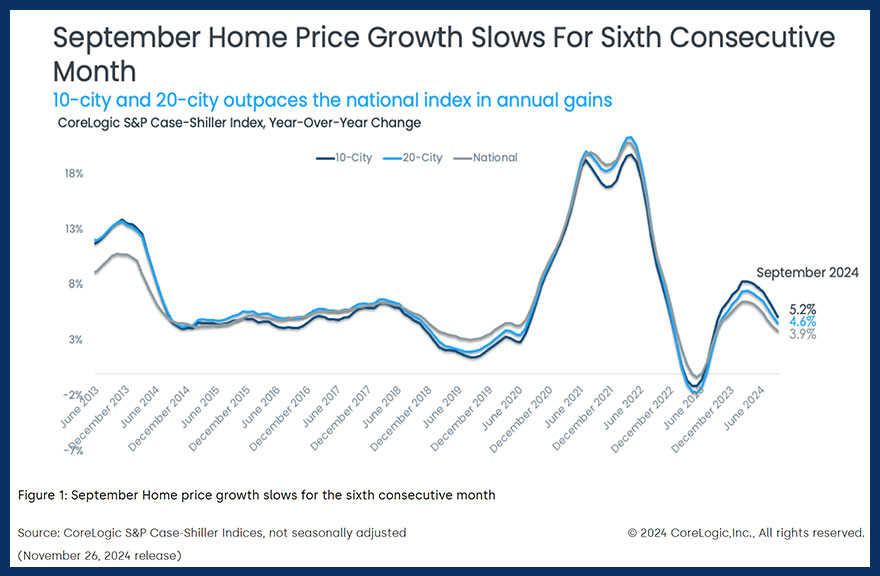
CoreLogic’s report shows that home price growth has indeed been slowing for six consecutive months. However, it’s crucial to understand what this actually means. We’re not seeing price drops across the board. In fact, home prices are still reaching new highs month after month. The 10-city and 20-city composite indexes have posted their 15th straight month of new peaks in September.
So why the concern? The growth rate is decelerating, a significant shift from the breakneck pace we’ve seen in recent years. To put this in perspective, let’s look at the September numbers.
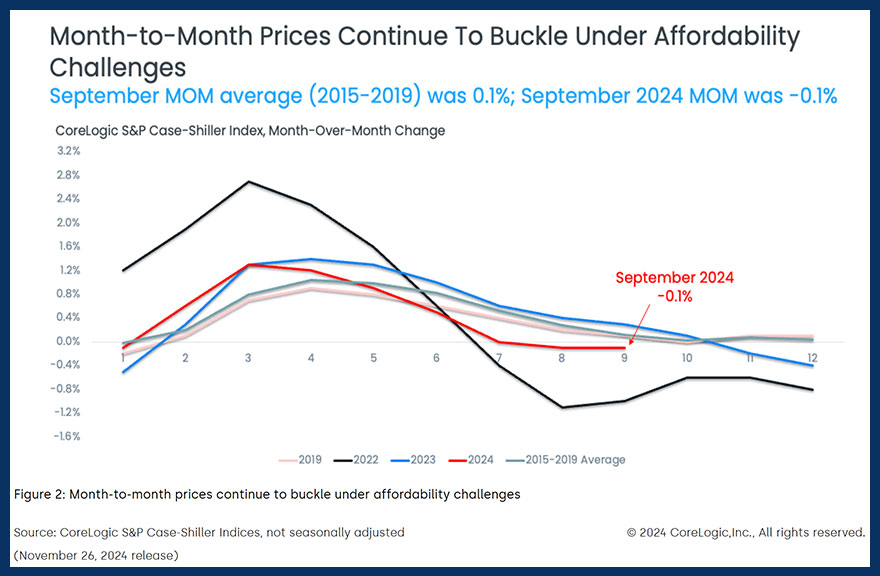
The non-seasonally adjusted, month-over-month index recorded a 0.1% decline. That might not sound like much, but it’s a stark contrast to what we typically see this time of year. Between 2015 and 2019, September usually saw an average increase of 0.12%.
This change in pattern is noteworthy. Historically, home prices tend to increase in the early fall. September 2023 bucked this trend, marking the first monthly decline since the summer of 2022. It’s a clear indicator that market dynamics are shifting.
But before we jump to conclusions, let’s look at what’s driving these numbers. There are several factors at play here. For one, changes to real estate agent fees took effect in August, which could be impacting higher median price markets. We’re also seeing the effects of what some are calling “inflation fatigue.” Homebuyers are grappling with the double whammy of rising prices and elevated mortgage rates, leading to a more cautious approach to purchasing.
It’s important to note that while nominal prices have increased significantly, the picture changes when we adjust for inflation. CoreLogic’s analysis reveals that inflation-adjusted prices haven’t appreciated as much as the headline numbers might suggest. Nationally, home prices are 19% higher than in 2006 when adjusted for inflation. However, the 10-city index is only 5% above its 2006 level when accounting for inflation.
This slowdown in home price growth is expected to continue into the middle of next year. But remember, this prediction likely assumes minimal changes in mortgage rates. If rates rise, we could see even more cooling in the market.
To understand the full picture, we need to zoom in on month-to-month changes. These short-term fluctuations can reveal trends that annual data might miss. Let’s take a closer look at how prices have been moving on a monthly basis and what it means for buyers and sellers in today’s market.
Keep Up With New Trends In Tallahassee!
Get The Tallahassee Real Estate Newsletter
 Don't be the one that doesn't know what's going on when you sell a home or buy a home in Tallahassee.
Other buyers, sellers, lenders, and real estate agents have this critical information, and now you can too!
Get immediate access to our most recent newsletter.
Let more than 30 years of experience work for you with charts, graphs, and analysis of the Tallahassee housing market.
Home Price Changes Varied Across Metro Areas
You’ve heard the phrase “location, location, location” in real estate. But have you ever wondered just how dramatically location can impact home prices, even in a cooling market? The latest data from CoreLogic exposes a stark divide between cities that’s reshaping the housing landscape.
While national trends give us a broad overview, it’s crucial to remember that real estate is fundamentally local. Supply and demand dynamics can vary significantly from one city to another, leading to vastly different outcomes in home prices. This September, we saw this principle in action as some markets diverged sharply from the national trend.
Let’s look at the numbers.

CoreLogic’s data reveals that only 3 out of 20 major metropolitan areas showed an acceleration in annual price growth from August to September. This is a clear indicator that most markets are experiencing a slowdown. However, those three outliers tell an interesting story about the factors driving local market resilience.
What’s behind these pockets of growth? Several factors come into play. Some areas may be benefiting from strong local economies or migration patterns that are boosting demand. Others might have limited housing supply, keeping prices elevated despite broader market pressures. It’s a complex interplay of local conditions that can lead to these divergent outcomes.
But it’s not just about the outliers. The data also shows significant variations in price movements across different markets. California cities like Los Angeles, San Diego, and San Francisco saw the largest month-over-month declines, each dropping by 0.9% in September. On the flip side, 13 metropolitan areas recorded weak monthly gains, with Cleveland and Phoenix leading the pack.
This bifurcation in the market is creating a challenging landscape for buyers and sellers alike. In some areas, particularly in the Midwest, we’re still seeing strong appreciation. Meanwhile, previously hot markets in California have cooled significantly. This divergence underscores the importance of understanding your local market conditions when making real estate decisions.
The housing market is clearly cooling off, but how does this compare to pre-pandemic trends? Let’s take a look.

CoreLogic’s analysis reveals that monthly gains are lagging behind pre-pandemic trends in most places. This is a significant shift from the frenzied market we saw in 2021 and early 2022.
Before the pandemic, we typically saw modest but steady price growth in most markets. Now, we’re seeing more volatility and regional variation. Some areas are still posting gains, but they’re smaller than what we saw in the years leading up to 2020. Other markets are experiencing outright declines, a stark contrast to the pre-pandemic norm.
To truly understand these market dynamics, we need to look at different price tiers. Not all segments of the housing market are reacting in the same way to current conditions. Let’s break down how low, medium, and high-end markets are faring in this changing landscape.








Housing Crash or Boom? Here’s What’s Coming in 2025

BIGGEST Housing Market Myth EXPOSED by New Foreclosure Data
Price Tier Tug-of-War: Low, Medium, and High-End Markets
Imagine the housing market as a three-way tug-of-war between low, medium, and high-end properties. Recent data reveals an unexpected shift in this delicate balance. The question is: which segment is pulling ahead, and why?
September’s data from CoreLogic shows some intriguing differences across these tiers.

Let’s break down the numbers. Medium-tier properties saw the largest decline, with prices falling by an average of 0.5%. Medium-tier homes weren’t far behind, dropping 0.4%. But here’s where it gets interesting: low-tier properties experienced the smallest decline at just 0.1%. This variation tells us that the market isn’t cooling uniformly across all price ranges.
So why are we seeing these differences? Several factors are at play. Affordability challenges are a key driver. In expensive markets like California, we’re seeing notable price declines across all tiers in major cities such as Los Angeles, San Diego, and San Francisco. The high costs in these areas are pushing buyers to more affordable options.
This trend isn’t limited to the West Coast. Cities like Atlanta, Chicago, Las Vegas, Washington D.C., and Miami are actually seeing upticks in prices for low-tier properties. Buyers seem to gravitate towards more affordable homes as costs rise across the board.
These price tier variations have significant implications for both buyers and sellers. If you’re in the market for a lower-priced home, you might face more competition and potentially higher prices in some areas. Conversely, sellers of median and high-end properties may need to adjust their expectations, as these segments are experiencing more pronounced cooling.
But to truly understand today’s market, we need to zoom out and look at the bigger picture. Here’s a startling fact: according to CoreLogic’s Home Price Index, home prices are now 51% higher than at the start of the pandemic. This massive jump isn’t just about real estate – it’s a reflection of broader inflationary pressures.

This inflation impact hasn’t been felt evenly across price tiers. It’s contributed to the shifting dynamics we’re seeing, pushing more buyers towards affordable options and cooling demand for higher-priced homes. The result is a market that’s more complex and nuanced than headline numbers might suggest.
Now, let’s put all these pieces together and look towards the future. With such significant changes happening across different price tiers and regions, what can we expect in the coming months? And more importantly, how might these trends affect your real estate decisions?





Fannie Mae Report: It's The TRUTH About The Housing Market

Real Estate Meltdown: Starter Homes at $1M in 233 Cities

Is the Housing Market Crashing? | Redfin April 2025 Update

Is This The CALM Before The CRASH? Volatility Rocks Housing

Warning Signs For Home Buyers And Sellers
Forecasting the Future: What’s Next for Home Prices?
Just when you thought you had a handle on the housing market’s twists and turns, along comes a forecast that could change everything. But here’s the million-dollar question: can we trust these predictions in such a volatile market? Let’s dive into CoreLogic’s crystal ball and separate fact from fiction.
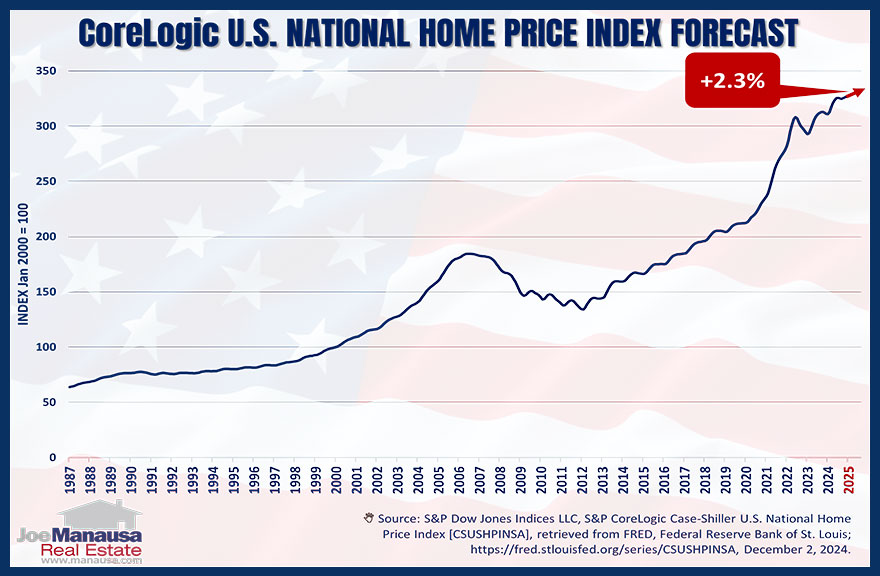
CoreLogic’s latest forecast suggests that home price gains will slow to 2.3% by next August. This projection might seem surprisingly optimistic given the recent cooling trends we’ve observed. It’s a far cry from the doom and gloom scenarios painted by some YouTube pundits who’ve been predicting a housing market crash.
But before we accept this forecast at face value, let’s consider the factors that could influence future price trends. The elevated mortgage rates we’re currently experiencing are likely to continue subduing home price appreciation. This stands in stark contrast to the stronger price gains we saw in previous years. The market is still adjusting to these economic pressures, and it’s causing buyers to think twice before making a move.
One crucial element to watch is the potential thawing of the lock-in effect. CoreLogic’s analysis suggests that the spring homebuying season in 2025 might see some changes. We could see an increase in for-sale inventories as homeowners who’ve been reluctant to sell due to their low mortgage rates finally decide to make a move. This influx of inventory could have a significant impact on home prices.
It’s also worth noting that inflation has been exceptionally high in the 2020s. Average prices are up 22% as of June 2024, surpassing the entire 2010s inflation rate of 20%. This inflationary pressure has had a substantial impact on housing costs and buyer sentiment. Some areas have experienced inflation rates as high as 30%, highlighting the regional disparities in economic conditions.
But what does this all mean for you? The key takeaway is that the housing market’s future is far from certain. While CoreLogic’s forecast provides a baseline expectation, it’s crucial to remember that housing market predictions are often subject to change based on unforeseen economic factors. Shifts in interest rates, changes in inflation, or unexpected economic events could all alter the trajectory of home prices.
As a potential buyer or seller, you’ll need to stay informed about your local market conditions. The data shows that housing price trends may diverge significantly across different metropolitan areas. What holds true for one city might not apply to another. This variability means that blanket statements about the housing market’s future are likely to be oversimplifications.
CoreLogic has been tracking home prices in selected markets for nearly 60 years, providing a wealth of historical data to inform their projections. However, if you want a more comprehensive view of the U.S. housing market, including data from a wider range of locations, be sure to check out our recent Zillow housing market update. It offers additional insights that can help you make more informed decisions in this complex and ever-changing real estate landscape.