
The Reality Behind Rising Mortgage Delinquencies
I must address something important floating around in the news lately. Yes, mortgage delinquencies are trending higher, but there’s a critical distinction most headlines completely miss when reporting these numbers.
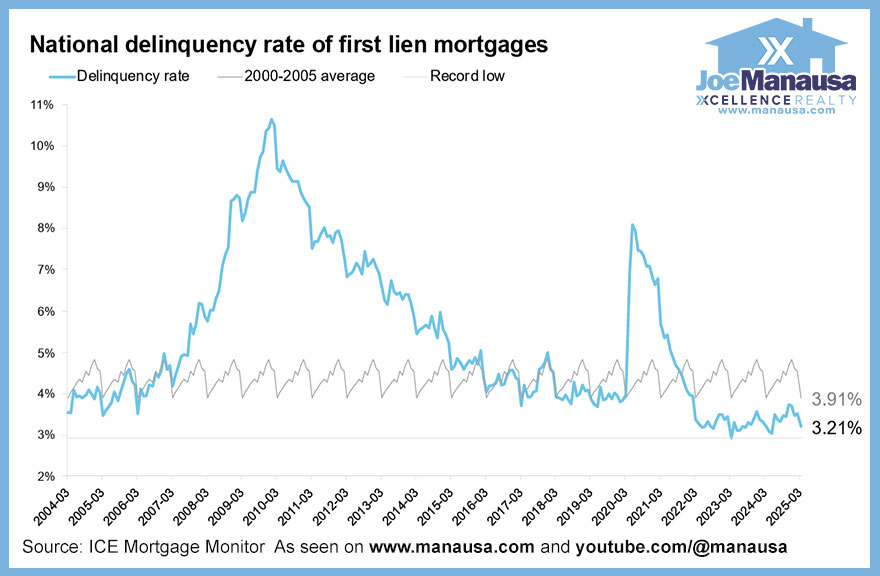
The latest ICE Mortgage Monitor shows that delinquency rates increased by 29 basis points above the RECORD LOW set in March 2023. Serious delinquencies have risen 14% since March 2024, representing about 60,000 more mortgages where borrowers are significantly behind on payments. The report also shows foreclosure starts are up 28% from last March.
These statistics might sound alarming, but they require context. Being delinquent on your mortgage simply means falling behind on payments, like a warning light on your car dashboard rather than an engine failure. It’s quite different from a foreclosure sale, which is the actual loss of your home.

This increase in delinquencies is concentrated almost entirely in FHA loans, which now make up nearly half of all serious delinquencies nationwide. This concentration reveals we’re seeing stress in a specific market segment rather than a broad mortgage crisis.
Let me use a concrete example to illustrate why this matters. Say you bought a house in 2019 for $300,000 with a conventional loan. Even if you’re struggling with payments today, that house is likely worth around $420,000 now. If you fall behind, you can sell the house, pay off your remaining mortgage (probably around $270,000), and walk away with cash instead of a foreclosure on your record.
This equity position creates multiple options that weren’t available during the 2008 housing crisis. Today, you can refinance, sell and downsize, or work with your lender on payment plans because they know you have that equity cushion.
The foreclosure increase we’re seeing is primarily coming from VA loans after their foreclosure moratorium expired. This represents a return to normal processing of loans that were already troubled, not a sudden wave of new problems. When we look at actual foreclosure sales – people actually losing their homes – the numbers continue at historically low levels. March volumes were up just 4% from last year, far below crisis levels.
The data confirms equity is making a difference. Among FHA loans where borrowers are three or more payments behind, only 22% are in active foreclosure, compared to 49% for privately securitized loans in the same delinquency status. This tells us most delinquent borrowers are finding alternatives to foreclosure.
FHA loans typically have lower down payment requirements, meaning these borrowers often start with less equity. The concentration of delinquencies in FHA loans supports the equity theory: borrowers with the least equity are struggling most.
This is why we’re not seeing a housing market collapse. When homeowners have options beyond foreclosure, the market remains stable. Banks aren’t desperate to dump properties at fire-sale prices because most struggling homeowners can sell conventionally if needed.
Rising delinquencies deserve attention, but understanding the relationship between delinquency, equity positions, and actual foreclosures shows why most homeowners remain protected even during temporary financial difficulties. Equity creates options, and what we’re seeing is financial stress in a specific segment of borrowers, buffered by equity gains most homeowners have experienced over the past five years.
Keep Up With New Trends In Tallahassee!
Get The Tallahassee Real Estate Newsletter
 Don't be the one that doesn't know what's going on when you sell a home or buy a home in Tallahassee.
Other buyers, sellers, lenders, and real estate agents have this critical information, and now you can too!
Get immediate access to our most recent newsletter.
Let more than 30 years of experience work for you with charts, graphs, and analysis of the Tallahassee housing market.
The Protective Shield: Low Inventory and Equity Positions
Here’s what makes today’s market fundamentally different from 2008: two protective factors that weren’t present during the last housing crisis and completely changed the game for homeowners.
This dual shield of persistently low inventory and fairly steady buyer demand creates a protective barrier for homeowners even in challenging times. Let’s examine how this works in practice.

The ICE report shows housing inventory has improved but still remains 20% below pre-pandemic levels. This creates a persistent shortage of homes that keeps prices from falling dramatically. We’re talking about hundreds of thousands of missing homes compared to what would be normal in a balanced market. Despite inventory improving, with new listings up 10% year-over-year in March, we’re still far below normal levels needed for a balanced market. At the current rate, we wouldn’t return to pre-pandemic inventory levels nationally until mid to late 2026 – over a year away.

This inventory shortage directly creates a floor under home prices. Even with cooling appreciation rates of just 1.9% in early April data, prices hold steady rather than crash. The ICE Home Price Index shows that single-family home prices were still up 2.1% year-over-year, though condos saw a slight decline of 0.4%, the first annual decline since 2012. When prices remain stable, homeowners maintain and grow their equity positions.
The second factor protecting the market is steady buyer demand. First-time homebuyers now make up a record 58% of agency purchase loans. Nearly 6 out of 10 mortgages are going to first-time buyers, showing remarkably strong demand despite affordability challenges. Generation Z is entering the market in force, accounting for 15% of all mortgaged purchases and 25% of first-time homebuyer purchases. These younger buyers are finding ways to overcome the hurdles, although they’re having a harder time in high-cost areas like California and the Northeast.
When these two factors combine – low supply and steady demand – they prevent the price collapse needed for a foreclosure crisis to develop. For a foreclosure wave to crash the housing market, we would need both a surge in distressed homeowners AND falling home values that put those owners underwater on their mortgages.
Consider this real-world example: A homeowner in Phoenix bought a house in 2020 for $350,000 and now faces financial hardship. In a normal market, they might struggle to sell quickly and could face foreclosure. But in today’s low-inventory environment, that same house might be worth $430,000 and could sell within weeks. Even after paying a real estate commission, they’d walk away with money rather than a foreclosure on their record.
This is how record-low housing inventory protects the market – it maintains home values above mortgage balances, preserving equity even as price growth cools. When distressed homeowners can sell quickly in a supply-constrained market, foreclosures remain the exception.
To be clear, foreclosures are happening, particularly in FHA loans, which we discussed earlier. But the critical mass needed for a foreclosure crisis simply isn’t present today. Moreover, we are just above an all-time low in foreclosure sales, so reports telling you to prepare for a foreclosure crisis are not based on real data.
For a widespread foreclosure crisis, three things must happen simultaneously: many homeowners facing financial hardship, those same homeowners having no equity, and a slow-selling market. Currently, only the first condition exists for a small subset of homeowners, while equity positions and the quick-selling market work in their favor.
This is why, despite concerning rises in delinquencies, we’re not headed for a repeat of 2008. Today’s market structure provides significantly more protection for homeowners, even those facing financial difficulties.







Housing Crash or Boom? Here’s What’s Coming in 2025