Tallahassee Foreclosure Listings






Overview Of Mortgage Performance
What if I told you that foreclosures are actually 34% below pre-pandemic levels? With all the talk about the housing market’s troubles, you might expect foreclosures to be skyrocketing. But that’s not the case at all. Let’s dive into what’s really happening with mortgage performance.

Loans 90+ days past due hit a 16-month high, but remain historically low nonetheless. The number of loans in active foreclosure is still 34% below pre-pandemic levels, confirming that people who are falling behind on their mortgage payments are able to sell the homes, and pocket some equity after repaying their loans. This is the fact that most fearmongers either don’t understand or do not want to report, that foreclosure starts today are not making it to a foreclosure sale. Finally, another sign of market strength is that prepayment activity continued to pick up, rising +43% from last September.





Fannie Mae Report: It's The TRUTH About The Housing Market

Real Estate Meltdown: Starter Homes at $1M in 233 Cities

Is the Housing Market Crashing? | Redfin April 2025 Update

Is This The CALM Before The CRASH? Volatility Rocks Housing

Warning Signs For Home Buyers And Sellers
National Delinquency Rate Of First Lien Mortgages
So how many people are missing mortgage payments?

In September, the national delinquency rate hit 3.48%, up 5.7% compared to last year. This marks the fourth consecutive month of increase. Serious delinquencies – loans 90 or more days past due but not in foreclosure – are also up. We’re seeing a 5.9% increase, bringing them to the highest level since May 2023. On the surface, this might sound concerning.
You might think rising delinquencies automatically lead to more foreclosures. It’s a logical assumption – if more people are behind on payments, more people must be losing their homes, right? But here’s the surprising truth. Despite these increases, delinquency rates are still 24% lower than the averages from 2000 to 2005. Even with this “bad news,” we’re performing significantly better than what was normal before the 2008 housing crisis.
There’s more good news in the data. While we’re seeing more loans becoming past due, the overall health of the mortgage market remains strong. Prepayment activity – often a sign of a robust housing market – is up 43% from last year.
So what does this mean? We’re not heading for the cliff that some people want you to believe. Yes, home affordability is a major crisis. More people are struggling with mortgage payments. But that does not have to mean foreclosures are around the corner.
Now, you might be wondering why these delinquent homeowners aren’t losing their homes. Even with rising delinquencies, we’re not seeing a corresponding spike in foreclosures. The reason? It all comes back to those numbers I mentioned at the start. But let’s not get ahead of ourselves…
Keep Up With New Trends In Tallahassee!
Get The Tallahassee Real Estate Newsletter
 Don't be the one that doesn't know what's going on when you sell a home or buy a home in Tallahassee.
Other buyers, sellers, lenders, and real estate agents have this critical information, and now you can too!
Get immediate access to our most recent newsletter.
Let more than 30 years of experience work for you with charts, graphs, and analysis of the Tallahassee housing market.
Interest Rates Forecast
Let’s examine recent interest rate trends and see what ICE believes about where rates are heading.

Forecasting mortgage interest rates rarely is successful over the long run, but ICE provides an update on recent interest rate trends and how they are affecting lending and origination metrics. Ice reports that after rates eased in September and the Fed cut its benchmark federal funds rate by a half a percent, positive economic and labor market news injected uncertainty for the Fed’s future rate path, driving rates sharply higher. The 10-year Treasury rebounded, after falling as low as 3.62%, to reach 4.27% on Oct. 28.
According to the ICE U.S. Conforming 30-year Fixed Mortgage Rate Lock Index, mortgage rates also bounced up to 6.71% on Oct. 28 from their 18-month low on Sept. 16. I can tell you that it had an immediate impact in local markets, causing many buyers to push the pause button.
Composite forecasts for mortgage rates (from the MBA and Fannie Mae) have yet to fully adjust but are now projecting 6.10% for the end of 2024 and 5.70% for the end of 2025. I’m not so optimistic.
ICE also shifted it’s forecast upward, as of Oct. 28, with the average rate implied to reach near 6.6% by March 2025 (up from their last month’s projection of 5.9%).
If you are waiting to buy a home hoping for rates to drop further, you might consider buying now to lock in a lower home price. Many new loans offer a free, one-time opportunity to lower your rate, so if rates do come down, you get the lower rate and the lower home price.







Housing Crash or Boom? Here’s What’s Coming in 2025

BIGGEST Housing Market Myth EXPOSED by New Foreclosure Data
Home Affordability Update
The latest jump in 30-year rates has halted recent improvements in home affordability.

After affordability hit its best level since early 2023 in September, rising rates have pulled some of that improvement back out of the market.
You might think you know what it takes to buy a home, but the numbers tell a different tale. What if I told you that the American Dream is slipping away for the average family? The truth about home affordability today might surprise you – and it’s not just about interest rates.
Let’s talk about something called the national payment-to-income ratio. It’s a fancy term that basically tells us how much of your paycheck you need to fork over each month to afford the average home. And right now? That number is through the roof.
Here’s the deal: As of October, if you wanted to buy the average-priced home in America, you’d need to shell out $2,317 every single month just for your mortgage payment. That’s not including property taxes, insurance, or any of the other costs that come with owning a home. Now, $2,317 might not sound too bad if you’re pulling in a six-figure salary. But here’s the kicker – that payment eats up a whopping 34.3% of the median household income.
Let that sink in for a moment. One-third of your income, gone before you even think about groceries, utilities, or heaven forbid, a night out. And it gets worse. This 34.3% is nearly 10% higher than what Americans have been paying, on average, for the past 30 years. We’re not just talking about a little bump in costs – this is a seismic shift in home affordability.
No wonder we’re seeing a pullback in demand for home purchases. After a brief glimmer of hope when mortgage rates dipped, we’re right back where we started.
Purchase applications have plummeted to levels we haven’t seen since mid-August. People are looking at these numbers and thinking, “Maybe now’s not the time to buy.”
But here’s the crucial detail that most reports are missing, the piece of the puzzle that really brings home the affordability crisis we’re facing: The median-income family can no longer afford the median-priced home. Full stop. This isn’t just a temporary blip or a minor inconvenience. We’re talking about a fundamental shift in who can and can’t buy a home in America.
Why is this happening? Well, it’s not just about rising home prices or interest rates. Builders aren’t producing affordable homes like they used to. Instead, they’re focusing on higher-end properties that only wealthier families can afford. And what about everyone else? They’re being pushed into the rental market, where rents have skyrocketed over the past four years.
This shift is changing the entire landscape of homeownership. We’re looking at a future where owning a home might become a luxury rather than a standard part of the American Dream.

The Best Time To Lower The Price In A Home Sale

Want to Sell Your Home Quickly and Profitably? Watch This Now

Time-Lapse Tree Removal!

What Does A Realtor Earn?

How To Sell Your House When You Are In A Hurry

Do's And Don'ts During The Home Loan Process

7 Tips On Buying A Home With A Pool

How much house can you actually afford (By Income)?

What Sellers Need To Know About Robo-Offers In Real Estate
For Sale Inventory
ICE provides a great image of the latest trends in for-sale inventory nationwide.
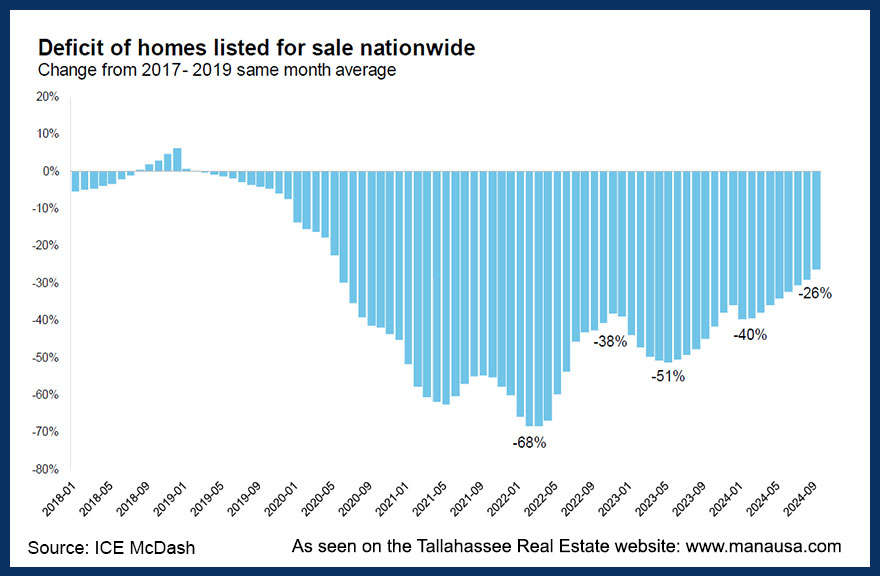
The number of homes listed for sale improved for the eighth consecutive month in September on a seasonally adjusted basis, with active inventory up 3.5% in the month and up 34% from the same time last year. There were 26% fewer homes listed for sale in September than in the average September from 2017-2019 leading up to the pandemic, marking the shallowest such inventory deficit since mid 2020.
While modest purchase demand has been allowing inventories to grow, there was a sharp return of sellers to the market in September as well. Nationally, 400K homes were listed in the month, roughly 12% below the September average from 2017-2019. That 12% deficit is the most minor such shortage since July 2022 and half the deficit of one month prior. ICE reports that it’s too early to tell if that was a signal of rates getting low enough to ease rate lock-in pressures, or if September was an anomaly, but it’s a trend worth watching closely in coming months.

This graph shows the deficit of new listings entering the market. ICE reports that roughly three in four markets have seen improvements in the number of homes coming up for sale in the third quarter compared to the second quarter, but noticeable deficits remain, especially in California and parts of the Northeast.
In September, 13% of markets were back to ‘normal’ levels (up from 9% in the second quarter), with another 24% within 10% of long run averages (more than twice the share seen in the second quarter). Only 1 in 5 markets had deficits of new listings of more than 25% in September, down from nearly half of all markets on average in the second quarter.

When looking at the third quarter as a whole, a handful of Sunbelt markets saw a surplus of new listings in the quarter, compared with pre-pandemic averages, led by Lakeland, Fla., Nashville, Tenn., McAllen, Texas, and Cape Coral, Fla.
The most significant deficits were in California, with Sacramento, Fresno, San Diego, and Oxnard all having 35%+ fewer new listings than they would typically see this time of year.

Buy Now Or Wait? The 91.6% Rule

Biased Results? The New York Times Rent Or Buy Calculator
Do's And Don'ts During The Home Loan Process

6 Real Estate Contract Terms You Should Not Overlook
7 Tips On Buying A Home With A Pool
How much house can you actually afford (By Income)?

What Does "Marry The House Date The Rate" Mean In Real Estate?

Why Fixer Uppers Are the New Gold | Home Renovation Guide

8 Tips For Buying An Affordable Florida Vacation Home
ICE Home Price Index
ICE tracks US home prices with a tool it calls the ICE Home Price Index.

Annual home price growth cooled for the seventh consecutive month to +2.9% in September, from a revised +3.0% in August and +6.2% back in February. On a seasonally adjusted basis, prices rose by 0.14% in the month (equivalent to a seasonally adjusted annualized rate of 1.72%), a modest uptick from August.
While the market remains cool, annual home price growth rates – which have been slowing since February – could flatten, or even tick up slightly, over the year’s final three months.
Softer price growth late last year – when mortgage rates climbed above 7.5% – provides a lower starting point for year-over-year comparisons, which will give a modest boost to annual growth rates in this year’s final quarter, despite current monthly gains running below their backward-looking 12-month average.



How To Sell Your House On Your Own

10 PROVEN Strategies To Increase A Home's Selling Profit
2025s HOTTEST Home Selling Strategies You Need NOW

The 3-DAY Method To Sell Your Home For More (2025)
The Best Time To Lower The Price In A Home Sale

How FOMO Makes Your Home Sale More Profitable

Home Sale Sabotage: Top 10 Mistakes Sellers Make
Debt Versus Equity In The US Housing Market
One great way to forecast the start of a foreclosure crisis is with a study of the overall debt versus equity in the US housing market. If the debt level is rising and the equity level is not keeping pace or falling, you can expect that more foreclosure starts will make it to a foreclosure sale, as homeowners have no means to repay their debt.

Imagine having a $200,000 safety net. That’s the reality for many homeowners today. It’s not a fantasy or a far-off dream – it’s cold, hard equity. And it’s this equity that’s acting as a powerful shield against foreclosures, even as delinquency rates climb.
Now, you might be wondering how this works. Home equity is essentially the difference between what your home is worth and what you owe on your mortgage. It’s like a piggy bank that grows as you pay down your mortgage and as your home’s value increases. And right now, that piggy bank is overflowing for millions of Americans.
Here’s where things get really interesting. We’re seeing high delinquency rates, but foreclosures aren’t following suit. Why? Because homeowners are sitting on a mountain of equity. We’re talking about a staggering $17.2 trillion in total homeowner equity across the country. That’s trillion with a ‘T’. It’s a number so large it’s hard to wrap your head around.
But wait, there’s more. Out of that $17.2 trillion, about $11.2 trillion is what we call ‘tappable equity’. This is the amount homeowners could potentially access while still maintaining 20% equity in their homes. It’s like a massive rainy day fund that’s built into the very walls of your house.

Equity growth has begun to moderate along with broader home prices in recent months, but that’s still the largest volume of equity we’ve seen on record, adjusting for seasonality.
Now, you might be thinking, “That’s great for the country as a whole, but what does it mean for me?” Well, let’s break it down to the individual level. The average homeowner today has about $319,000 in equity. And of that, $207,000 is tappable. That’s over $200,000 that could potentially be used if needed.
This equity is changing the game when it comes to foreclosures. In the past, if a homeowner fell behind on payments, foreclosure might have been the only option. But today, with so much equity, there are other choices. Homeowners can sell their homes, pay off their mortgages, and still walk away with a substantial amount of cash. It’s a get-out-of-jail-free card that’s keeping foreclosure rates low despite rising delinquencies.
And it’s not just about avoiding foreclosure. This equity is providing a strong buffer against market fluctuations. The current debt-to-equity ratio on mortgaged properties is at an all-time low of 45%. In simple terms, this means homeowners own more of their homes outright than ever before. It’s a position of strength that’s helping to keep the housing market stable.

How To Get 20% Or More With Leveraged Real Estate
8 Tips For Buying An Affordable Florida Vacation Home

Should you sell your home or rent it out?

Is turning your college student into a homeowner a wise investment or a financial faux pas?

6 Real Estate Investing Lessons from the 2008 Housing Bubble

How To Avoid Common Legal Issues When Buying Or Selling A Home

Should You Buy A House For Your Child?

How To Use Price Per Square Foot When Valuing A Home

Is Home Ownership A Hedge Against Inflation?
Home Equity Lines Of Credit
Homeowners are sitting on more equity than ever before. It’s still sitting there, untouched. But here’s the twist: the key to unlocking it might be changing right before our eyes. Let’s take a closer look at why this treasure trove has remained sealed – and how that might be about to change.

We’re talking about Home Equity Lines of Credit, or HELOCs. These are financial tools that let homeowners borrow against the equity in their homes. With all the equity we’ve seen building up, you’d think HELOCs would be incredibly popular right now. But they’re not. In fact, homeowners are using them less than half as much as they have over the past decade. That means we would normally see $476 Billion more dollars in the US economy than we see right now.
So what’s going on? Why aren’t people tapping into this massive pool of wealth? The answer, as it often does in real estate, comes down to interest rates. Recent HELOC rates have been sky-high, topping out at 9.5%. That’s a tough pill to swallow for many homeowners.
Let me break it down for you with some real numbers.
Back in March 2022, if you took out a $50,000 HELOC, your monthly payment would have been about $167. Fast forward to January 2024, and that same $50,000 withdrawal would cost you $413 a month. That’s more than double! No wonder people have been hesitant to use their HELOCs.
But here’s where things get interesting. The tide might be turning. The Federal Reserve has recently made some cuts to short-term interest rates. This is big news for HELOC holders because these lines of credit are often tied to the prime rate, which follows the Fed’s lead.
So what does this mean for the future? Well, some experts are projecting that HELOC rates could drop to the low 7% range by the end of 2025. That’s a significant decrease from where we are now. If these projections hold true, that $50,000 HELOC withdrawal we talked about earlier? Its monthly payment could fall below $300.
Now, don’t get me wrong – $300 is still higher than what we’ve seen historically. But it’s a lot more manageable than $413. And it could be enough to convince many homeowners to start using their HELOCs again.
This potential shift in HELOC rates could have far-reaching effects. Imagine being able to use your home’s equity for major purchases, like buying a car, at a much more affordable rate. And remember, the interest on HELOCs can often be tax-deductible, making them an even more attractive option for many homeowners.