The Million Dollar Starter Home Crisis
Looking at the geographic distribution of these million-dollar starter homes reveals a fascinating pattern.
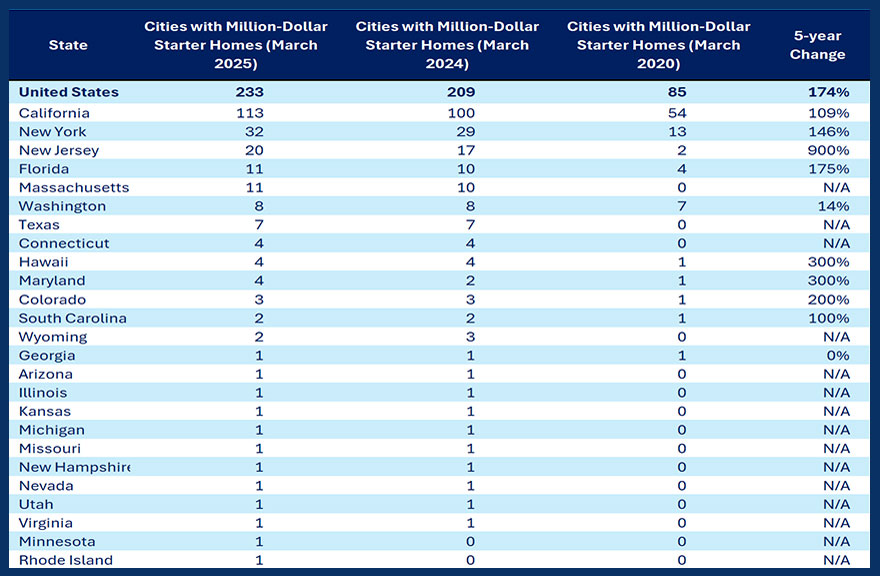
Overall, in the US, the number of cities with million-dollar starter homes has increased by 174% over the past five years. California, with 113 (which is 57% of these cities), has grown by 109%, New York is up by 146%, and New Jersey has increased by 900%! Florida is up 175%, with 20 cities where typical starter homes exceed the million-dollar threshold.
We’re witnessing a fundamental reshaping of the entry-level housing landscape across America. Markets once considered affordable alternatives to expensive coastal cities are becoming exclusionary to first-time buyers. The migration patterns triggered by remote work and chronic underbuilding have created price pressure in previously attainable markets.
The problem extends beyond the coasts. Even in the heartland, starter home prices have soared beyond historical norms. This geographical expansion of unaffordability represents a concerning aspect of the current market – there are fewer refuge cities where middle-income Americans can reasonably expect to purchase their first home.
This spread in unaffordability not only reshapes our map of entry-level housing but also influences buyer confidence, as seen in March’s housing data.

Existing home sales declined 2.4% year-over-year despite mortgage rates being lower than many analysts had anticipated earlier in the spring. This downturn contradicts conventional market wisdom, suggesting that buyer activity should increase when financing costs decrease.
We’re observing what economists call a “sticky market” – one where theoretical drivers of activity don’t produce their expected results. The median existing-home sales price in March was $403,700, a 2.7% increase from the previous year. This price growth, modest by recent standards but still outpacing wage increases, continues to strain affordability for potential buyers.
The cooling market has led to an accumulation of inventory as homeowners seeking premium prices encounter increasingly resistant buyers. This growing inventory should give buyers more leverage, but we’re not seeing widespread price adjustments that would improve affordability.
Many potential buyers are sitting on the sidelines, watching inventory accumulate while waiting for more substantial price corrections. This creates a market standoff. Sellers who purchased or refinanced during the ultra-low rate environment of 2020-2021 are reluctant to sell at discounted prices, especially when doing so would mean trading their 3% mortgage for one that is at least twice as high. Meanwhile, buyers are unwilling to stretch their budgets further for homes they perceive as overvalued.
Market analysts suggest that unless sellers adjust their pricing expectations or mortgage rates decline more substantially, we can expect “choppy, sideways movement” through the spring season. This pattern of hesitation creates market paralysis, where even positive developments like slightly lower rates fail to stimulate activity.
Keep Up With New Trends In Tallahassee!
Get The Tallahassee Real Estate Newsletter
 Don't be the one that doesn't know what's going on when you sell a home or buy a home in Tallahassee.
Other buyers, sellers, lenders, and real estate agents have this critical information, and now you can too!
Get immediate access to our most recent newsletter.
Let more than 30 years of experience work for you with charts, graphs, and analysis of the Tallahassee housing market.
Zillow’s Market Forecast Reversal
That affordability paradox we’ve been examining has taken a dramatic turn, as Zillow just delivered their most significant forecast revision in years.
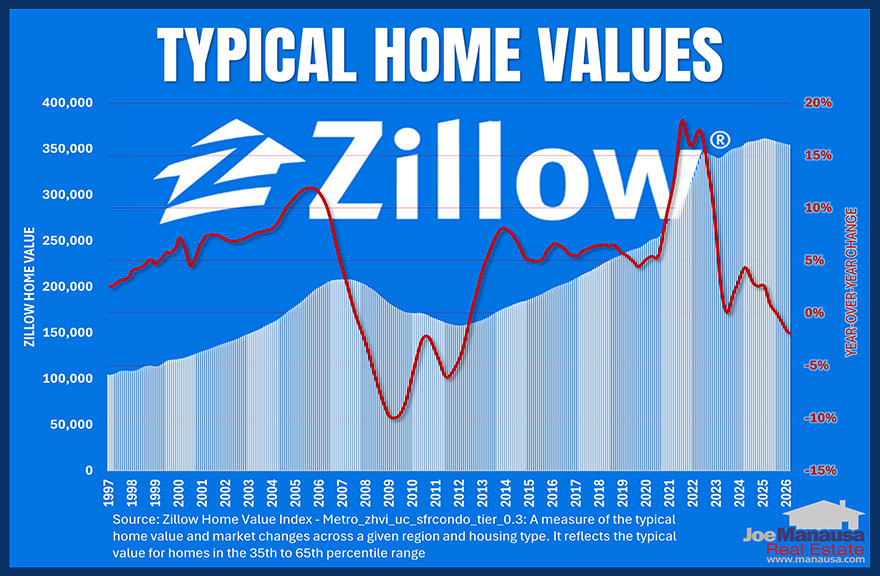
After consistently predicting continued appreciation throughout the past year, they’ve completely reversed course, now projecting home values to decline by 1.9% in 2025 – the first time they’ve forecasted falling prices since the pandemic began. This substantial shift from their previous 0.6% growth projection signals a potential inflection point in the market that deserves closer examination.

Zillow’s new forecast simultaneously predicts a 3.3% increase in existing home sales for 2025, reaching approximately 4.2 million transactions. This combination of projections suggests we’re experiencing a market adjustment rather than a collapse – likely a necessary recalibration after years of unsustainable price appreciation combined with the interest rate shock of the past two years.
The primary catalyst behind this forecast revision is the accelerating growth in housing inventory, which has surged 23% compared to last year. This expanding selection of homes is fundamentally altering market dynamics by giving buyers something they haven’t had in years – options and negotiating power.
As inventory grows and homes linger on the market longer, we’re witnessing the first signs of meaningful price competition among sellers. The days of multiple offers within hours of listing are fading in many markets, replaced by a more measured approach where buyers can actually take time to consider their options. This shift in leverage is exactly what Zillow’s analysts are responding to with their revised forecast.
The contrast between price and volume projections reveals something important about Zillow’s analysis. They expect modest price concessions from sellers to unlock pent-up demand, creating a more active market with slightly lower valuations. This is evident in their forecast that mortgage rates will settle near 6.5% by year-end – not a dramatic drop, but enough stability to allow buyers to adjust expectations and move forward with purchases. This mortgage rate projection is key to their changed forecast, as they previously anticipated rates would drop to 6% or below.
For sellers who have been holding out for peak pricing, Zillow’s revised forecast represents an important wake-up call. The data increasingly suggests that their leverage is eroding as inventory grows and buyers gain alternatives. The markets seeing the most significant price adjustments are those where new listings are increasing fastest relative to sales pace.
This forecast doesn’t indicate a housing crash – the 1.9% projected decline represents a minor correction in the context of massive recent appreciation. However, it clearly signals that the market has reached a turning point where observable changes in inventory and buyer behavior directly influence major forecasts and market expectations.





Fannie Mae Report: It's The TRUTH About The Housing Market

Real Estate Meltdown: Starter Homes at $1M in 233 Cities

Is the Housing Market Crashing? | Redfin April 2025 Update

Is This The CALM Before The CRASH? Volatility Rocks Housing

Warning Signs For Home Buyers And Sellers
The Rental Market and New Construction Paradox
As the market correction unfolds, a surprising divergence emerges between two traditionally synchronized segments. New construction surges while existing home sales continue downward, revealing a fundamental shift in how different real estate sectors respond to today’s challenging conditions.
The affordability crisis extends well beyond the purchase market. According to Zillow’s April 2025 forecast, renters will continue facing upward pressure on housing costs, though with interesting nuances.

Single-family rental homes are projected to see a 3.1% increase in 2025, while apartment rents are expected to rise at a slower 2.1% pace. Both figures represent a moderation compared to historical standards, suggesting some cooling in rental appreciation.
The gap between these two rental categories is narrowing. Historically, wider disparities existed between single-family and multifamily rent growth, but evolving construction patterns are changing this dynamic. The data points to a slowdown in apartment building while single-family home development gains momentum – a shift reshaping rental market dynamics.
This construction pattern adjustment creates a remarkable dichotomy in the for-sale market that few analysts predicted.

March 2025 new home sales completely bucked the broader market trend, jumping to 724,000 units on a seasonally adjusted annual rate – a substantial 7.4% leap from February’s revised rate of 674,000.
The year-over-year comparison is equally telling, with new construction sales sitting 6.0% above March 2024 levels according to the U.S. Census Bureau. This robust performance contrasts sharply with the trajectory in existing homes, highlighting a fundamental split in the market.
Builders have recognized the opportunity and are strategically positioning themselves through pricing adjustments. The median price of newly constructed homes sold in March was $403,600 – a significant 7.5% reduction compared to last year. This price correction creates relative value opportunities in new homes that aren’t materializing in the existing home market.
There is an 8.3-month supply of new houses for sale, down from 8.9 months in February but barely higher than the 8.2 months in March 2024.
The builder community employs multiple strategies beyond headline price cuts. According to the National Association of Home Builders, 29% of builders reduced prices in March, up from 24% during the same month last year. The average price reduction remained at approximately 5%, while nearly 59% of builders offered some sales incentive.
This divergence in market responses underscores a more profound shift in how supply and demand evolve in today’s real estate landscape. While individual homeowners remain resistant to significant price adjustments – many still anchored to peak valuations of recent years – professional builders respond more pragmatically to market conditions.
This contrast resembles the difference between a nimble business that adjusts its pricing strategy to maintain cash flow versus individuals who can afford to wait out market fluctuations. With their business models requiring ongoing sales velocity, builders are adapting rapidly. Individual homeowners, many still enjoying historically low mortgage rates, can afford to wait rather than adjust prices downward.







Housing Crash or Boom? Here’s What’s Coming in 2025

BIGGEST Housing Market Myth EXPOSED by New Foreclosure Data
Declining Volatility?
Now, let’s turn our attention to the daily mortgage rate volatility impacting homebuyers nationwide.

During the first 100 days of the Trump Administration, rate fluctuations were increasingly driven by tariff headlines rather than underlying economic fundamentals.

Now that the President seems to be retreating on his tariff stance, we might see the volatility fade, potentially easing the long-term affordability crisis.
An in-depth look at Redfin’s recent forecast reveals additional nuances not covered by Zillow. Their analysis suggests different market trajectories that could affect your buying decisions. Check out my recent Redfin housing market update to understand these contrasting predictions.