
Let’s start by diving into a question on everyone’s mind: Is the housing market really about to crash? You’ve probably heard these doom-and-gloom predictions all over social media, but I’m here to tell you why they’re missing the mark. Let’s look at some hard data that paints a very different picture.
Unemployment Creates Mortgage Defaults
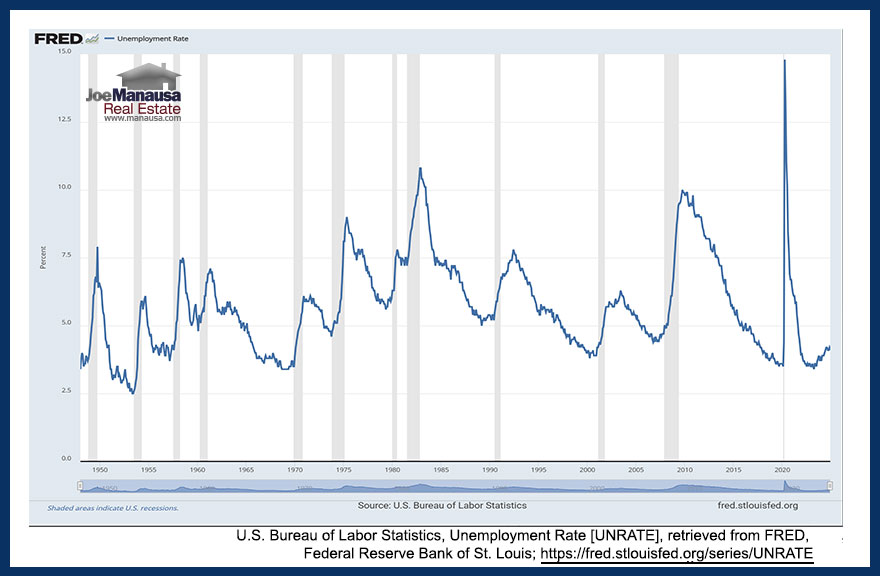
First, we must discuss the economy’s role in home prices. The unemployment rate tells us more about home prices than you might think. Right now, we’re sitting at a 4.1% unemployment rate. This is slightly higher than the rate one year ago but significantly lower than the long-term average of 5.68%. That’s a substantial number, and it has big implications for the housing market.
Think of the housing market as a garden. Low unemployment is like good soil – it provides the foundation for healthy growth. When people have jobs, they can afford to water their gardens (make mortgage payments) and even plant new seeds (buy homes). Let me show you a graph that tracks unemployment over time. Do you notice any patterns? When unemployment is low, like it now, it typically means we’ve got a strong economy. And a strong economy usually supports stable or rising home prices.
When people have jobs, they have money. When they have money, they can continue making mortgage payments to avoid losing their homes. This job security also increases consumer confidence, making people more likely to make big purchases like buying a home.
Now, some economists argue that other factors like interest rates and economic policies also affect housing prices. They’re not wrong – these factors do play a role. But even when you factor in these other elements, a strong job market is still a powerful indicator of a healthy housing market.
So what does all this mean for you? If you’re thinking about buying or selling a home, don’t let those crash predictions scare you off. The current low unemployment rate suggests a thriving economy, which historically supports stable or rising home prices. It’s not a guarantee, but it’s a pretty good sign.
But here’s where it gets really interesting. The unemployment rate is just one piece of the puzzle. There’s another crucial indicator that crash predictors often overlook – mortgage delinquencies. And when you see this data, you’ll wonder why the crash pros never address it.
Get Our Free Market Update
Other buyers, sellers, lenders, and real estate agents have this critical information, and now you can too!
Get immediate access to our most recent newsletter.
Let more than 30 years of experience work for you with charts, graphs, and analysis of the Tallahassee housing market.
Each Monday morning we send out a simple, one-page report that provides a snapshot of the Tallahassee housing market. It only takes 2 minutes to read, but it gives you better market intelligence than most real estate agents possess. Just tell us where to send it below!
Mortgage delinquency rates are the real crystal ball for predicting housing market crashes. These rates tell us a different story than what doom-and-gloom predictors want you to believe. Currently, U.S. mortgage delinquency rates are near historic lows, around 3%, compared to over 10% before the 2008 crash. This is crucial because delinquencies often lead to foreclosures, flooding the market with homes and driving prices down.
Mortgage Delinquencies Are Near All-Time Lows

Look at a graph of U.S. mortgage delinquency rates over time. It shows the percentage of mortgage holders behind on payments. Notice the big spikes before major market shifts? It’s like a warning signal flashing red. But today’s rate isn’t flashing a warning – it’s near an all-time low. This suggests we’re unlikely to see a wave of foreclosures anytime soon. And without foreclosures, it’s hard to have a housing market crash.
Now, you might be thinking, “What about rising interest rates? Won’t that cause a crash?” It’s a fair question, but here’s the thing – both high rates and lower prices can exist without a crash if mortgage delinquencies stay low. It’s about homeowners’ ability to keep paying their mortgages.
Let’s put this in perspective. Before the 2008 crash, mortgage delinquencies were skyrocketing. Today, they’re at historic lows. This fact is often overlooked by those predicting a crash. If people consistently make mortgage payments, even in a tough economy, they’re not being forced to sell their homes. Without a flood of homes hitting the market, we don’t see the rapid price drops typical in a crash scenario.
The housing market isn’t perfect. We’ve got challenges, no doubt. But a crash? The data doesn’t support it. We’re seeing a market adjusting, finding its new normal after the past few years. Many “crash pros” focus on alarming headlines rather than accurate, data-driven analysis. They often ignore the crucial role of mortgage delinquencies in market stability.
So, next time you hear crash predictions, ask about mortgage delinquency rates. The truth is in the data, and it’s telling us a very different story than the doomsayers would have you believe.





Housing Crash or Boom? Here’s What’s Coming in 2025
BIGGEST Housing Market Myth EXPOSED by New Foreclosure Data
Have you ever wondered what 60 years of home price data can tell us about the housing market? Let’s take a deep dive into this fascinating information.

Looking at the long-term trends, we see that significant price drops are rare. In fact, over the past six decades, there have only been a handful of periods where median home prices declined noticeably.
But here’s where it gets interesting: these drops almost always coincide with economic recessions. Take the 2007-2009 housing crash, for example. During this period, which overlapped with the Great Recession, median home prices fell by about 20%. That’s a substantial hit, but it’s important to note that it’s an outlier in the grand scheme of things.
Now, you might think, “Wait a minute, aren’t home prices just going up because of inflation?” That’s a great question. While inflation does play a role in the upward trend we see over time, home prices have generally increased over the long term.
Looking at the overall trend, home prices tend to rise over time, with those drops being the exception rather than the rule. The 60-year data shows that home values typically recover and continue climbing after economic challenges.
But here’s the thing: we’re in a very different situation now than previous market cycles. The doomsayers predicting another major crash and the eternal optimists saying prices will skyrocket forever might be off the mark. Why? Because while home prices have indeed been high, we’re not seeing the same red flags we did before previous crashes.
Remember those low mortgage delinquency rates I mentioned earlier? That’s just part of the puzzle. We don’t know how factors like remote work and changing demographics might reshape housing demand in ways we’ve never seen before. We’re in uncharted territory, with the market adjusting and finding its new normal after the craziness of the past few years.
So, when we look at past housing market behavior, are we really comparing apples to apples? The truth is, the data just doesn’t support predictions of a crash. But it also doesn’t suggest we’re heading for another period of runaway price growth unless interest rates plummet below 5%. We’re in a period of adjustment, and only time will tell how it all shakes out.



Fannie Mae Report: It's The TRUTH About The Housing Market

Real Estate Meltdown: Starter Homes at $1M in 233 Cities

Is the Housing Market Crashing? | Redfin April 2025 Update

Is This The CALM Before The CRASH? Volatility Rocks Housing

Warning Signs For Home Buyers And Sellers
Let’s dive into some surprising statistics that matter. Out of the past 61 years, there were only 12 years where home prices declined. Even more shocking? In five of those years, the decline was a mere 1% or less. This is crucial information many so-called experts ignore when making doom-and-gloom predictions.
The Truth Behind US Home Prices
Let’s dive into some surprising statistics that really matter. Today’s data is from the Federal Reserve Economic Data, and it is far more conservative than most of our other sources which show fewer declining years.

The table reveals that out of the past 61 years, there were only 12 years where home prices declined. Even more shocking? In five of those years, the decline was a mere 1% or less. This is crucial information many so-called experts ignore when making doom-and-gloom predictions.
Looking closer at those declining years, we see they’re clustered around specific economic events. The 2008 financial crisis, the early 1990s recession, and the economic turmoil of the early 1980s all coincide with these drops. These aren’t random; they’re tied to broader economic downturns.
Inflation impacts housing just like everything else. We should expect home prices to rise yearly unless the economy shows signs of recession. That’s why those declining years are so significant. They’re the exception, not the rule.
Now, we’re in uncharted territory. The market is adjusting after the craziness of the past few years. But a crash? The data doesn’t support it. We’re seeing a period of adjustment, not catastrophe.
Remote work is reshaping where people choose to live, creating new housing hotspots. This shift is changing housing demand in ways we’ve never seen before. It’s not just about prices or mortgage rates anymore; changing demographics and work patterns are wild cards in the housing market.
So what about those YouTube “experts” predicting a crash? They’re using fear tactics for clicks and views. They’re not considering factors like the low unemployment rate, historically low mortgage delinquencies, and the significant lack of inventory supporting home prices.
We’re not headed for a crash or a boom. Both extremes are unlikely because the data shows we’re in a period of adjustment. The real question is how these unprecedented factors will impact local markets differently.
The home affordability crisis in America won’t be solved by crash predictions or wishful thinking. It requires thoughtful, data-driven policies considering the new realities of how and where people want to live. Local and national policymakers must learn from past mistakes and address this crisis with informed forward-thinking solutions.

Buy Now Or Wait? The 91.6% Rule
Biased Results? The New York Times Rent Or Buy Calculator

Do's And Don'ts During The Home Loan Process

6 Real Estate Contract Terms You Should Not Overlook

7 Tips On Buying A Home With A Pool

How much house can you actually afford (By Income)?

What Does "Marry The House Date The Rate" Mean In Real Estate?

Why Fixer Uppers Are the New Gold | Home Renovation Guide