 The Tallahassee housing affordability crisis is no longer a future concern. It is here, reshaping how residents buy, sell, and think about homes in our community. The latest data from the Tallahassee Board of Realtors MLS show that values continue to rise across all price points, but the sharpest increases are occurring at the lower end of the market. The homes that once formed the foundation of Tallahassee’s entry-level inventory have become the segment moving out of reach the fastest.
For homeowners and homebuyers seeking to make sense of this market, the story is impossible to ignore. The affordability crisis is not a mystery. It is the predictable outcome of chronic mismanagement by our elected officials and city and county growth management leadership.
While some markets experience affordability challenges due to population booms or investor activity, Tallahassee’s situation is different. Our crisis is rooted in policy decisions that restrict the creation of new homes. When a city grows but fails to expand its housing supply, prices rise not because of market speculation but because of simple math. Tallahassee is underbuilt, and the consequences are becoming more severe each year.
Home Price Growth Shows the Greatest Affordability Loss in the Lowest Quartile
The price-change graph makes the affordability story unmistakable.

From 2020 to 2025, bottom-quartile prices rose from about $147K to $210K. That 42.9 percent increase outpaced both the median and the upper quartile. Median values rose 36 percent. Upper quartile values rose 33.8 percent.
Every buyer feels the impact of these increases, but the lowest tier bears the most significant burden. First-time buyers, young families, and workforce households rely on this price segment to gain a foothold in the market. When the lowest-priced homes appreciate faster than every other tier, the market locks out the very people who need access the most.
This is the core of the Tallahassee housing affordability crisis. The bottom of the market continues to rise faster than the incomes designed to support it.
Rising Median Prices Confirm That Affordability Is Declining Across Tallahassee
The median home price graph reveals one of the clearest signs of Tallahassee’s housing affordability crisis.

The graph shows a significant and historic shift in the relationship between new-construction prices and existing-home prices. In the early 2000s, new homes typically sold for less than a 10 percent premium over the median price of existing homes. That level matched what Tallahassee saw through the 1990s as well. A modest premium of that size reflects a balanced, well-functioning market where builders deliver homes ordinary families can afford.
Today, that premium sits at nearly 45 percent.
This change did not happen by accident. A market does not leap from a single-digit premium to a near-50 percent premium unless it stops building the kinds of homes that middle-income buyers can afford. Tallahassee’s new construction pipeline has shifted almost entirely toward larger, more expensive homes. Builders follow what the approval process rewards. When leadership blocks opportunities for modest, smaller homes, the only viable projects that remain are high-priced ones.
This widening premium signals a fundamental breakdown in growth management. Instead of encouraging attainable new construction, city and county leadership have allowed a system in which new homes enter the market only at price points well beyond the reach of most residents. That drives buyers back into the resale market, increases competition for existing homes, and accelerates appreciation in the lowest quartile.
The median graph makes the problem unmistakable. In the 1990s and 2000s, Tallahassee built homes that were affordable to the general public. In 2025, Tallahassee builds homes that only higher-income households can afford. It’s not that we’re building more big houses, it’s that we’re building far fewer smaller homes.
This shift reflects a failure of policy, not a change in consumer preference. Residents still want smaller, attainable homes. But leadership continues to deny the zoning, land-use flexibility, and development approvals necessary to build them.
The result is predictable. A city that once held the lowest price premium in the region now has one of the highest. And the affordability crisis deepens because the housing types that could reverse the trend never reach the market.
Keep Up With New Trends In Tallahassee!
Get The Tallahassee Real Estate Newsletter
 Don't be the one that doesn't know what's going on when you sell a home or buy a home in Tallahassee.
Other buyers, sellers, lenders, and real estate agents have this critical information, and now you can too!
Get immediate access to our most recent newsletter.
Let more than 30 years of experience work for you with charts, graphs, and analysis of the Tallahassee housing market.
What the Year-Over-Year Table Reveals About Price, Value, and Supply
The annual comparison table shows how each year differs from the previous year in total homes sold, median price, and median value per square foot. Although the numbers fluctuate, the pattern is consistent.
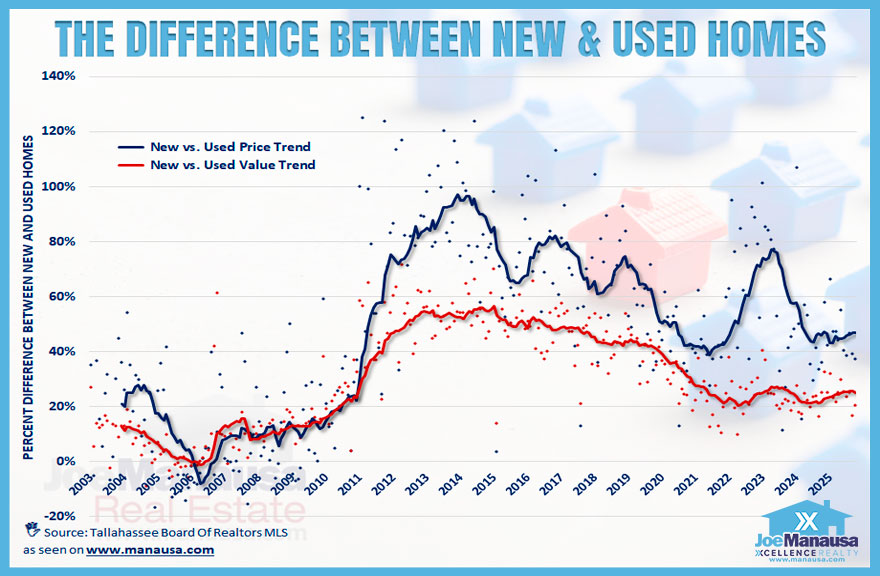
This graph shows the years when new-construction costs were only modestly higher than those of existing homes, and the years when the gap widened sharply. But the trend that matters most today is the long climb from a relatively healthy price difference to the extreme gap we face now. As new-construction prices rise far beyond attainable levels, buyers who cannot stretch into that tier shift to the resale market. That shift would be manageable in a city with strong inventory growth. Tallahassee does not have that growth.
The following visual confirms exactly how this imbalance plays out year after year.

The table shows that the median price almost always increases year over year, indicating buyers continue to face higher costs. It also shows that the median price per square foot almost always increases, indicating that sellers consistently receive more for their homes. These two metrics increase steadily over time.
The one metric that does not show a clear long-term pattern is the number of homes sold. That figure increases in some years and decreases in others. This fluctuation is not a demand signal; buyers remain active, but it reflects how many homes the market can actually deliver.
This is where interpretation becomes unavoidable. Tallahassee cannot sell homes it does not have. The availability of buildable lots continues to shrink, which limits the construction of new homes, especially affordable ones. As supply tightens, both prices and values rise faster than usual as buyers compete for a limited number of homes and fewer new properties come online.
This table confirms the exact message observed across all datasets. Without more buildable lots and a plan to produce affordable homes, Tallahassee will continue to experience higher-than-historic appreciation and deepening affordability challenges.

The Best Time To Lower The Price In A Home Sale
Want to Sell Your Home Quickly and Profitably? Watch This Now
Time-Lapse Tree Removal!

What Does A Realtor Earn?
How To Sell Your House When You Are In A Hurry

Do's And Don'ts During The Home Loan Process

7 Tips On Buying A Home With A Pool
How much house can you actually afford (By Income)?

What Sellers Need To Know About Robo-Offers In Real Estate
Luxury Market Trends Amplify the Effects of Tallahassee’s Supply Shortage
The luxury segment provides another important perspective on Tallahassee’s affordability challenges. Although these homes are priced well above the price points at which most residents shop, the behavior of the upper tier influences the entire market.

This graph shows a clear rise in million-dollar home sales during the early 2020s, followed by a recent decline. While that decline might suggest the luxury market is cooling, the impact of the surge remains. Those record-setting years raised comparable values, reshaped appraisals, and reset expectations across neighborhoods. When supply remains tight and demand remains steady, those upper-tier shifts ripple downward.
Luxury development did not create Tallahassee’s affordability crisis, but it reinforced the conditions that allow it to worsen. During the years when demand and prices climbed sharply at the top of the market, the city and county continued to restrict opportunities to build affordable homes. As a result, higher-end appreciation pushed the entire pricing structure upward, and the lower quartiles had no new supply to absorb displaced demand.
Even as million-dollar sales level off, the effects of those earlier spikes remain embedded in the market. They contribute to a pricing landscape where entry-level buyers face rising costs without the relief that new construction should provide.
Affordability Pressure Now Reaches Every Quadrant of Tallahassee
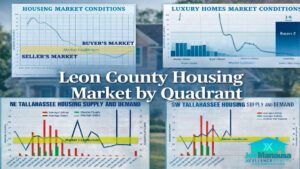
The quadrant comparison graph shows how home values differ across Tallahassee’s major regions and how each price tier behaves within those areas.

The graph highlights a trend that now extends across the entire city. The Northeast and Southeast continue to record the highest home values, but the Northwest and Southwest have experienced strong appreciation in their lower quartiles as well. These two quadrants once provided Tallahassee’s most accessible entry-level homes, yet their lower-priced inventory has moved far beyond what many local buyers can manage.
The lower quartile has increased substantially across all four quadrants. Without new construction to expand the supply, all buyers seeking affordable homes must compete for the same limited pool of existing properties. This competition raises prices in areas that once offered relief. The result is a citywide affordability squeeze that affects households at multiple income levels.
This pattern reinforces the broader story revealed across all datasets. Tallahassee does not have an affordability issue confined to any single part of town. It has a housing shortage that affects every quadrant. Without a plan to add smaller, attainable homes across the city, the path to homeownership will continue to narrow for residents who need opportunity most.
What This Means for Tallahassee Homeowners and Homebuyers in 2026
The trends across all graphs and tables lead to the same conclusion. Tallahassee has reached a point at which the supply of homes no longer meets the needs of the people who live here. Prices continue to rise, values continue to increase, and affordability continues to decline because the number of homes we bring to market does not keep pace with housing demand. This imbalance affects every price range, but it takes the greatest toll on the residents who depend on attainable entry-level homes.
For homeowners, this means continued equity growth; your property benefits from years of constrained supply, steady demand, and minimal new construction. For sellers, the market remains favorable because buyers have insufficient choices. For buyers, the path forward requires preparation, awareness of current conditions, and a realistic understanding of how quickly values change when supply stays tight.
Tallahassee cannot solve its affordability crisis without a commitment to building more homes across multiple price points. The city and county must recognize that a healthy housing market does not happen by accident. It requires leadership, planning, and a willingness to approve developments that support working families and first-time buyers. Without a coordinated strategy, the entire burden falls on the resale market, and affordability continues to deteriorate.
This article has presented the data that defines contemporary conditions. The decisions you make as a homeowner or homebuyer depend on how these trends shape your neighborhood and your price range. Understanding the data allows you to navigate this market with confidence rather than uncertainty.
If you want Tallahassee to thrive and remain a place where ordinary people can build a future, speak up. Tell your elected leaders to work together and take real action on the housing affordability crisis.
When moving to, in, or from Tallahassee, you will fare better if you work with a local expert. We are here to help. If you have further questions on the Tallahassee real estate market, you can leave a comment below, give us a call at (850) 366-8917, or drop us a note and we'll give you the local information needed to ensure a successful, smooth transaction.
As a local born and raised in Tallahassee with a focus on customer service, I promise you'll find great success when working with Joe Manausa Real Estate, just as have our past customers. You can read thousands of their reviews reported on Google, Facebook and Zillow right here: Real Estate Agent Reviews Tallahassee.
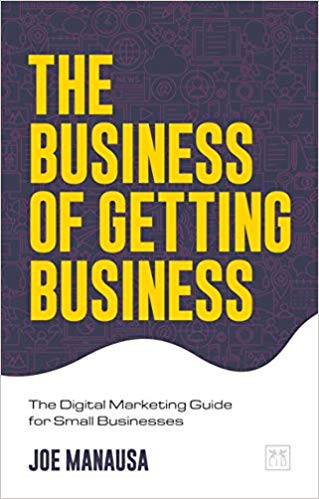 Have you heard about my new book "The Business of Getting Business?" It's a comprehensive guide for small businesses to help them make the move to digital. For those of us who want to survive and thrive in a world where large corporations are taking over, it is a must-read. It's also the perfect guide for how to sell a home in the digital age. You can find The Business Of Getting Business by clicking on any of the trusted retailers below.
 |
 |
|||
 |
 |
|||

Think all REALTORS are alike?
Read what people are saying about working with Joe Manausa Real Estate! You can see thousands of real customer reviews reported on Google, Facebook and Zillow at this link: CLICK HERE FOR REAL ESTATE AGENT REVIEWS.