
The February housing market update for the Tallahassee area real estate market reveals a steady and evolving landscape. Home prices in the Tallahassee MSA remain elevated relative to historical norms, while Tallahassee-area housing inventory shows meaningful variation by price range and zip code. Sales activity early this year suggests normalization rather than contraction, which is an important distinction for homeowners trying to interpret headlines.
Let’s walk through what the data actually shows.
Home Value Trends Across the Tallahassee MSA
Long-term home values tell the equity story behind today’s headlines.
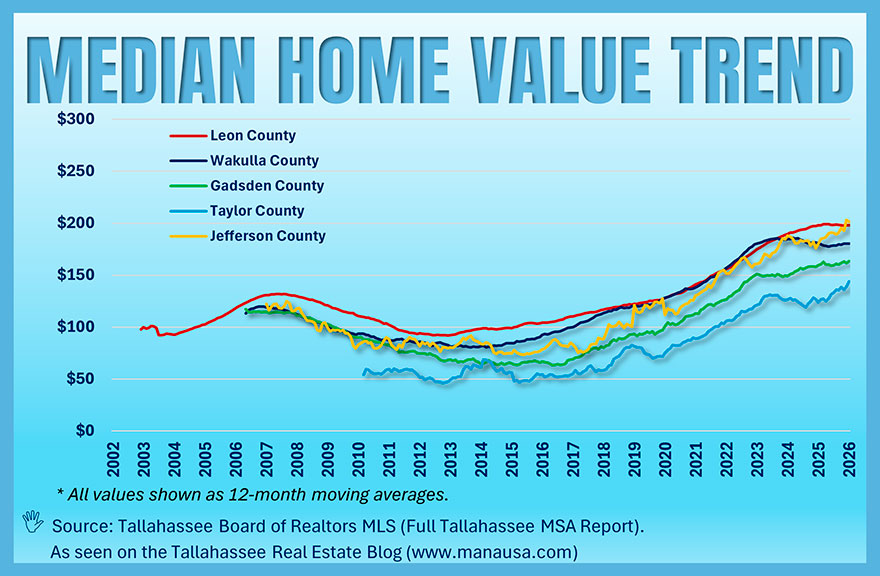
When we examine median home value trends across Leon, Wakulla, Gadsden, Jefferson, and Taylor counties, we see a full market cycle. Early 2000s appreciation was followed by the sharp correction during the housing downturn. From roughly 2013 forward, the Tallahassee area real estate market began a steady recovery.
The acceleration that occurred between 2020 and 2023 stands out. Low mortgage rates, strong in-migration, and constrained supply pushed values higher at a pace we had not seen in decades. Since then, appreciation has moderated, but values have largely held their gains.
For homeowners, this matters. Equity growth across the Tallahassee MSA remains significant compared to pre-pandemic levels. Even with slower price movement recently, most long-term owners are sitting on substantial unrealized gains. This housing market update shows that long-term value trends remain intact despite slower transaction activity.
Home Prices in the Tallahassee MSA
Sale prices show how buyers and sellers are negotiating in real time.
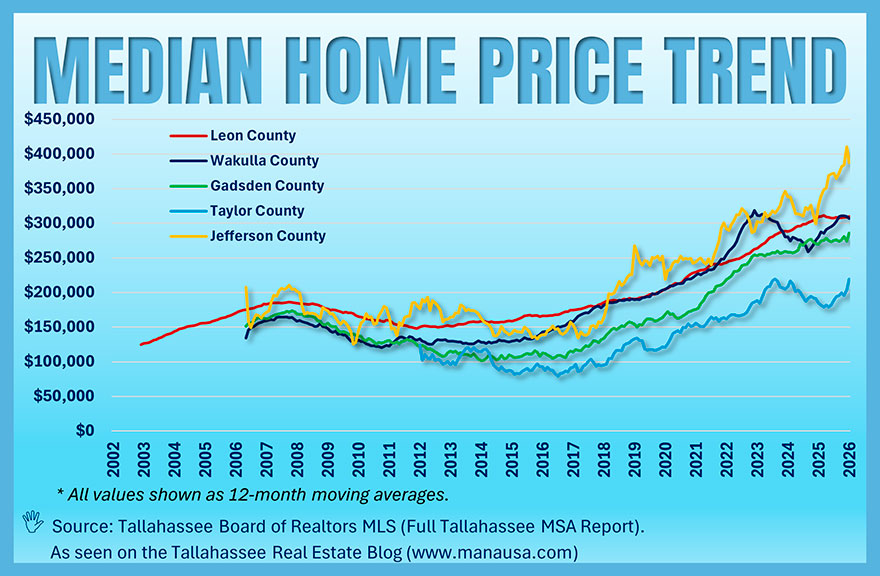
Median home prices in the Tallahassee MSA reflect transaction reality. While value models move gradually, sale prices respond more quickly to shifts in mortgage rates, buyer urgency, and available inventory.
Leon County continues to anchor the region in both volume and pricing stability. Surrounding counties show more volatility, particularly where transaction counts are lower. Smaller markets can see sharper swings based on fewer closed sales.
Importantly, we are not seeing broad-based price declines. Instead, we are observing selective negotiation. Well-positioned homes still attract attention. Overpriced properties tend to sit longer and eventually adjust. This is a healthier pattern than abrupt price compression.
Housing Market Update Reveals Inventory Trends
Inventory levels determine who holds leverage in any housing market update.
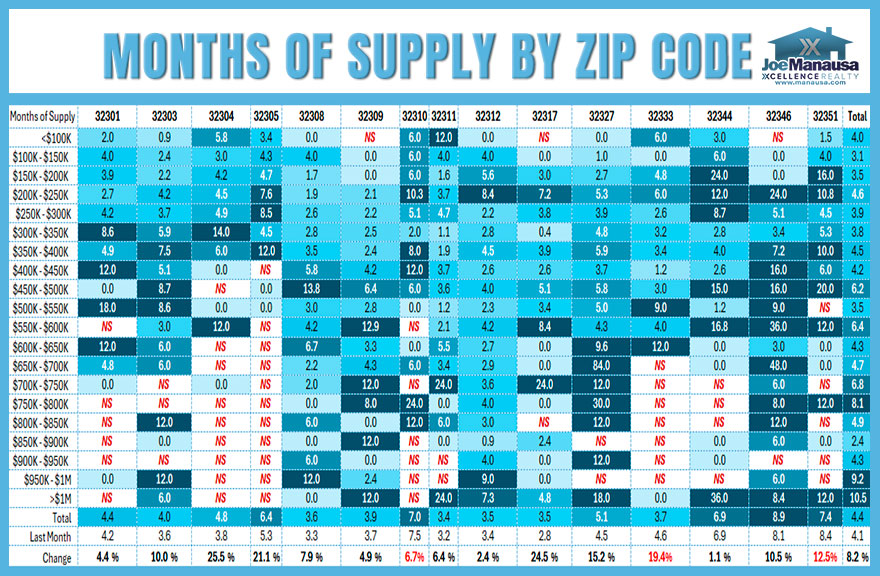
Months of supply is one of the clearest indicators of balance. Generally speaking, four to six months suggests a balanced market. Below that range favors sellers. Above it gives buyers more negotiating power.
Across the Tallahassee area, housing inventory data show variation by price range and zip code. Entry-level segments remain tighter in many areas. Higher price points often show more supply, particularly in neighborhoods with larger homes or longer build cycles.
This fragmentation means there is no single market condition. A homeowner in one zip code may experience very different demand dynamics than someone just a few miles away. Strategic pricing and positioning are critical. This housing market update makes it clear that inventory growth alone does not solve affordability constraints.
Year-to-Date Home Sales Activity
Sales velocity reveals buyer participation, and this month’s data deserves careful attention.
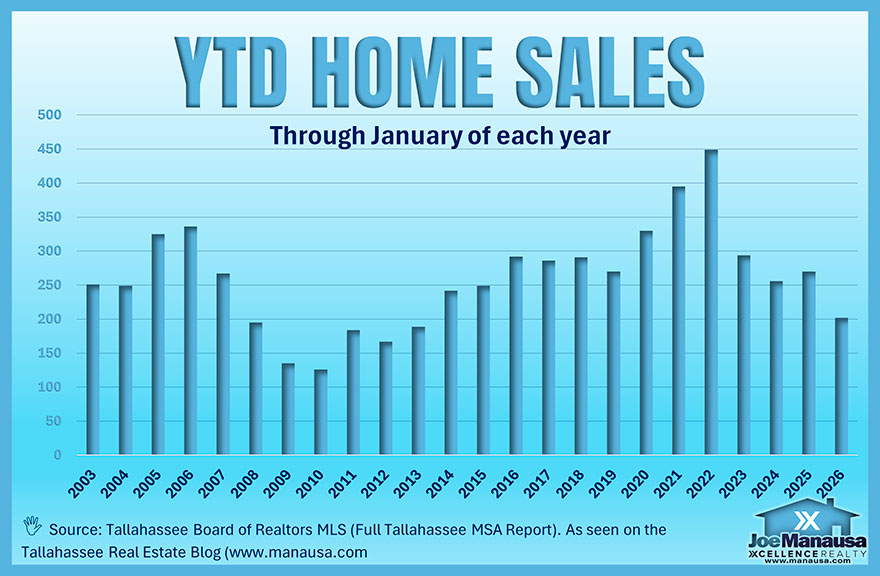
Year-to-date home sales through January are down approximately 25 percent compared to last year. In fact, this marks the slowest January start for the Tallahassee area real estate market since 2013.
That is a meaningful shift.
It is also important to put it in context. The previous two years reflected fairly normal sales activity by long-term standards. They were not inflated by emergency-low mortgage rates, nor were they distressed years. What we are seeing now is not a collapse from an overheated peak. It is a pullback from typical levels.
Early-year sales totals can be volatile, particularly in smaller regional markets like the Tallahassee MSA. A softer January does not automatically define the trajectory of the entire year. However, it does indicate that buyers are proceeding more cautiously.
This slowdown is less about rising mortgage rates and more about structural affordability pressures in the Tallahassee real estate market.
While overall housing inventory has increased compared to the tightest years of the pandemic cycle, the supply of homes priced within reach of most Tallahassee households remains critically limited. Entry-level and workforce housing segments continue to experience constrained availability, even as higher price points show more balance.
In other words, supply is up, but not where demand is strongest.
That imbalance is suppressing transaction volume. Many would-be buyers simply do not see enough viable options within their financial comfort zone. As a result, absorption has slowed, and overall sales are down, even though the market is not oversupplied.
When we align weaker transaction volume with stable pricing and only moderate total inventory, the market does not yet resemble distress. However, this housing market update shows that affordability constraints are clearly limiting mobility, particularly for first-time and move-up buyers.
What This Housing Market Means For Homeowners
Selling in Today’s Market
The 25 percent decline in year-to-date sales is not evenly distributed across price ranges. The greatest constraint is at price points most local buyers can realistically afford.
For sellers in entry-level and workforce segments, properly priced homes continue to attract attention due to limited competition. However, pricing discipline is critical. Buyers are financially stretched, and even modest overpricing can reduce already limited demand.
For sellers in higher price brackets, increased inventory and slower absorption mean strategic positioning matters more than timing alone. Professional marketing, condition, and pricing alignment are now decisive factors.
The margin for error has narrowed.
Buying in February
Buyers are navigating a market with more total supply but fewer affordable options. That dynamic creates a split experience.
At accessible price points, competition remains present because inventory is thin. Buyers must act decisively when a well-priced property comes to market.
In higher price segments, negotiation leverage has improved modestly due to increased availability and slower transaction velocity.
This is not a universally soft market. It is a segmented one.
Preparation, clarity in financing, and realistic expectations are more important than ever.
Holding for Long-Term Equity
Long-term homeowners remain in a fundamentally strong position.
Home prices in the Tallahassee MSA are still significantly above pre-2020 levels. Even with reduced transaction volume, pricing has remained relatively stable.
The current slowdown reflects mobility constraints rather than value erosion. When affordable inventory is scarce, fewer households can move, which limits sales volume but does not automatically compress prices.
However, prolonged affordability strain can eventually influence pricing if transaction activity remains subdued for an extended period. That is not the current condition, but we will continue to monitor it closely.
Final Thoughts on This Housing Market Update
This February housing market update presents a more restrained picture than in recent years.
Year-to-date sales are down 25 percent from last year and mark the slowest January since 2013. At the same time, overall inventory has improved, yet the supply of homes priced within reach of most Tallahassee households remains far too low.
That imbalance is the defining characteristic of today’s Tallahassee area real estate market.
Home prices in the Tallahassee MSA remain historically elevated. Tallahassee area housing inventory varies meaningfully by price tier. Transaction volume has softened due to affordability bottlenecks rather than systemic distress.
Markets do not shift all at once. They evolve in stages. Right now, we are observing a market constrained by accessibility more than excess.
For homeowners considering a move, the key is not reacting emotionally to slower sales numbers. It is understanding where your property sits within the supply-demand structure.
If you would like a custom equity review, a price-range specific demand analysis, or a neighborhood-level strategy session, the Joe Manausa Team at Xcellence Realty is ready to help you evaluate your options with clarity and confidence.