The Price Paradox: Why Home Values Continue Rising Despite Market Headwinds
Isn’t it strange that home prices continue climbing when headlines constantly predict a market crash?
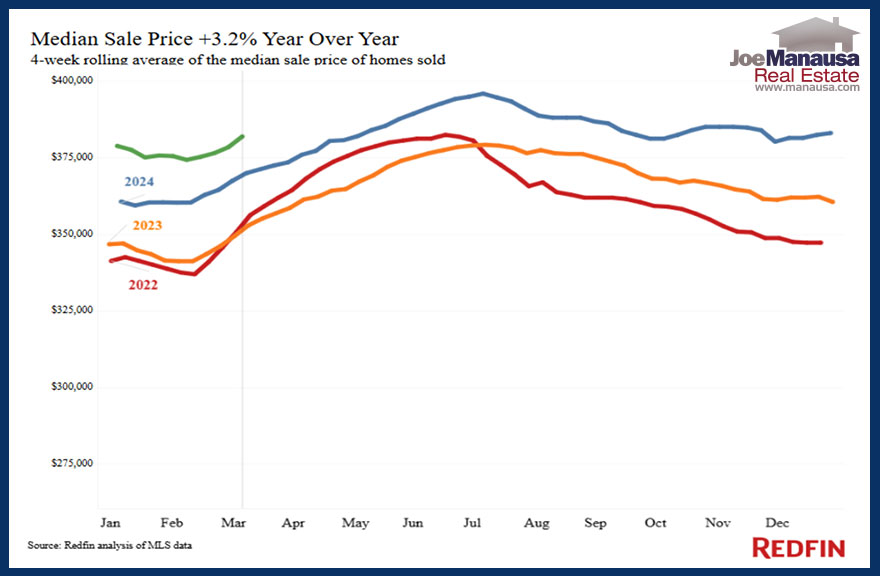
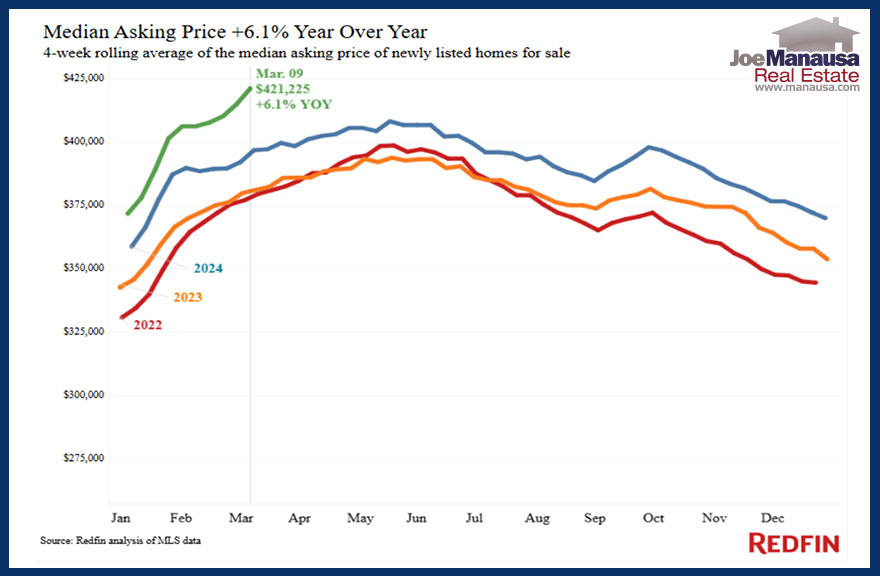
Looking at our first graph, we can see the median sale price of homes across the country has reached $381,975, increasing 3.2% year over year, while our second graph shows the median asking price at $421,225, up 6.1%.
These numbers directly contradict what crash predictions would suggest.
What’s fascinating is how these price increases persist despite significant economic headwinds. With concerns about tariffs, potential government workforce reductions, and economic uncertainty, many economists expected housing values to retreat. Yet the market demonstrates remarkable resilience, representing a return to more sustainable pre-pandemic appreciation rates of 4-5% annually rather than the frenzied double-digit increases of 2021-2022.
Regional variations reveal a complex story beneath national figures. Milwaukee saw February median sale prices increase by 20% to $330,000—the most significant increase among major metropolitan areas. Meanwhile, Austin experienced a 3.9% decline to $430,000. These contrasting examples highlight how dramatically local markets can differ from broader trends. I often get viewers who tell me I’m crazy because they are seeing something different than the national average, so I want to remind our viewers that real estate is local and that your area’s supply and demand dynamics, coupled with local economic conditions, will guide you on your market conditions.
These market conditions translate to substantial affordability challenges for buyers.
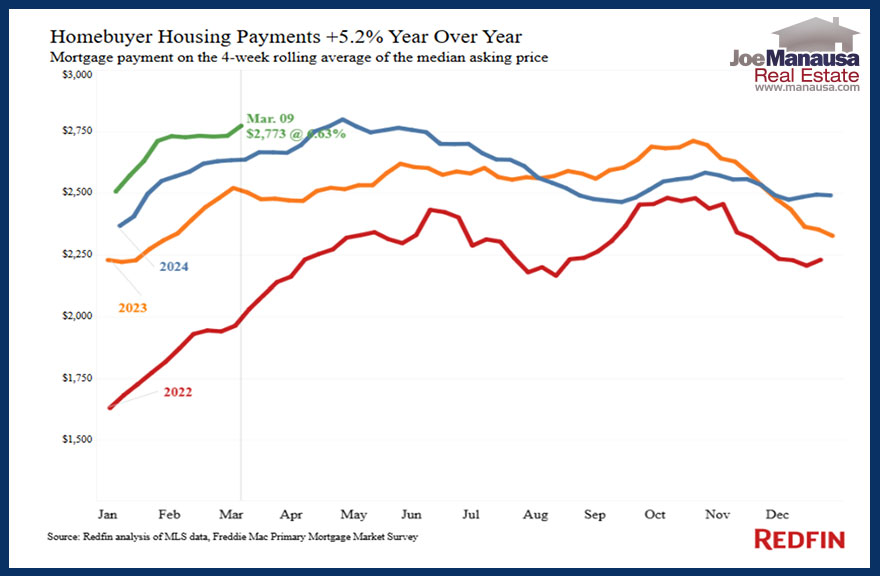
The typical monthly mortgage payment is currently $2,773—just $26 shy of the all-time high and up 5.2% from last year. This figure captures the combined effect of price appreciation and interest rates that buyers must contend with.
The persistent price growth stems from a fundamental reality: demand still outpaces supply in most markets. Even with recent inventory improvements, the housing shortage that began well before the pandemic continues to put upward pressure on prices. As Redfin’s Senior Economist Elijah de la Campa notes, while we’re seeing national increases in supply, regional variations mask significant differences in market conditions.
This raises an intriguing question: What’s happening with actual sales activity if prices rise and payments are approaching record highs? Are buyers willing to accept these elevated costs, or are they beginning to resist?
Keep Up With New Trends In Tallahassee!
Get The Tallahassee Real Estate Newsletter
 Don't be the one that doesn't know what's going on when you sell a home or buy a home in Tallahassee.
Other buyers, sellers, lenders, and real estate agents have this critical information, and now you can too!
Get immediate access to our most recent newsletter.
Let more than 30 years of experience work for you with charts, graphs, and analysis of the Tallahassee housing market.
The Demand Disconnect: Falling Pending Sales vs. Rising Buyer Interest
The housing shortage pushing prices higher is only half the story. Behind the numbers lies a fascinating behavioral shift among potential buyers. People are looking more but buying less, with Google searches for “homes for sale” up 10% year-over-year, while pending transactions have fallen 6.4% during the four weeks ending March 2, 2025. This peculiar contradiction suggests we’re entering a phase where buyer psychology matters just as much as supply constraints.
This disconnect between interest and action becomes more evident in our next graph.
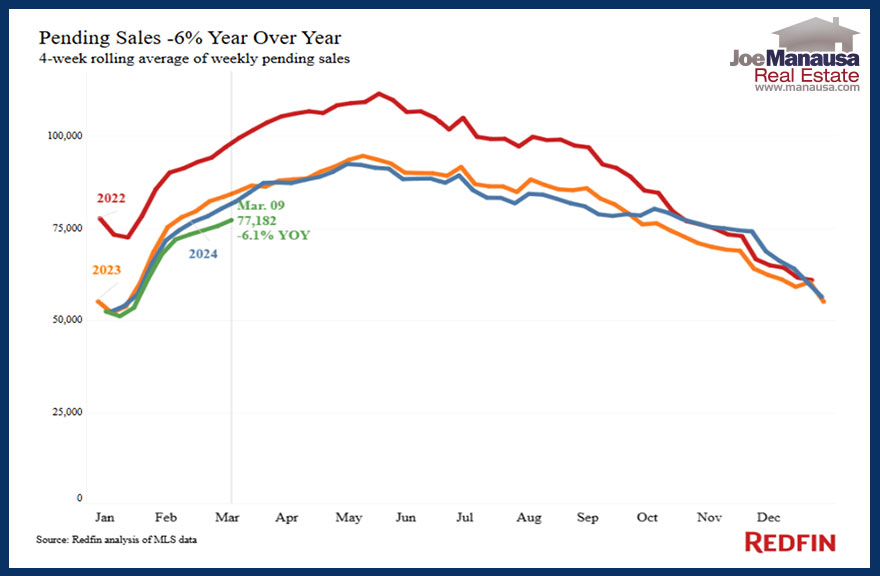
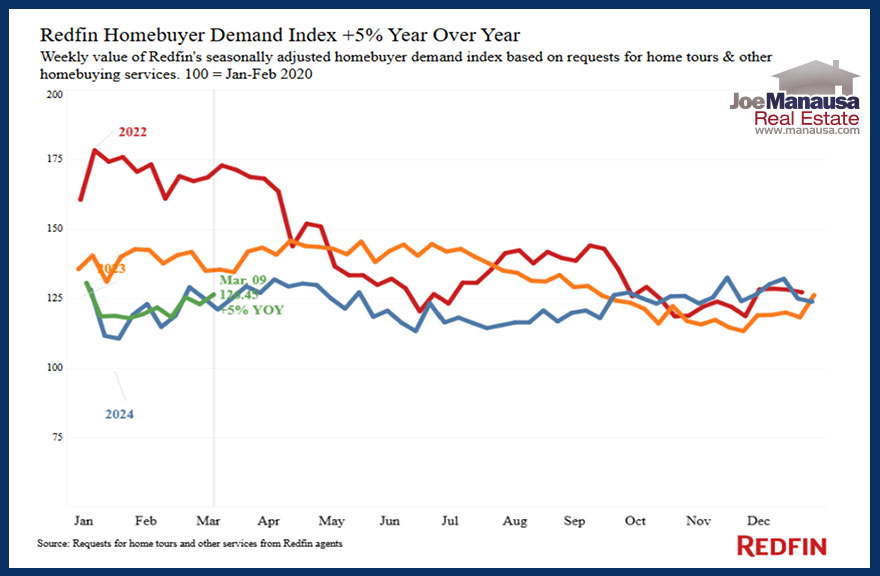
While pending home sales continue declining (down 6.4% compared to last year), the Redfin Homebuyer Demand Index shows tours and buying services increasing by 5%.
Mortgage purchase applications simultaneously reached their highest level since early February, jumping 9% week-over-week as rates dropped to 6.72% – a five-month low.
This creates a puzzling market scenario: heightened interest in homebuying that doesn’t translate to completed transactions. Buyers are looking, securing financing, and then pausing before making the final commitment.
The national pattern becomes more revealing when we examine regional variations. In stark contrast to the overall trend, Southern California markets show surprising strength, with Los Angeles and Anaheim seeing pending sales increase 8.5% and 6.3%, respectively. Meanwhile, other major markets tell a different story – Miami and Atlanta are experiencing severe contractions exceeding 16%. These regional differences highlight how local conditions create varied buyer behaviors nationwide.
Marketing timelines further illustrate this hesitation. Homes sold in February spent 54 days on market – the longest February average since 2020, demonstrating the widening gap between initial interest and purchase commitment.
Economic uncertainty appears to be driving this cautious approach. Despite improved affordability from lower rates, buyers remain concerned about job security and recession possibilities. They’re actively exploring the market but proceeding extremely cautiously when finalizing decisions.
The result is a market at a psychological inflection point. As rates ease, buyers return but bring unprecedented caution with them, weighing improved affordability against broader economic worries. This creates a slower-moving market where transactions take longer and buyers gain negotiating leverage. The era of multiple offers and bidding wars is fading in most markets as buyers carefully consider their options.






Housing Crash or Boom? Here’s What’s Coming in 2025

BIGGEST Housing Market Myth EXPOSED by New Foreclosure Data
The Supply Revolution: How Inventory Changes Are Reshaping Market Dynamics
The decreased frequency of bidding wars isn’t just about cautious buyers—it’s the direct result of a supply revolution. After years of extreme shortage, housing inventory is making a remarkable comeback, moving us from an extreme sellers’ market to one that is fairly balanced.

The real story emerges from three critical metrics: new listings increasing by 3.1% year-over-year.

Active listings surged by 9.3%, and months of supply rose to 4.1 months – a 17% increase from last year.
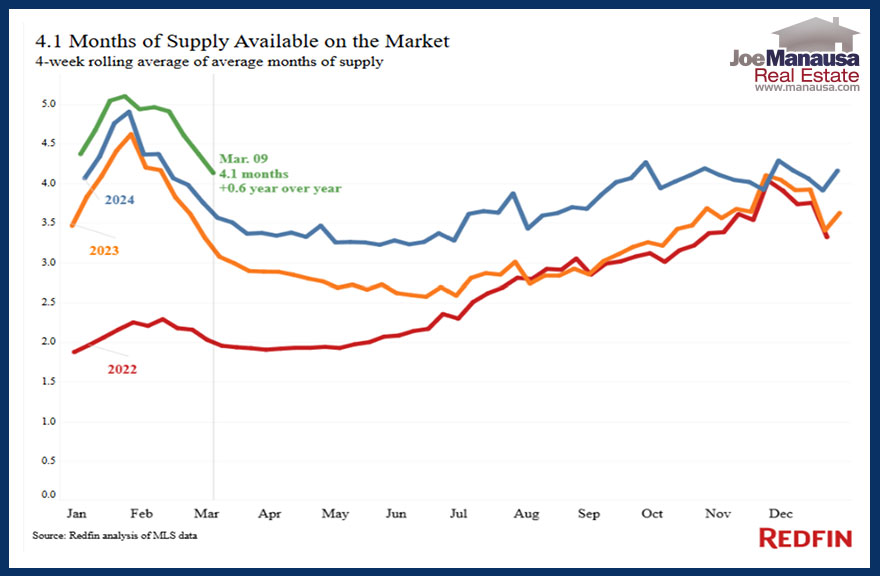
This graph signals we’re approaching balanced market territory, which Redfin defines as 4-5 months of supply.
This dramatic shift contrasts sharply with the extreme inventory shortage during the pandemic. Back then, buyers competed fiercely for minimal homes. Today’s steadily increasing inventory fundamentally alters the power balance between buyers and sellers.
The data suggests the mortgage rate lock-in effect that kept sellers on the sidelines is slowly eroding. Homeowners who previously secured ultra-low rates are now deciding they simply can’t postpone their moves any longer, especially as they see increased buyer demand materializing.
What’s fascinating about current inventory is how dramatically it varies by region, reflecting the complex nature of our housing recovery. In Oakland, active listings have increased by 37.5%, creating an entirely different market than Detroit, where listings have decreased by 6.7%. These regional differences mean buyers and sellers face vastly different conditions depending on location.
These inventory changes have measurable effects on market competition. The percentage of homes selling above list price has dropped to 22.9% – down from 25% a year ago. While still representing nearly a quarter of transactions, this decline demonstrates how increased housing options give buyers more leverage and reduce the pressure for aggressive bidding.
For sellers, this represents an important shift in market psychology. Gone are the days when simply putting a sign in the yard guaranteed multiple offers above asking price. The new reality requires thoughtful pricing strategies and potentially more patience as homes take longer to sell.




Fannie Mae Report: It's The TRUTH About The Housing Market

Real Estate Meltdown: Starter Homes at $1M in 233 Cities

Is the Housing Market Crashing? | Redfin April 2025 Update

Is This The CALM Before The CRASH? Volatility Rocks Housing

Warning Signs For Home Buyers And Sellers
Recession Risk vs. Housing Resilience: Why This Isn’t 2008
While sellers adjust to a more balanced market, a more significant economic question looms: could a recession trigger another housing collapse? Despite recession odds tripling to 40% in just two months, there’s a critical reason why today’s homeowners face an entirely different scenario than those who experienced the 2008 crash.
Let’s put this in perspective: economists’ concerns about a potential 2025 recession stem from government policy shifts, tariff uncertainties, and workforce reductions in key sectors. However, today, the housing market’s foundation stands on dramatically different ground than during the Great Financial Crisis.
The most significant buffer against a housing collapse is the unprecedented equity position of today’s homeowners combined with the mortgage rate lock-in effect.
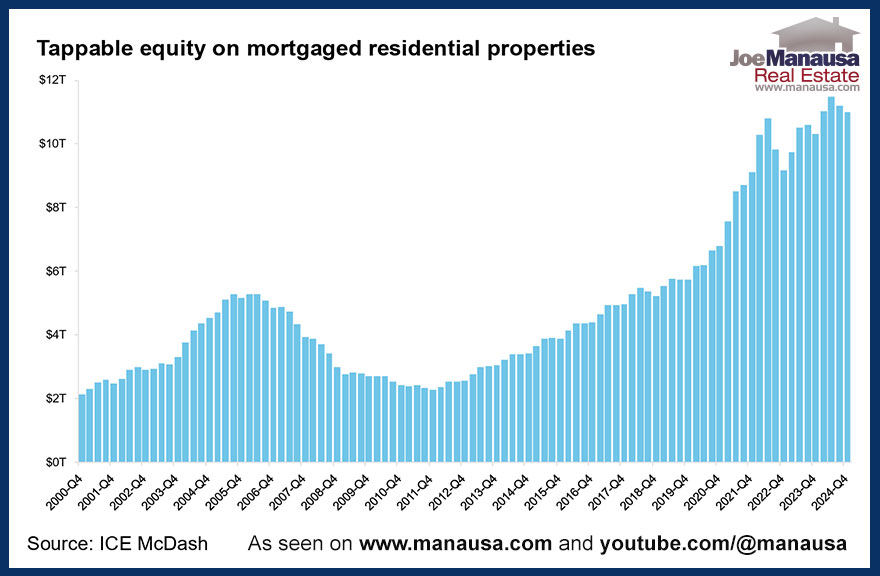
The average homeowner currently holds over $300,000 in home equity—a record high that creates a substantial cushion against market downturns. Approximately 80% of existing mortgages are fixed at rates below 5%, with many homeowners enjoying rates in the 2-3% range. This combination provides financial stability and staying power, preventing the flood of distressed inventory that characterized the last crash.
Back in 2008, millions of homeowners were underwater on their mortgages with loan-to-value ratios exceeding 100%, forcing them into foreclosure when financial hardship hit. Today, that financial vulnerability simply doesn’t exist for most homeowners.
The mortgage industry itself has undergone a complete transformation. Today’s underwriting standards require thorough income verification, reasonable debt-to-income ratios, and meaningful down payments. The Mortgage Bankers Association’s data shows serious delinquency rates at just 1.28% – near historic lows and a fraction of the 10%+ rates seen during 2008-2010.
Mortgage servicers have also evolved their approach to financial hardship. They now have sophisticated loss mitigation departments and federally-backed options for modifications, forbearance, and payment plans. Keeping homeowners in their homes has become economically and politically preferable to mass foreclosures.
A recession might impact renters more severely than homeowners. As job losses mount during economic contractions, rental demand decreases as household formation slows. This can lower rents in major markets – potentially providing relief in the rental sector while homeowners remain relatively insulated by their fixed payments and substantial equity.

The Best Time To Lower The Price In A Home Sale

Want to Sell Your Home Quickly and Profitably? Watch This Now
Time-Lapse Tree Removal!

What Does A Realtor Earn?

How To Sell Your House When You Are In A Hurry

Do's And Don'ts During The Home Loan Process

7 Tips On Buying A Home With A Pool

How much house can you actually afford (By Income)?