
Myth 1: Lower Interest Rates Mean Lower Home Prices
Now, about those interest rates everyone’s obsessing over. Grant Cardone and others are shouting that lower rates will bring down home prices. But here’s the kicker – historical data tells a completely different story. Ready to see how lower rates might actually push prices even higher?
Let’s dive into what Grant Cardone is claiming. He says,
“When interest rates come down, mortgage applications also go up, and people will start selling their homes.” ~ Grant Cardone
Sounds logical, right? But here’s where Cardone’s theory falls apart. Sure, lower rates do typically lead to more mortgage applications. And more people will put their homes on the market, which increases supply. But that’s the end of the good news. Because those sellers become buyers, so every unit of supply is neutralized by a new unit of demand. That’s zero impact, except buyers are now armed with more purchasing power.
Think about it. Lower rates mean buyers can afford higher-priced homes for the same monthly payment. This boosts their purchasing power, allowing them to bid more aggressively. And in a market already short on inventory? That’s a recipe for price increases, not decreases.
Mortgage Rates Versus Home Prices
History backs this up. Historically, periods of lower interest rates have often coincided with rising home prices. It’s simple supply and demand. More buyers competing for a limited number of homes pushes prices higher.

Need proof? Look at what’s happened since January 2020. Despite all the rate fluctuations we’ve seen, U.S. home prices surged with double-digit annual appreciation. That’s right – even with rates bouncing around, prices kept climbing.
I have highlighted three points in the graph:
- Mortgage interest rates (in red) generally fell for 25 straight years from 1981 to 2005. During that time, home prices (in blue) increased by 267%!
- Mortgage interest rates generally fell from 2009 to 2016, yet prices grew by 49%.
- Mortgage interest rates generally fell from 2018 to 2022, hitting an all-time low, and home prices exploded by 30% in just over four years.
So, what’s the real takeaway here? Lower rates don’t automatically mean lower prices. In fact, they often stimulate demand, potentially driving prices even higher. This is crucial to understand in today’s market.
Get Our Free Market Update
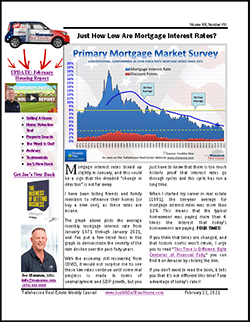
Other buyers, sellers, lenders, and real estate agents have this critical information, and now you can too!
Get immediate access to our most recent newsletter.
Let more than 30 years of experience work for you with charts, graphs, and analysis of the Tallahassee housing market.
Each Monday morning we send out a simple, one-page report that provides a snapshot of the Tallahassee housing market. It only takes 2 minutes to read, but it gives you better market intelligence than most real estate agents possess. Just tell us where to send it below!





Housing Crash or Boom? Here’s What’s Coming in 2025
BIGGEST Housing Market Myth EXPOSED by New Foreclosure Data
Myth 3: Mortgage Rates Will Return to Pre-Pandemic Levels
Speaking of housing market myths, let’s tackle a big one. Remember those rock-bottom mortgage rates from a couple years ago? Many folks are sitting on the sidelines, convinced they’ll return. But what if I told you that waiting for rates to drop could cost you big time?
Here’s the deal: experts are predicting only modest declines in mortgage rates, not a return to pre-pandemic levels. This isn’t just about the Federal Reserve’s decisions. Mortgage rates are influenced by a whole bunch of factors including economic conditions, inflation, and housing demand.
Mortgage Rate History
Let’s look at history for some perspective.

Mortgage rates have been on a wild ride over the years. They hit highs of over 18% in the 1980s and below 3% during the pandemic. But here’s the kicker: those ultra-low rates we saw recently? They were the exception, not the rule. The average 30-year fixed mortgage rate over the past fifty years is 7.7%. Today’s higher rates are actually lower than average!
A book titled “This Time Is Different: Eight Centuries of Financial Folly” suggests we might be poised for 40 years of increasing interest rates. It explains how all the experts of an era got it wrong when forecasting a significant change in rates. When asked why they would not follow the long-term cycles, they always had a way of explaining why “this time is different!”
So, what’s the takeaway here? Waiting for rates to drop back to pandemic lows could be a costly mistake. The housing market isn’t standing still while you wait. Prices could keep climbing, potentially outpacing any savings you might get from a slightly lower rate. And if rates do fall, you can always refinance.
Remember, it’s not just about the rate but the overall cost of homeownership. A slightly higher rate on a lower-priced home could be better than waiting for rates to drop while prices keep rising.



Fannie Mae Report: It's The TRUTH About The Housing Market

Real Estate Meltdown: Starter Homes at $1M in 233 Cities

Is the Housing Market Crashing? | Redfin April 2025 Update

Is This The CALM Before The CRASH? Volatility Rocks Housing

Warning Signs For Home Buyers And Sellers
Myth 4: Remote Work Has Permanently Shifted Housing Demand
While discussing home prices, let’s address another game-changer: remote work. You might think you know how it’s affected the housing market, but recent trends are painting a different picture. What’s really happening with work-from-home and housing preferences?
Evolution of Remote Work in the U.S. Workforce (2003–2024)

Remember when everyone thought we’d all be working from beach houses? The initial surge in remote work during the pandemic led many to believe that housing demand would permanently shift towards more rural or vacation-style properties. It seemed like a logical assumption – if you can work from anywhere, why not live somewhere picturesque?
But here’s where things get interesting. Many companies have since required employees to return to the office, and this shift is beginning to influence housing preferences back toward urban areas.
Perhaps the most ironic example of this was when Zoom required employees within 50 miles of an office to return to in-person work at least two days per week starting in August 2023. This decision was newsworthy because Zoom had become a symbol of the remote work revolution during the pandemic, making it surprising when the company shifted toward a hybrid work model.
The data shows that remote work initially increased demand for homes in less populated areas, but this trend has stabilized. In major cities where remote work was once prevalent, there’s been a noticeable decrease in demand for homes as companies push for a return to in-person work. It’s not a complete reversal, though. The remote work trend is evolving, with many employees adopting hybrid work models. This has created a more nuanced impact on housing demand than initially predicted.
As a result, the long-term effects of remote work on housing demand are still unfolding. Regions that experienced a surge in demand due to remote work are seeing a leveling off, with housing preferences shifting back towards urban centers. But it’s not a simple “back to normal” scenario.
The reality is that the impact of remote work on housing demand is more complex than many initially thought. It’s not a permanent shift away from cities or a complete return to pre-pandemic patterns. Instead, we’re seeing a new equilibrium influenced by evolving work policies and individual preferences.

The Best Time To Lower The Price In A Home Sale
Want to Sell Your Home Quickly and Profitably? Watch This Now
Time-Lapse Tree Removal!

What Does A Realtor Earn?

How To Sell Your House When You Are In A Hurry

Do's And Don'ts During The Home Loan Process

7 Tips On Buying A Home With A Pool

How much house can you actually afford (By Income)?

What Sellers Need To Know About Robo-Offers In Real Estate
Myth 5: The reason that there is an inventory shortage is that Wall Street is buying up all the houses
Now, let’s tackle another hot topic in real estate: Wall Street’s role in the housing shortage. Think you know who owns most of the homes in America? The truth might surprise you. What if I told you that the “big bad” Wall Street investors aren’t the housing market villains they’re made out to be?
US Homeownership – Not What You’ve Been Told

You’ve probably heard the narrative: Wall Street is buying up all the homes, leaving regular folks out in the cold. Headlines screamed, “How do we compete with corporations?” It’s a compelling story, but here’s the kicker – the numbers do not back it up. Large investment banks own less than one-half of 1% of all homes in the US. That’s right, less than 1 in 200 homes. Note in the graph that you cannot even see the tiny plot of the institutionally owned homes.
But wait, there’s more. Many of these larger holders are selling off homes for profit. They’re not all hoarding properties; many are treating them like any other investment. Buy low, sell high. It’s Business 101, not a sinister plot to dominate the housing market. Were it not for the supply shortage, Wall Street would have continued ignoring the single-family homes market like it has for the previous 130 years. If we build more homes, the supply and demand balance will slow the appreciation rate, making it less exciting for corporate investors. We can use capitalism to thwart this threat by increasing the housing stock.
So if Wall Street isn’t the boogeyman, what’s really causing the inventory shortage? The answer lies in a long-term trend that’s been building for years. We’re facing a severe supply crisis due to 15 years of under-building. This isn’t a temporary blip – it’s a systemic issue that’s been slowly but surely tightening the housing market.
This supply shortage is the real culprit behind our affordability crisis. With demand outstripping supply, prices have nowhere to go but up. And unlike the Wall Street narrative, this problem won’t be solved by pointing fingers at investors. It requires a fundamental shift in how we approach housing construction and policy.



How To Sell Your House On Your Own

10 PROVEN Strategies To Increase A Home's Selling Profit
2025s HOTTEST Home Selling Strategies You Need NOW
The 3-DAY Method To Sell Your Home For More (2025)
The Best Time To Lower The Price In A Home Sale

How FOMO Makes Your Home Sale More Profitable

Home Sale Sabotage: Top 10 Mistakes Sellers Make
Buy Now Or Wait? The 91.6% Rule
Biased Results? The New York Times Rent Or Buy Calculator
Do's And Don'ts During The Home Loan Process

6 Real Estate Contract Terms You Should Not Overlook
7 Tips On Buying A Home With A Pool
How much house can you actually afford (By Income)?

What Does "Marry The House Date The Rate" Mean In Real Estate?

Why Fixer Uppers Are the New Gold | Home Renovation Guide

8 Tips For Buying An Affordable Florida Vacation Home
Myth 7: The Housing Market Will Crash
Now, you might be thinking, “With all these challenges, surely the housing market is about to crash?” It’s a common belief, but here’s the thing – the data doesn’t support it. In fact, the truth about our housing market’s future might be hard for some to swallow. Are you ready to challenge everything you thought you knew about the so-called “imminent crash”?
Let’s face it, we’ve all seen the doom and gloom headlines. Heck, last month Peter Schiff released a video exclaiming 80 to 90% price crash is expected! But he’s just pandering for clicks. Experts are actually predicting price stabilization rather than a crash, and this next graph shows why we aren’t heading for a 2008-style meltdown!
No 2008-Style Meltdown
Current market conditions are significantly different from those leading up to the 2008 crash.

Back then, over four million homes flooded the market, left waiting for buyers who had the mortgage rug yanked out from under them by a well-meaning but mismanaged government. Today, just over one million homes are on the market. Can you see why there is no pricing crash? Supply has fallen harder than demand! It’s simple supply and demand – when there aren’t enough homes to go around, prices tend to stay high.
But let’s be real – the market isn’t uniform across the country. Some areas have seen price drops. Take Austin, for example, where prices took a significant dip. But here’s the key – these instances are anomalies. They don’t reflect the broader national trend.
As one expert put it, “The housing market has remained resilient and prices have held steady despite monthly payments reaching levels that economists considered unaffordable.” This resilience is a key factor in why we’re not seeing a crash.

How To Get 20% Or More With Leveraged Real Estate
8 Tips For Buying An Affordable Florida Vacation Home
Should you sell your home or rent it out?

Is turning your college student into a homeowner a wise investment or a financial faux pas?

6 Real Estate Investing Lessons from the 2008 Housing Bubble

How To Avoid Common Legal Issues When Buying Or Selling A Home

Should You Buy A House For Your Child?

How To Use Price Per Square Foot When Valuing A Home